Volkswagen ID.4 Range and Charging: Real-World Performance in Sunnyvale
How far can a Volkswagen ID.4 go on a charge in Sunnyvale? Real-world range, charging speeds, and home charging guidance for South Bay EV drivers.
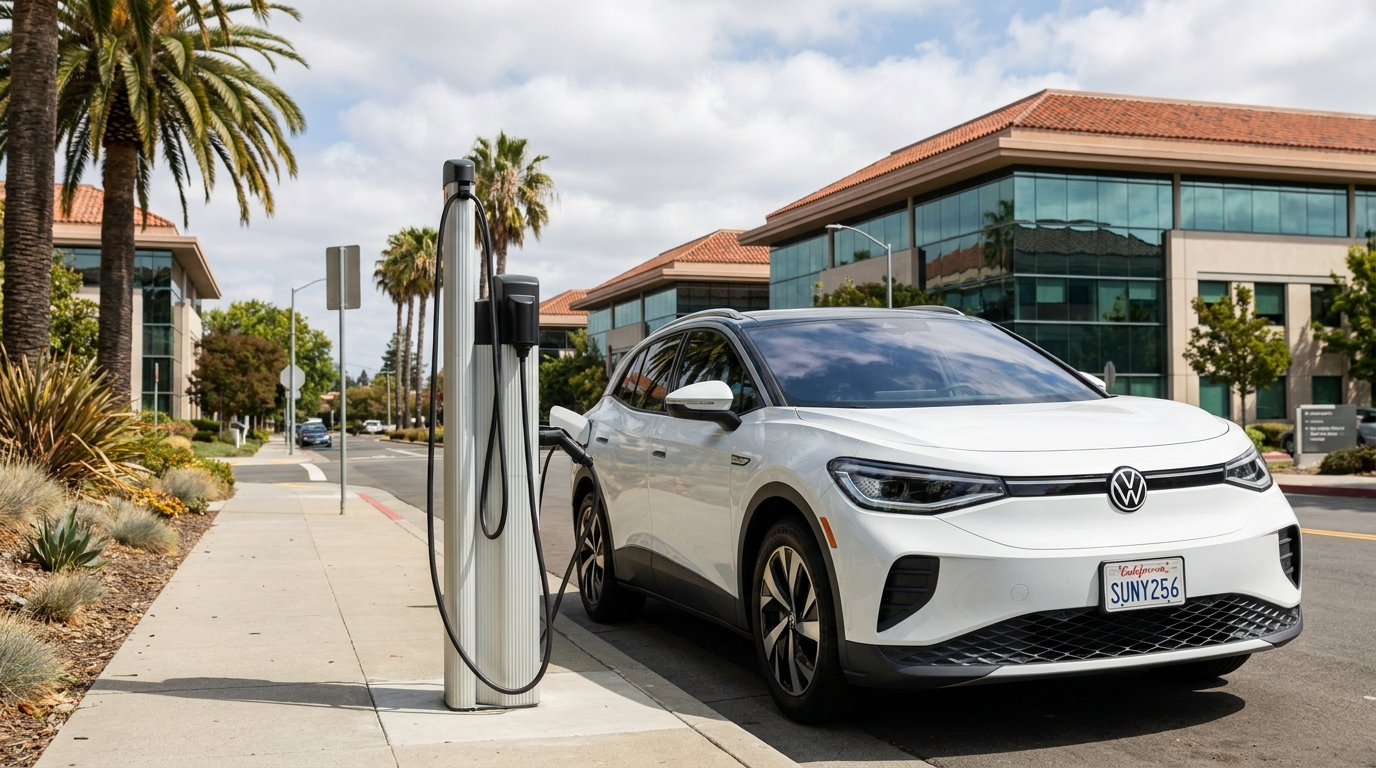
Range anxiety remains the single biggest question prospective EV buyers raise, and for good reason: the gap between an EPA window sticker and what a vehicle actually delivers on the freeway can shape daily life with the car. For Sunnyvale drivers eyeing the 2026 Volkswagen ID.4, the practical question isn't what the brochure promises — it's how far the SUV will go on a charge during a typical week of commuting between the South Bay, San Jose, and the Peninsula.
The short answer: most ID.4 owners in Sunnyvale can plan around 240 to 290 miles of real-world range per charge, depending on drivetrain and driving style. The longer answer requires looking at EPA figures, independent test data, and how Sunnyvale's specific climate and traffic patterns shift the math.
How Far Can a Volkswagen ID.4 Go on a Charge?
The 2026 Volkswagen ID.4 carries an EPA-rated range of 291 miles for the rear-wheel-drive Pro and 263 miles for the all-wheel-drive variants, both powered by an 82-kWh battery. Lower trims use a 62-kWh pack with shorter range. These figures come from EPA combined-cycle testing, which blends city and highway driving in controlled lab conditions.
Independent testing tells a more nuanced story. Car and Driver's instrumented 75 mph highway test of the AWD Pro S returned approximately 240 miles — about 23 miles, or 9%, below the EPA estimate. That gap isn't unusual. Sustained high-speed highway driving consistently reduces range below EPA combined estimates across every EV brand tested, a pattern documented by Consumer Reports (70 mph constant), Out of Spec (70 mph GPS-verified), and Edmunds (real-world mixed drive).
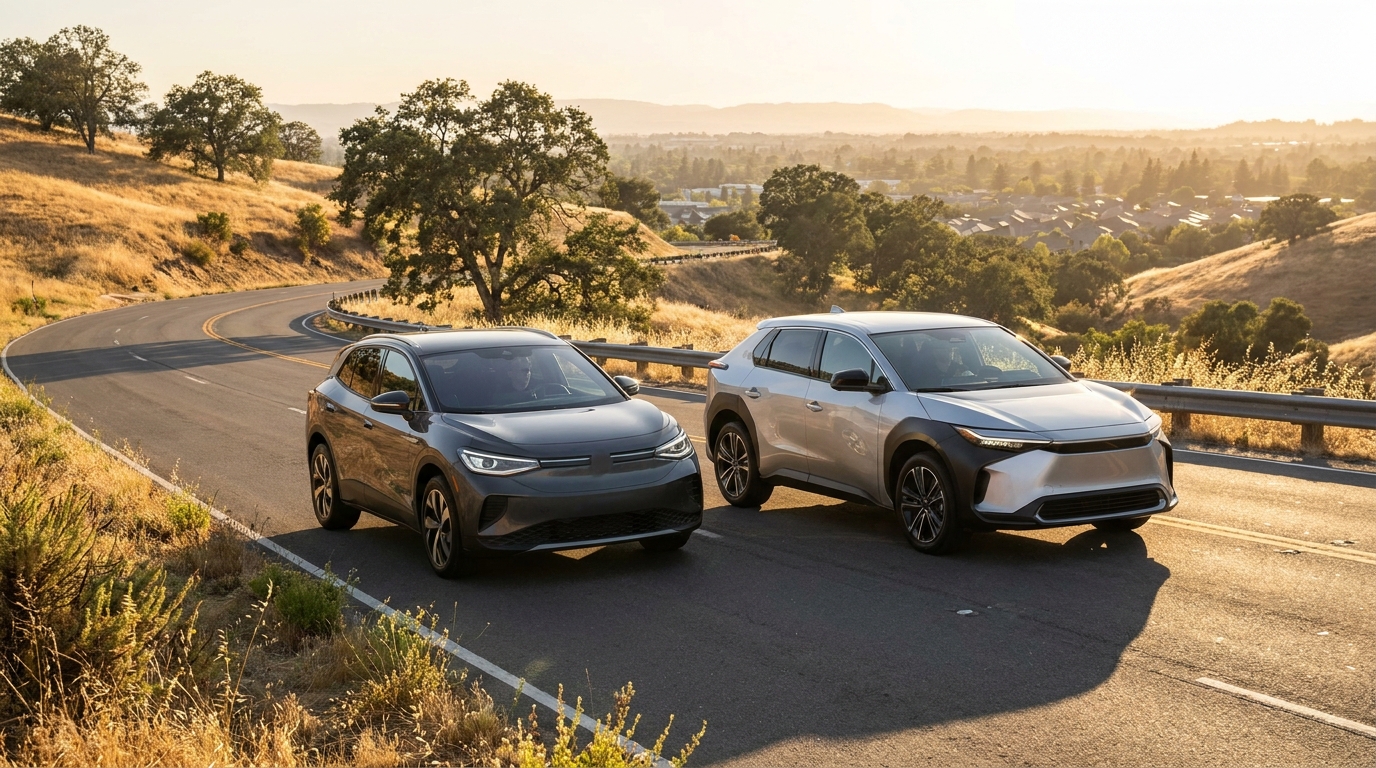
For context across the broader EV market, real-world testing has produced figures ranging from 108 miles for the MINI Cooper SE and 141 miles for the BMW i3s BEV at the low end, up to 395 miles for the Mercedes EQS 450+ and 500 miles for the Lucid Air Dream Edition at the high end. The ID.4 sits comfortably in the mainstream-crossover middle of that spectrum, alongside vehicles like the Kia e-Niro (255 miles tested) and the Jaguar I-Pace (223 miles tested).
What Sunnyvale Drivers Should Actually Expect
Sunnyvale's driving environment is unusually favorable for EVs. The mild Mediterranean climate rarely demands aggressive heating or air conditioning, the terrain is largely flat, and most local trips involve a mix of moderate-speed surface streets and freeway segments where traffic on the 101, 237, and 280 frequently moderates average speeds well below the 75 mph used in worst-case range tests.
Under these conditions, the AWD ID.4 should realistically deliver 240 to 260 miles per charge in daily Sunnyvale use, while the RWD Pro can approach its EPA figure, landing in the 260 to 290 mile range for typical mixed driving. A commuter living near Lawrence Station who drives to a job in Mountain View, Palo Alto, or even San Francisco can comfortably complete a full work week on a single charge.
Where the gap widens is on longer trips at sustained freeway speeds — a run down I-5 to Los Angeles, for example, will pull real-world range closer to the 240-mile Car and Driver figure for AWD models. Planning charging stops around that number, rather than the EPA estimate, is the realistic approach.
Charging the ID.4: Network Access and Speed
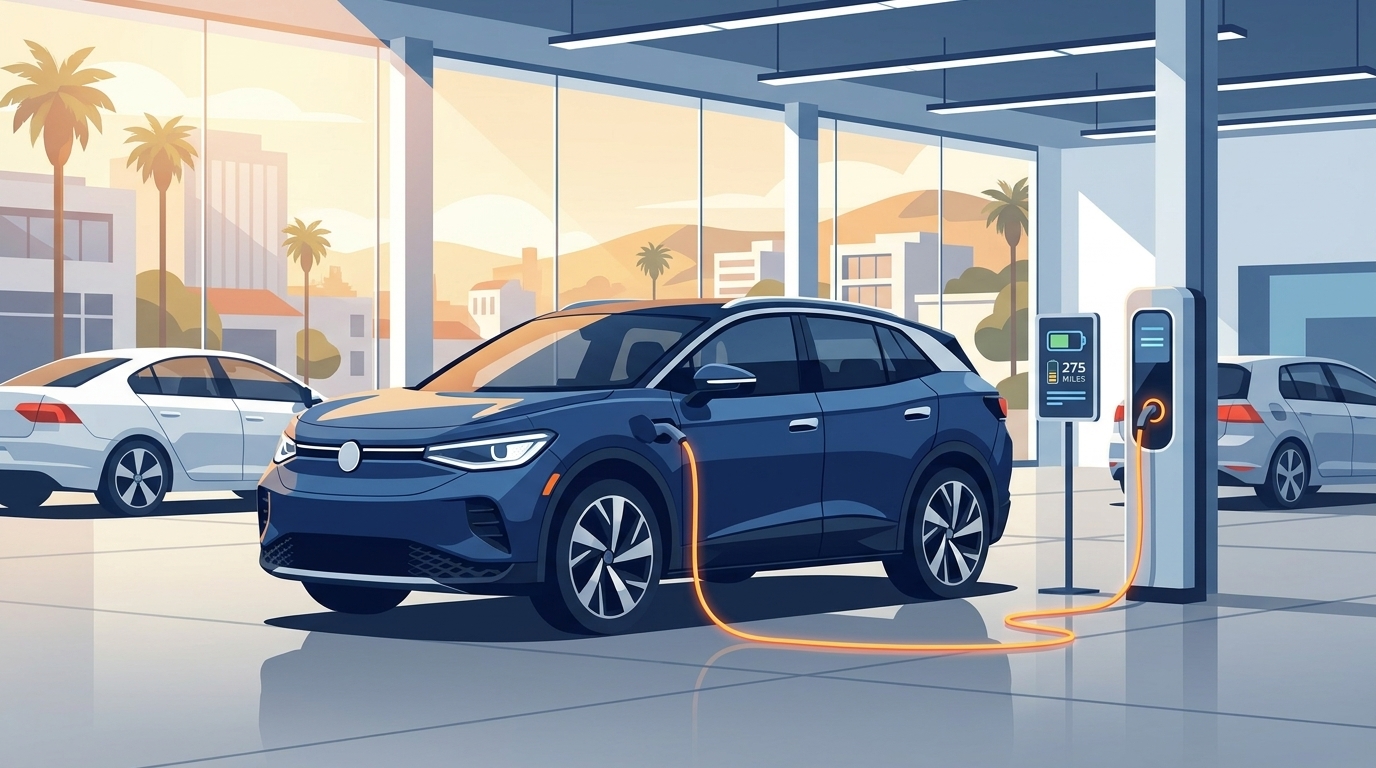
The 2026 ID.4 ships with a NACS port standard, giving owners direct access to the Tesla Supercharger network in addition to CCS stations via adapter. This matters in the Bay Area, where Supercharger density along El Camino Real, the 101 corridor, and the major shopping centers is substantially higher than CCS coverage.
DC fast charging peaks at 175 to 200 kW, with a 10 to 80% charge in roughly 30 minutes under ideal conditions. That's competitive for the compact-crossover segment, though some newer luxury rivals exceed 250 kW. For most Sunnyvale owners, the bigger consideration is whether DC fast charging is needed regularly at all — and for daily commuters, it usually isn't.
Home EV Charging in Sunnyvale
The most cost-effective and convenient way to live with an ID.4 in Sunnyvale is Level 2 home charging. A 240-volt circuit installed in a garage or carport can fully replenish the 82-kWh battery overnight, taking advantage of PG&E's EV-friendly time-of-use rate plans that price off-peak overnight electricity well below daytime rates.
Sunnyvale homeowners installing a Level 2 charger should account for several local realities:
- Electrical permits are required through the City of Sunnyvale's Building Safety Division for any new 240-volt circuit installation, and a licensed electrician must perform the work.
- Older homes in neighborhoods like Heritage District and Birdland often have 100-amp service panels that may require an upgrade or a load-management device to support a 40-amp or 48-amp EV circuit.
- PG&E offers separate EV time-of-use rate schedules that reward charging between roughly midnight and early morning, when rates drop significantly compared to peak afternoon hours.
- Condo and townhome owners in complexes near Downtown Sunnyvale or along Mathilda Avenue should review HOA rules; California's Right to Charge law generally protects EV owners' ability to install charging at their dedicated parking, though specific approval processes vary by association.
For renters and apartment dwellers, public Level 2 stations at Sunnyvale Community Center, Las Palmas Park, and several Caltrain station lots provide practical alternatives, though they require more active planning than home charging.
The 2026 ID.4 in Context: Pricing and Practicality
The 2026 ID.4 starts at $45,095 MSRP for the Pro RWD and climbs to roughly $57,695 for the Pro S Plus AWD, before destination charges, taxes, and dealer fees. TrueCar transaction data has shown average selling prices around $44,156, suggesting real-world discounts off MSRP. California state and local EV incentives may further reduce effective cost for qualifying buyers, though those programs change periodically and should be verified at the time of purchase.
Beyond range, the ID.4 delivers practical family-SUV utility: 30.3 cubic feet of cargo behind the rear seats expanding to 64.2 cubic feet with seats folded, seating for five, and towing capacity up to 2,700 pounds. The AWD model hits 60 mph in 4.8 seconds per Car and Driver's instrumented testing, while the RWD manages 7.3 seconds — quick enough for confident merging onto 237 or 101.
Volkswagen's warranty coverage includes a 4-year/50,000-mile basic warranty, an 8-year/100,000-mile battery warranty, and 2 years or 20,000 miles of complimentary maintenance — standard coverage for the EV segment that addresses long-term ownership concerns around the most expensive component.
Frequently Asked Questions
Does cold weather affect ID.4 range in Sunnyvale?
Sunnyvale's mild climate rarely produces the temperatures that meaningfully degrade EV range. While cold-weather testing of other EVs — such as the Tesla Model 3 Long Range returning 270 miles in cold conditions — shows climate impact elsewhere, Sunnyvale owners can generally expect performance close to EPA estimates year-round.
Can I road trip an ID.4 from Sunnyvale to Lake Tahoe?
Yes, with planned charging stops. The 175 to 200 kW peak DC fast charging and NACS Supercharger access make I-80 corridor stops straightforward. Plan around the 240-mile real-world highway figure rather than the EPA number when mapping the route.
What's the difference between the RWD and AWD ID.4 for daily Sunnyvale driving?
The RWD Pro offers 28 more miles of EPA range (291 vs. 263) and starts at a lower price, while the AWD adds traction in wet conditions and cuts 0-60 times nearly in half. For most Sunnyvale commuters, RWD makes more sense; for those who regularly drive to Tahoe or coastal areas in winter, AWD adds margin.
The Bottom Line for Sunnyvale ID.4 Shoppers
The 2026 Volkswagen ID.4 is well-matched to Bay Area driving patterns. Its real-world range comfortably handles weekly Silicon Valley commuting, its NACS port simplifies public charging across the region, and its pricing keeps it accessible relative to luxury EV alternatives. The roughly 9% EPA-to-highway gap is consistent with the broader EV segment — not an ID.4-specific shortcoming.
Sunnyvale drivers evaluating the ID.4, weighing RWD versus AWD, or planning a home charging installation can reach Sunnyvale Volkswagen at https://www.sunnyvalevw.com/ to discuss configurations, current inventory, and the practical details of EV ownership in the South Bay.