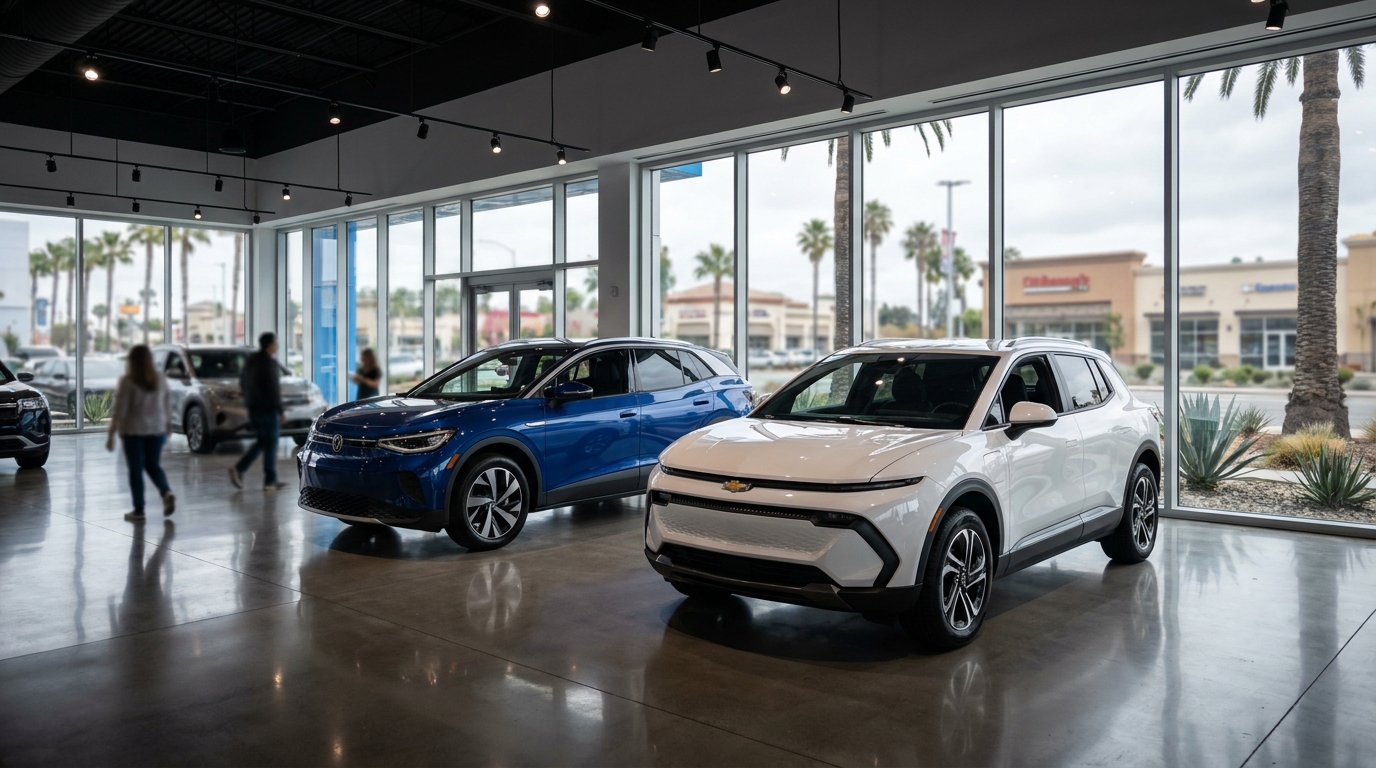
New vs Used Electric Car in Santa Clarita, CA (2026)
A Santa Clarita buyer's guide to new vs used EV economics in 2026: incentives, sales tax, commuter range needs, and when each option pencils out.
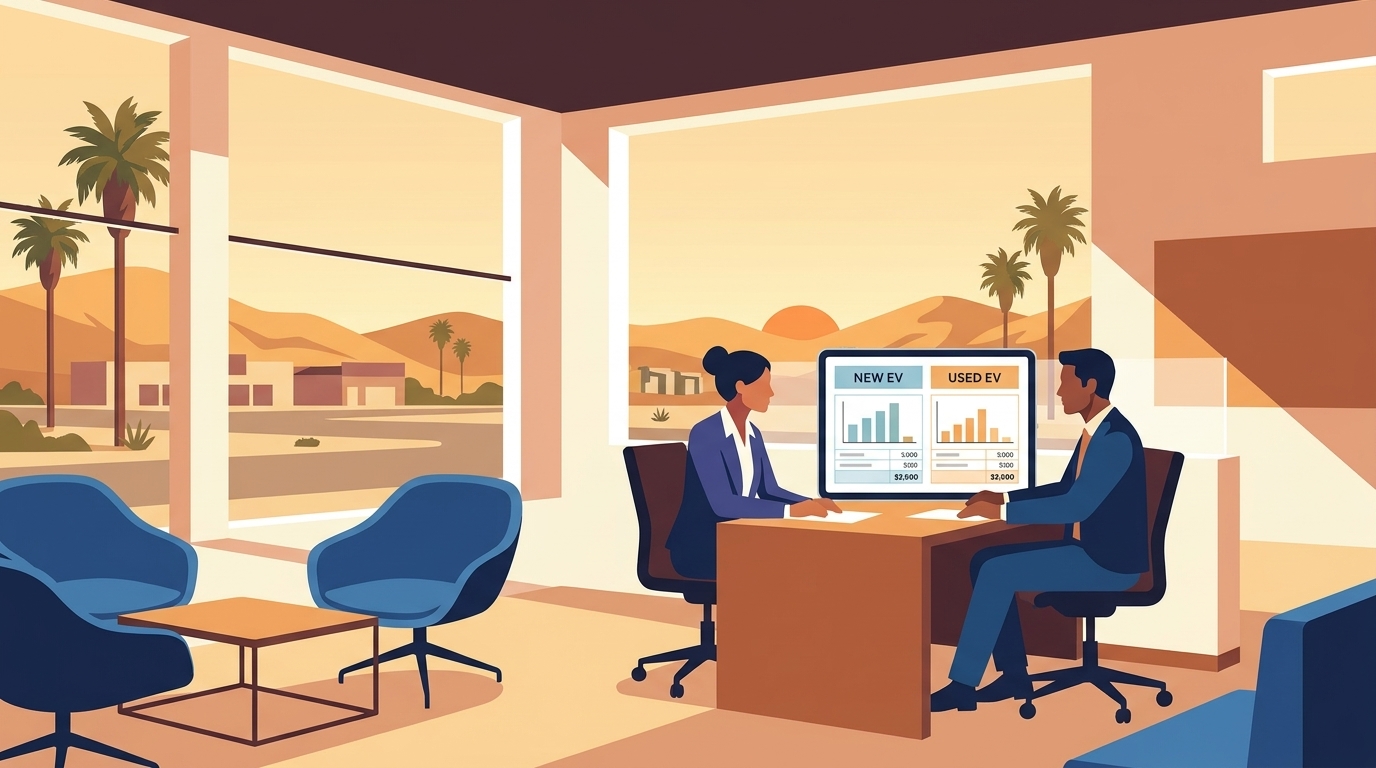
For most Santa Clarita buyers in 2026, a new EV makes financial sense when the household can absorb higher upfront cost in exchange for full warranty coverage and the latest battery range, while a used EV wins when the priority is minimizing monthly outlay and the commute stays within a proven range envelope., which has meaningfully changed how the comparison pencils out for Santa Clarita households shopping today.
This guide breaks down the real cost drivers — incentives, California sales and use tax, financing, and commute-specific range requirements — so buyers along the I-5 and SR-14 corridors can decide which side of the new-versus-used line fits their situation.
The Incentive Landscape Has Shifted in 2026
Under IRC §25E, buyers previously could claim 30% of the sale price, capped at $4,000, on a qualifying used EV purchased from a licensed dealer at $25,000 or less, provided the vehicle was at least two model years old.
The new-vehicle IRC §30D credit was terminated on the same date under the same legislation. That means Santa Clarita shoppers in 2026 generally cannot count on either federal credit as part of the purchase math — a significant departure from the incentive environment of the past three years.
At the state level, The remaining state-level EV assistance flows through income-qualified grant programs: the Clean Vehicle Assistance Program (CVAP), which serves households at or below approximately 400% of the Federal Poverty Level, and Clean Cars 4 All (CC4A), which requires scrappage of an older high-polluting vehicle and operates only in participating air districts such as South Coast and the Bay Area. These are grants, not tax credits, and eligibility is narrower than the CVRP was.
What This Means for the Math
With federal credits off the table for 2026 acquisitions, the used EV's traditional "$4,000 tax credit advantage" has evaporated. That doesn't automatically make new the better deal — depreciation still favors used — but the gap has narrowed. Buyers who don't qualify for CVAP or CC4A are now comparing sticker-to-sticker, financing-to-financing, without a federal thumb on the scale.
Sales and Use Tax: The Santa Clarita Reality
California imposes sales tax on dealer EV purchases and use tax on private-party purchases at the same rate, with no EV-specific exemption or reduced rate under Revenue and Taxation Code §§6051 and 6201. The Santa Clarita rate is the combined California statewide base rate plus Los Angeles County and applicable district add-ons authorized under RTC §§7251 et seq. Because that combined rate changes as local district taxes are adopted or expire, buyers should confirm the current figure with CDTFA's rate lookup tool before signing.
Two practical implications for Santa Clarita EV buyers:
- Dealer purchases: Sales tax is collected at the point of sale on the full purchase price. There is no EV discount and no reduced rate.
- Private-party used EV purchases: Use tax is collected by the DMV at registration, not by the seller. The rate is the same as sales tax, so the "I'll save on tax buying from a private party" assumption doesn't hold in California.
For a $25,000 used EV versus a $45,000 new EV, the absolute dollar difference in tax is meaningful — roughly proportional to the price gap — and that difference compounds the depreciation argument for used.
Range and the Santa Clarita Commute
Range is where the new-versus-used decision gets genuinely local. Santa Clarita commuters routinely drive to Burbank, Glendale, downtown Los Angeles, or the west San Fernando Valley — round trips of 40 to 80 miles are common, and traffic on I-5 through the Newhall Pass can turn a nominal commute into a two-hour battery drain in summer, when Santa Clarita's inland climate regularly pushes past 100°F and HVAC load reduces effective range.
New EVs in 2026 typically deliver EPA-rated ranges that comfortably absorb a hot-weather Grapevine climb or a Magic Mountain-to-Century City round trip with margin. Older used EVs — particularly first-generation compliance cars — may have degraded battery capacity that leaves little cushion after five to seven years of Santa Clarita heat cycling. Battery health is the single most important pre-purchase inspection item on any used EV in this market.
What to Verify Before Buying Used
- Battery state-of-health report, not just odometer reading
- Remaining battery warranty (most manufacturers cover 8 years / 100,000 miles from original in-service date)
- DC fast-charging capability and current charging speed relative to spec
- Documented service history, including any battery module replacements
Financing: How the Monthly Payment Actually Compares
Used EV financing rates in 2026 generally run higher than new EV rates because lenders price in battery-degradation risk and shorter remaining useful life. A used EV at $22,000 financed at a higher rate can produce a monthly payment surprisingly close to a new EV at $38,000 financed at a manufacturer-subsidized promotional rate, particularly when the new vehicle carries a longer term.
Santa Clarita buyers should run three scenarios side by side before deciding:
- New EV with manufacturer financing incentive, five-year term
- Certified pre-owned EV with dealer financing, four- to five-year term
- Private-party used EV with credit-union financing, plus DMV-collected use tax
The winner is rarely obvious on sticker price alone. Total cost of ownership over five years — payment, insurance, tax, expected battery service, and residual value — is the number that matters.
When New Makes Sense and When Used Wins
New tends to win when: the household drives 15,000+ miles per year, commutes involve significant elevation change (the Grapevine, SR-14 to the Antelope Valley), the buyer wants full warranty coverage through the ownership period, and monthly payment isn't the binding constraint.
Used tends to win when: the commute is predictable and under 50 miles round trip, the buyer can pay cash or carry a shorter loan, and a verified battery state-of-health report shows minimal degradation. The loss of the federal §25E credit hurts this case in 2026, but depreciation on lightly-used EVs is still steep enough to reward patient shoppers.
FAQ
Can I still claim the federal used EV tax credit in 2026?
, subject to the MAGI limits (under $75,000 single, $112,500 head of household, $150,000 married filing jointly) and the requirement that no §25E credit was claimed in the prior three years.
Do I pay California sales tax on a private-party used EV in Santa Clarita?
Yes — but it's called use tax and it's collected by the DMV at registration, not by the seller. The rate matches the Santa Clarita sales tax rate, so there is no tax advantage to buying private-party over dealer in California.
Is a used EV a bad idea given Santa Clarita's summer heat?
Not inherently, but battery health verification is essential. Heat accelerates lithium-ion degradation, and a used EV that lived its early years in Santa Clarita's inland climate should be evaluated with a state-of-health report before purchase, not just a test drive.
Are there any California incentives left for a typical Santa Clarita buyer?
For middle- and upper-income buyers, largely no.. CVAP and CC4A remain but are limited to income-qualified households, and CC4A operates only in participating air districts and requires scrapping an older vehicle.
The Bottom Line for Santa Clarita Buyers
With federal EV credits terminated for 2026 acquisitions and California's broad-based rebate program closed, the new-versus-used decision now turns almost entirely on depreciation, financing terms, battery condition, and how well a given vehicle's range fits the buyer's actual Santa Clarita driving pattern. There is no longer a $4,000 federal reason to lean used, and no state rebate reason to lean new — the math is honest again.
Santa Clarita residents weighing the decision can work through the numbers with the team at Sunnyvale Volkswagen, whose EV inventory and financing specialists can model total cost of ownership across new and pre-owned scenarios. Details, current inventory, and appointment scheduling are available at https://www.sunnyvalevw.com/.