Volkswagen Trade-In Process in Santa Clara, CA
How a Santa Clara VW dealership appraises and applies your trade-in — plus how California's no-trade-in sales tax credit rule affects the math.

A Volkswagen trade-in at a Santa Clara dealership works in four steps: the dealer appraises the vehicle, presents a written offer, applies the accepted allowance as a credit toward the amount financed on the new vehicle, and — critically for California buyers — calculates sales tax on the full selling price of the new car without deducting the trade-in. That last point surprises buyers who moved here from states that discount tax by the trade-in value, and it materially changes how the numbers on the buyer's order add up.
This guide walks through the process specifically as it works under California law and in the Santa Clara market, including what documentation to bring, how appraisals are constructed, and how the California CARS Act taking effect October 1, 2026 changes what dealers must disclose in writing.
How the Trade-In Process Works Step by Step
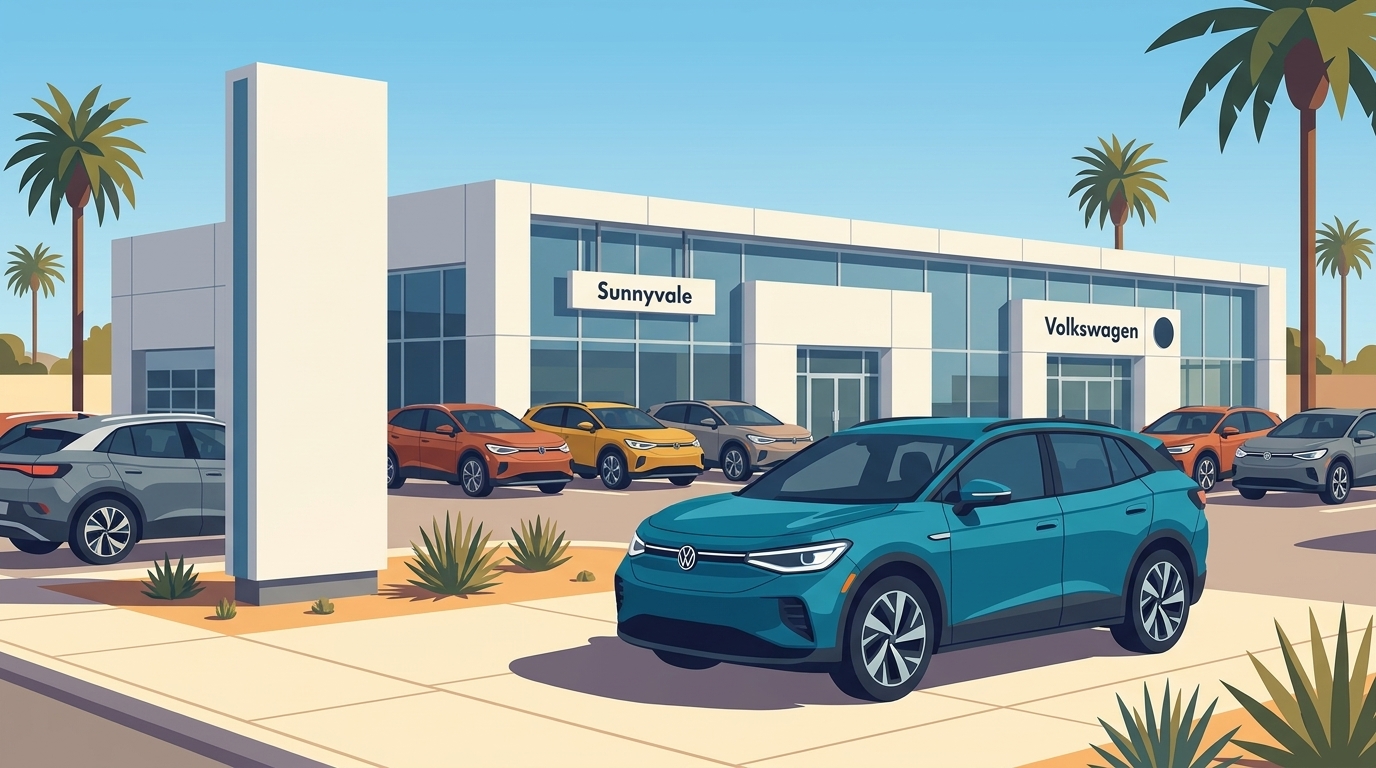
The mechanical sequence at any franchised Volkswagen store in Santa Clara — including Sunnyvale Volkswagen, which serves buyers across Santa Clara County — is consistent, even if numbers vary. Understanding the sequence lets a seller push back intelligently at each stage.
1. Vehicle Intake and Documentation
Bring the title (or current lienholder information and payoff), current registration, all keys and fobs, service records if available, and a valid California driver's license. If there is an outstanding loan, the dealer will contact the lender for a 10-day payoff quote; the payoff amount, not the payment balance, is what actually clears the lien.
2. Appraisal
An appraiser inspects the vehicle for mechanical condition, cosmetic wear, tire depth, mileage, accident history (via a vehicle history report), and any modifications. The appraiser then benchmarks the car against recent wholesale auction data and current retail demand for that specific model in the Bay Area. Trucks, three-row SUVs, and fuel-efficient commuters tend to hold value well in Santa Clara County; heavily optioned luxury sedans and older EVs with degraded batteries typically don't.
3. Written Offer
The dealer presents a written trade-in allowance. This number is negotiable, and it is separate from the price negotiation on the vehicle being purchased. Keeping the two conversations distinct — what is the trade worth, and what is the new car's out-the-door price — prevents the common tactic of moving money between the two lines to obscure the real deal.
4. Application to the Purchase
Once accepted, the trade-in allowance reduces the amount the buyer needs to finance or pay in cash. It does not reduce the sales tax owed on the new Volkswagen. More on that below.
How California Sales Tax Treats Your Trade-In
California taxes the full selling price of the new vehicle, with no deduction or credit permitted for the trade-in allowance. This is set by Revenue and Taxation Code sections 6011 and 6012, which define the taxable amount as total gross receipts including all consideration received, without reduction for trade-in value. CDTFA Publication 34 states plainly that the trade-in allowance "cannot be excluded from the amount on which tax is based."
The practical example CDTFA uses: if a vehicle sells for $20,000 and a trade-in is accepted at $4,000, tax is calculated on $20,000, not $16,000. The trade-in is treated as a separate transaction that reduces only the amount financed.
This rule applies statewide, so it is identical in Santa Clara, Sunnyvale, San Jose, Cupertino, and every other Santa Clara County city. Only the combined tax rate — state base plus the Bradley-Burns 1.25% plus applicable district taxes — varies by the buyer's specific address, which is why the CDTFA tax rate lookup should be checked against the buyer's home ZIP at the time of sale.
What This Means for the Real Math
Buyers relocating from states that offer a trade-in tax credit sometimes assume a $10,000 trade on a $40,000 Volkswagen means tax on $30,000. In California, tax is calculated on the full $40,000. The trade still has value — it lowers the check written and the amount financed — but the state does not treat it as a discount on the taxable base.
Over-Allowance and Under-Allowance
If a dealer offers more than fair market value on the trade (a common way to make a monthly payment look attractive), the excess cannot be treated as a discount that reduces taxable gross receipts. If the allowance is lower than fair market value, CDTFA presumes the agreed number is fair market value. In practical terms, the number on the contract is the number the state works from.
What Changes Under the California CARS Act on October 1, 2026
Effective October 1, 2026, the California CARS Act imposes new disclosure requirements that directly affect how trade-ins and financing are presented. Dealers must disclose a "total price" in any advertisement of a specific vehicle and in the first written communication with a consumer about that vehicle — including the total sales price, any dealer price adjustment, and any item installed on the vehicle at the time of the communication, though excluding taxes, fees, and charges.
When a dealer makes written representations about monthly payments, it must also disclose the total amount the consumer will pay after making all those payments. If lower monthly payment options are shown, the dealer must explain that lower payments often increase the total amount paid over the life of the loan — an important disclosure when a generous trade allowance is being used to stretch a term.
The Act also prohibits charging for add-on products or services if the buyer would not benefit from them, and requires clear disclosure of whether add-ons are voluntary. For used vehicles priced up to $50,000 sold at retail, buyers get a right to cancel within three calendar days or 400 miles, whichever comes first — relevant for the Certified Pre-Owned Volkswagen shoppers who compare inventory across Santa Clara County.
Practical Tips for Santa Clara Sellers
- Time the appraisal. Bay Area demand for compact SUVs and efficient commuters tends to firm up ahead of the summer travel season and again in the fall as tech companies bring workers back on-site. Appraisals track that demand.
- Get more than one offer. An instant-cash offer from an online buyer establishes a floor. A dealer appraisal may exceed it, especially if the buyer is trading into a same-brand vehicle where the dealer can retail the trade on its own lot.
- Separate the negotiations. Agree on the new car's out-the-door price first, then negotiate the trade allowance. Combining them lets a weak deal on one side hide inside a strong number on the other.
- Verify the tax rate for your address. A buyer in Santa Clara proper, one in Sunnyvale, and one in an unincorporated pocket of the county may all see slightly different combined rates. CDTFA's lookup tool settles it.
- Read the buyer's order line by line. After October 1, 2026, expect additional written disclosures around total price and total-of-payments. Those disclosures exist to be read.
Frequently Asked Questions
Does trading in my car lower the sales tax on my new Volkswagen in Santa Clara?
No. California calculates sales tax on the full selling price of the new vehicle, with no deduction for the trade-in allowance. The trade-in reduces the amount financed, not the taxable amount, under Revenue and Taxation Code sections 6011 and 6012 and CDTFA Publication 34.
Can I trade in a car that still has a loan on it?
Yes. The dealer obtains a 10-day payoff from the lender and pays off the lien directly. If the trade allowance exceeds the payoff, the difference is credited to the new deal; if the payoff exceeds the allowance, the negative equity is typically rolled into the new financing.
Do I have to trade in at the same dealership where I buy?
No, but bundling the transactions is usually cleaner and can be more efficient because the dealer handles the DMV paperwork on both sides. Selling privately may yield a higher gross figure but requires the seller to manage title transfer, payment security, and lien release independently.
What documents does the dealer need for the trade-in?
The title or lienholder payoff information, current registration, all keys and remotes, a valid California driver's license, and — if available — service records. The vehicle itself should be present for physical inspection.
How does a Certified Pre-Owned Volkswagen purchase interact with a trade-in?
The mechanics are identical. A CPO purchase is still subject to California's full-price sales tax rule, and after October 1, 2026, used vehicles priced up to $50,000 also carry the CARS Act three-day / 400-mile cancellation right.
Getting a Trade-In Appraisal in Santa Clara
Buyers in Santa Clara County who want a written trade-in appraisal alongside a specific new or Certified Pre-Owned Volkswagen quote can reach Sunnyvale Volkswagen at https://www.sunnyvalevw.com/. A dealership appraisal — reviewed against an independent instant-cash offer and with the California tax math understood up front — is the most reliable way to know what the trade is actually worth and how it fits into the total deal.