Volkswagen vs Honda Resale Value in Sunnyvale, CA
Compare Volkswagen and Honda resale value in Sunnyvale, CA — depreciation trends, dealer network impact, and which brand holds up better for 2026 buyers.
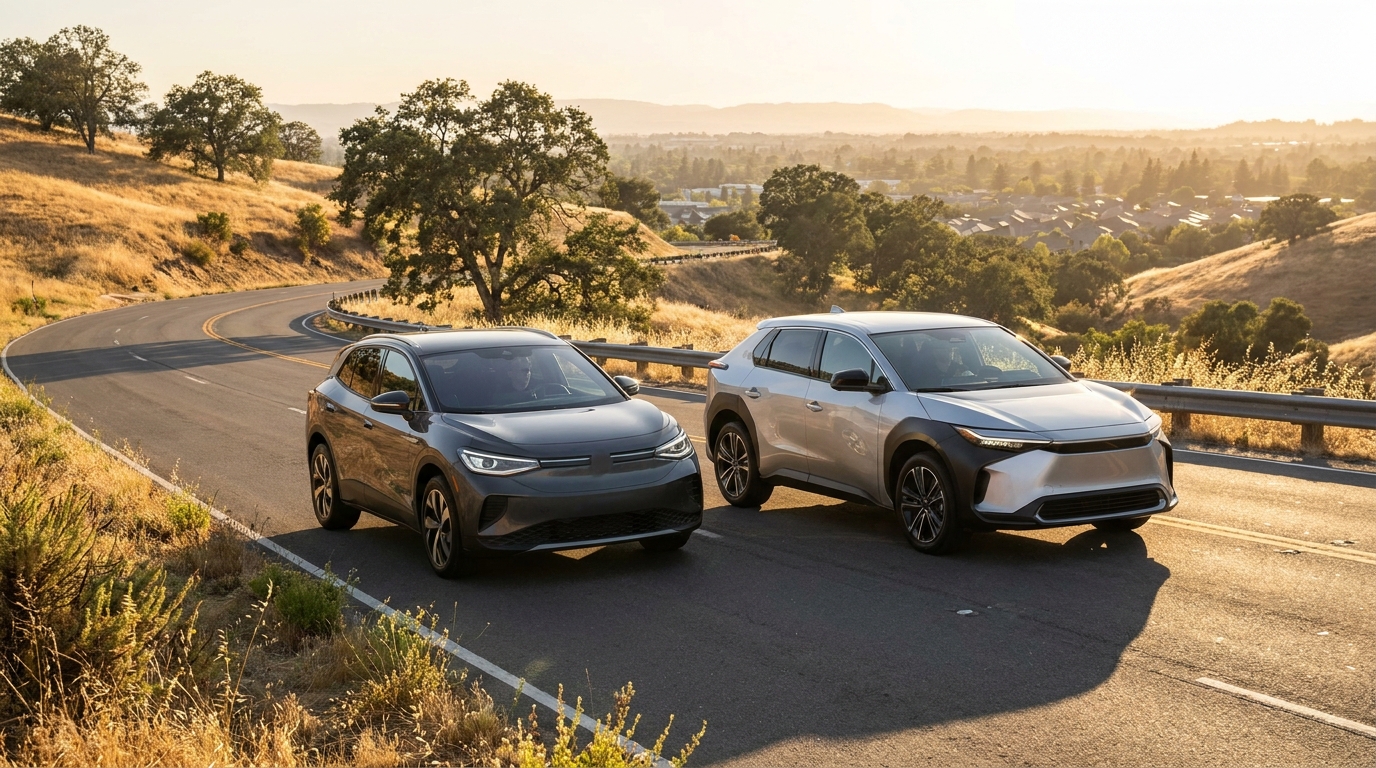
Honda generally holds its resale value better than Volkswagen in the California market, driven by a denser statewide dealer network, stronger reliability reputation, and consistently high buyer demand for the CR-V, Civic, and Pilot. Volkswagen models like the Tiguan, Atlas, and Jetta depreciate faster on paper but often deliver more car for the money at trade-in when factoring in original transaction price, longer warranty coverage, and lower initial destination costs relative to feature content.
That's the short answer. The longer answer — the one that actually matters for a Silicon Valley buyer choosing between a Tiguan and a CR-V in 2026 — depends on how long the car is kept, how it's driven, and what the ownership math looks like when destination charges, warranty, and California-specific taxes are all in the frame.
Which brand holds its value better in California in 2026?
Honda holds a measurable resale advantage in California. The CR-V, Civic, and Pilot benefit from dense statewide dealer coverage, strong used-market demand, and a reliability reputation that props up private-party values. Volkswagen's Tiguan, Atlas, and Jetta trail on retained value but frequently start from a lower effective price point and carry a longer basic warranty, which narrows the real-world gap.
For buyers in Sunnyvale weighing a five-to-seven-year hold, this matters more than a percentage point on a depreciation chart. Silicon Valley's used-car market is unusually liquid — commuters cycling through leases, tech relocations, and second cars for teenagers keep demand steady for both compact SUVs and efficient sedans. That liquidity rewards cars that are easy to sell, and Honda's brand recognition here is hard to beat.
Sunnyvale Volkswagen, located on the El Camino Real corridor near the border with Mountain View, sees this dynamic firsthand: shoppers cross-shop the Tiguan against the CR-V and the Jetta against the Civic almost daily, and the resale conversation comes up on nearly every test drive.
How do VW and Honda depreciation curves actually compare?
Volkswagen models typically depreciate faster in the first three years than comparable Hondas, but the gap narrows over a longer hold. Honda's CR-V and Civic are consistently ranked among the slowest-depreciating vehicles in their segments nationally, while VW's Tiguan and Jetta land in the middle of the pack. The Atlas holds up reasonably well among three-row SUVs but trails the Pilot in retained value.
A few structural factors drive the difference:
- Dealer network density. Honda has significantly more California rooftops, which supports parts availability and service confidence — both of which feed used-buyer demand.
- Reliability perception. Honda's long-running reputation for durability shapes what private buyers will pay used, independent of any individual car's actual condition.
- Fuel economy. With California gas prices among the highest in the country, the CR-V Hybrid's roughly 37–40 mpg combined rating commands a real premium on the used market versus the Tiguan's 25–29 mpg combined.
- Starting price gap. The Tiguan opens at $30,805 versus the CR-V at $31,520 — VW's lower entry price means a lower depreciation floor to fall to.
Head-to-head: Tiguan vs CR-V, Atlas vs Pilot, Jetta vs Civic
Resale value never lives in isolation — it's shaped by what the car costs to buy, own, and eventually sell. The table below lays out the key variables for the three most common cross-shops in the Sunnyvale market.
| Dimension | Volkswagen | Honda |
|---|---|---|
| Compact SUV starting MSRP | Tiguan: $30,805 | CR-V: $31,520 |
| Destination charge | $1,225–$1,475 (plus import fee on Mexico-built models) | $1,150 (consistent lineup-wide) |
| Compact SUV MPG combined | Tiguan: 25–29 mpg | CR-V gas: ~30 mpg; Hybrid: ~37–40 mpg |
| Compact SUV horsepower | Tiguan: 201 hp / 268 hp available | CR-V gas: 190 hp; Hybrid: 204 hp |
| Compact SUV cargo (max) | Tiguan: 69.8 cu. ft. | CR-V: 39.3 cu. ft. |
| Basic warranty | 4 years / 50,000 miles (Tiguan) | 3 years / 36,000 miles (CR-V) |
| Three-row SUV horsepower | Atlas: 2.0L turbo 4-cyl | Pilot: 285 hp V6 |
| Sedan starting horsepower | Jetta: 158 hp | Civic (compact sedan) |
| Transmission character | 8-speed automatic (Tiguan, Jetta) | CVT (CR-V/Civic); 10-speed auto (Pilot) |
The Tiguan gives up ground on fuel economy and long-term resale percentage, but wins on maximum cargo (69.8 vs 39.3 cu. ft.), warranty length, and driving character. The CR-V Hybrid's efficiency advantage compounds every month a California commuter fills the tank.
Why does California specifically change the resale math?
California magnifies the fuel-economy premium and the dealer-network advantage more than any other state. Gasoline routinely runs a dollar or more per gallon above the national average, which pushes used buyers toward efficient vehicles like the CR-V Hybrid. Honda's dense dealer footprint from San Jose through the Peninsula also means service, parts, and certified pre-owned trade cycles are easier to complete, tightening used inventory and holding prices firm.
Two California-specific cost items also affect the resale equation:
- Sales tax on trade-ins. California taxes the full purchase price of a new vehicle — buyers do not receive a sales-tax credit for the value of a trade-in the way buyers in many other states do. That makes the actual dollar amount you get for your used car a bigger factor in the deal than a percentage-based resale chart suggests.
- Smog certification. California requires smog inspection at resale for most vehicles more than four model years old, and inspection results can influence private-party demand for older turbocharged engines.
Volkswagen has also been adding an import fee line item to destination charges for Mexico-built models — Jetta, Tiguan, and Taos — in response to current tariff conditions. That fee affects transaction price today but does not automatically translate into higher resale later, which is worth factoring into the total-cost-of-ownership picture.
When does a Volkswagen make more financial sense than a Honda?
Volkswagen makes stronger financial sense when the buyer plans to keep the car past the depreciation curve's steepest drop — typically five years or more — and values driving character, cargo flexibility, or three-row space over hybrid fuel economy. The Tiguan's 69.8 cu. ft. maximum cargo, 4-year/50,000-mile basic warranty, and lower starting MSRP versus the CR-V give it a real edge for long-hold owners who don't plan to flip the car at year three.
The calculus flips for short-hold buyers, hybrid-focused commuters, and anyone who prioritizes exit liquidity. If the plan is to sell or trade within three years, or if the daily commute from Sunnyvale to San Francisco or the East Bay makes 40 mpg meaningful, the CR-V Hybrid's resale strength and fuel savings are hard to argue with.
Buyers cross-shopping these brands often visit Sunnyvale Volkswagen for exactly this reason — to test-drive the Tiguan or Atlas back-to-back after seeing a Honda, and to run the total-cost-of-ownership math with a salesperson who won't pressure the decision. The dealership's 4.4-star Google rating across more than 1,400 reviews reflects a sales approach reviewers describe as transparent, with one recent customer writing that the process was “smooth and stress-free” from start to finish.
Frequently asked questions
Does a Honda CR-V really hold its value better than a Volkswagen Tiguan in California?
Yes, on average the CR-V retains a higher percentage of its original MSRP than the Tiguan over a three-to-five-year hold, driven by Honda's stronger dealer network in California, its reliability reputation, and high used-market demand for the CR-V Hybrid. The Tiguan closes some of that gap through a lower starting MSRP of $30,805 and a longer 4-year/50,000-mile basic warranty.
Which Volkswagen model has the best resale value?
Among the current lineup, the Atlas typically holds up best in absolute dollar terms because three-row SUVs retain strong demand, followed by the Tiguan. The Jetta depreciates fastest of the three, in part because compact sedans as a segment face pressure from crossovers. Trim matters — the Tiguan SEL R-Line Turbo with 268 hp and the Atlas in higher trims tend to retain value better than base configurations.
How does California sales tax affect a trade-in?
California charges sales tax on the full purchase price of the new vehicle, not the difference after trade-in credit. That means the dollar amount received for a trade does not reduce the taxable base of the new car. Buyers should factor this into resale expectations because it makes the absolute trade-in value more important than percentage-based depreciation charts suggest.
Is the CR-V Hybrid worth the premium over the gas CR-V for resale?
In California, yes. The CR-V Hybrid's combined fuel economy of roughly 37–40 mpg commands a strong premium in the used market compared to the gas CR-V's roughly 30 mpg combined, particularly given persistent high gas prices statewide. Used-buyer demand for efficient hybrids has been consistently strong, which supports higher retained value at trade-in.
Does Volkswagen's longer warranty offset weaker resale value?
Partially. Volkswagen's 4-year/50,000-mile basic warranty on the Tiguan exceeds Honda's 3-year/36,000-mile coverage on the CR-V, which reduces owner cost during the first ownership period and can support second-owner confidence. However, warranty length affects total cost of ownership more than resale percentage — the resale gap between the brands is driven more by demand and reliability perception than by warranty terms.
What is the best-resale-value car available in California in 2026?
Within the Volkswagen and Honda comparison, the Honda CR-V Hybrid and Honda Pilot typically lead on retained value in California, thanks to high fuel economy demand and three-row utility respectively. The Volkswagen Atlas and Tiguan are competitive on total cost of ownership when accounting for lower starting MSRP and longer warranty, particularly for buyers holding the vehicle five years or more.
The bottom line for Sunnyvale buyers
Honda wins the resale percentage battle in California. Volkswagen often wins the total-cost-of-ownership battle for buyers who keep their cars long enough to let the initial depreciation curve flatten out, and who value cargo space, warranty coverage, and driving character over hybrid fuel economy. Neither answer is universal — the right choice depends on hold period, commute distance, and how important exit liquidity is at trade-in time.
Readers in Sunnyvale, CA who want to test-drive the Tiguan, Atlas, or Jetta and run the resale and total-cost math against a specific Honda cross-shop can reach Sunnyvale Volkswagen at https://www.sunnyvalevw.com/ to get started.