Home EV Charging for Volkswagen Owners in Santa Clara: A Practical Setup Guide
A Santa Clara guide to home Level 2 charging for Volkswagen EVs — permits, utility incentives, code requirements, and what VW owners should know.
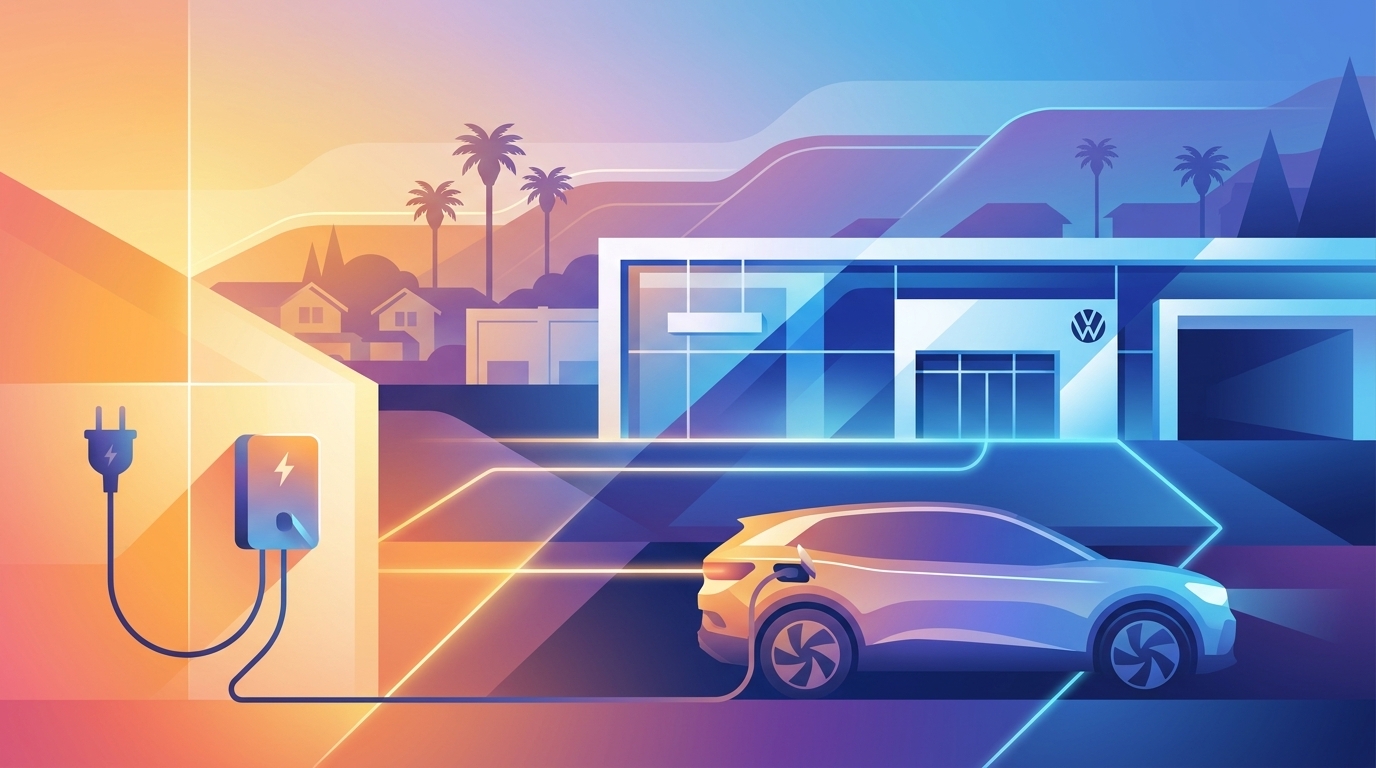
For Santa Clara residents who have just taken delivery of an ID.4 — or are weighing a Volkswagen electric SUV against other options — the most consequential decision often happens after the test drive: how to charge at home. A properly installed 240-volt Level 2 setup turns an EV into the most convenient car a household has ever owned. A poorly planned one leads to permit headaches, missed utility rebates, and overnight charging that never quite finishes before the morning commute up the 101.
This guide walks Volkswagen owners through the specific permitting, utility, and code requirements that apply in Santa Clara, and explains how to sequence the work so the charger is ready when the car is.
Why Level 2 Charging Is the Standard for VW Electric Vehicles
Volkswagen's electric lineup — led by the ID.4 electric SUV — is designed around Level 2 home charging as the daily-use case. A standard 120-volt household outlet (Level 1) will technically charge an ID.4, but the rate is slow enough that owners with longer commutes or weekend trips toward Santa Cruz or Tahoe will find it inadequate. A 240-volt Level 2 circuit, typically sized at 40 to 50 amps, can replenish a depleted battery overnight.
Under California Electrical Code Article 625, the dedicated branch circuit serving an EV charger must be sized at 125% of the continuous EVSE load rating, with proper overcurrent protection and approved wiring methods. That math is why a 40-amp charger requires a 50-amp breaker and appropriately sized conductors — a detail that catches DIYers off guard and is a common reason unpermitted installs fail inspection.
Permits Are Required — Even for Plug-In Chargers
One of the most misunderstood points in the Santa Clara market is that a permit is required for any new 240-volt Level 2 charger installation, whether the unit is hardwired or plugs into a NEMA 14-50 outlet. The only true exception is charging from an existing 120-volt outlet with no new circuit added.
The Santa Clara County permit application must include three core documents:
- An electrical line drawing from the main service panel to the EVSE, showing panel ratings, conductor types and sizes, and raceway types and sizes
- Electrical service load calculations demonstrating the panel has capacity for the new load
- Specification sheets for the proposed charger and any related equipment
For most single-family homes installing a typical 40- or 48-amp charger, the project qualifies for streamlined, over-the-counter review: Level 2 installations at or below 60 amps with service equipment rated 125 amps or greater are exempt from the electrical plan review requirement. Installations above 60 amps, or homes with smaller service panels, require full plan review.
This streamlined pathway exists because of state law. AB 1236 (2026) and AB 970 (2026) require both the City and County of Santa Clara to accept EVSE permit applications electronically, maintain a publicly available submittal checklist, and provide expedited review for compliant applications. In practice, a clean application for a 40-amp ID.4 charger in a home with a 200-amp panel often clears the same day.
City vs. County: Know Which Jurisdiction Governs Your Address
Santa Clara homeowners sometimes assume "Santa Clara" means one jurisdiction. It does not. The City of Santa Clara and Santa Clara County operate separate permit portals, and addresses in unincorporated areas, Cupertino, Sunnyvale, or other municipalities fall under different building departments. Confirming the governing jurisdiction before submitting paperwork — and before contacting a utility for rebates — avoids weeks of rework.
This distinction matters most for the utility side of the equation. Customers inside City of Santa Clara limits are typically served by Silicon Valley Power (SVP); the rest of Santa Clara County is generally served by PG&E. The two utilities run separate residential EV programs with different eligibility rules.
Utility Incentives: SVP and PG&E Rebates
Both utilities tie rebate eligibility to the same fundamentals: a UL-listed Level 2 (240-volt) EVSE, a valid electrical permit, and proof of final inspection. Silicon Valley Power's residential EV incentive programs require the charger to be installed at the customer's SVP service address under a valid permit, with proof of final city inspection typically required as a condition of rebate payment.
PG&E's residential EV programs apply equivalent standards: UL-listed EVSE, installation in accordance with California Electrical Code and local codes, and documentation — permit number, inspection report, contractor invoice — that may be required for incentive eligibility.
Program amounts and application windows change frequently based on City Council action and CPUC decisions, so current terms should be confirmed with SVP or PG&E directly at the time of installation. The key planning insight: do not energize and use the charger before final inspection. Skipping that step can disqualify the entire installation from rebates that would otherwise offset a meaningful share of the project cost.
What Inspectors Actually Check
Permitted installations require both a rough inspection (before any wiring is concealed in walls or conduit) and a final inspection. Inspectors verify the branch circuit sizing under CEC Article 625, the overcurrent protection, the conductor and raceway sizes against what was submitted, and the equipment listing. If a service upgrade or a second meter for a separate EV utility rate is part of the project, that work must be explicitly included in the permit application and is likely to trigger plan review.
A Note on New Construction in Santa Clara
For homeowners building new or planning a major addition, CALGreen Section 4.106.4.1 applies to permit applications filed on or after January 1, 2026. The provision requires a listed raceway of minimum trade size 1, panel capacity for a 40-amp 240-volt dedicated branch circuit, reserved panel space, and permanent "EV Capable" labeling. The requirement does not retroactively apply to existing single-family homes adding a Level 2 charger.
Frequently Asked Questions
Does an ID.4 need a hardwired charger or a plug-in unit?
Either works. Both require a permit in Santa Clara. Hardwired units are common for installations above 40 amps and tend to look cleaner; plug-in units on a NEMA 14-50 receptacle are easier to swap out if the homeowner changes vehicles or moves.
How long does the permit process take?
For a streamlined application — 60 amps or less on a 125-amp-or-greater service panel — many homeowners report same-day or next-day issuance under the AB 970 timeline requirements. Projects requiring plan review take longer.
Can a Santa Clara homeowner do the work themselves?
Owner-builder permits are permitted under California law, but the work still must pass inspection. Unpermitted installs may trigger correction notices, mandatory as-built permits at higher fees, or orders to de-energize non-compliant work under Health & Safety Code §§ 17958 and 18941.5.
What happens if the existing panel is too small?
A service upgrade can be added to the permit application. It will likely trigger plan review and adds cost and time, but it is often the right move for older homes in established Santa Clara neighborhoods where 100-amp panels are still common.
Planning the Install Around the Car Purchase
The cleanest sequence is to start the permit process as soon as a Volkswagen electric SUV is ordered or test-driven, not after delivery. A 200-amp panel and a 40-amp ID.4-compatible charger usually clears permitting quickly, but a panel upgrade or unusual run from the service entrance to the garage can add weeks.
Santa Clara residents shopping the Volkswagen lineup — or weighing volkswagen electric cars for sale against other EVs — can talk through home charging logistics as part of the purchase conversation. Sunnyvale Volkswagen, located in the broader Santa Clara County market, works with buyers on the ID.4 and the wider VW electric vehicles lineup and can be reached at https://www.sunnyvalevw.com/ for those who want a single point of contact while coordinating the vehicle and the home charging setup.