Volkswagen Lease vs Buy Calculator: Which Option Saves You More Money?
Compare leasing vs buying a Volkswagen in Sunnyvale, CA. Use lease vs buy math, real-world examples, and 2026 financing insights to decide what saves you more.

You've narrowed it down to a Volkswagen — maybe a Jetta, a Tiguan, or that ID.4 you keep seeing zip down El Camino Real. Now comes the harder question: should you lease it or buy it? The right answer depends less on opinion and more on math, and a Volkswagen lease vs buy calculator is the fastest way to see that math laid out side by side.
This guide walks you through how those calculators work, what numbers actually move the needle, and how Sunnyvale, CA drivers can think about the tradeoffs in a market where commutes, tech jobs, and EV incentives all shape the decision.
How a Volkswagen Lease vs Buy Calculator Works
At its core, a lease vs buy calculator compares two total cost-of-ownership figures over the same time window — usually 36 months. On the lease side, it adds up your monthly payments, down payment, taxes, fees, and any disposition charge at lease-end. On the buy side, it adds up your loan payments, interest, taxes, and registration, then subtracts the vehicle's projected resale value at the end of the comparison period.
The output is a dollar difference. If the buy column comes in lower after accounting for resale, financing typically saves you more. If the lease column comes in lower, leasing wins on pure cash flow during that window.
The inputs that matter most
- MSRP and negotiated sale price — both leasing and financing start from the same number
- Money factor (lease) vs APR (finance) — these are the cost of borrowing
- Residual value — what VW Credit projects the car will be worth at lease-end
- Annual mileage — leases typically cap at 10,000, 12,000, or 15,000 miles
- Down payment or cap cost reduction
- How long you actually plan to keep the car
That last input is the one most calculators underweight, and it's the one that quietly decides the whole question.
VW Lease Benefits: When Leasing Wins the Math
Leasing a Volkswagen tends to come out ahead when you value lower monthly payments, want to drive a new car every few years, and stay inside the mileage cap. Because you're only paying for the depreciation that happens during your term — not the full vehicle — monthly payments on a lease are usually noticeably lower than financing the same model.
For Sunnyvale drivers, a few situations make leasing especially attractive:
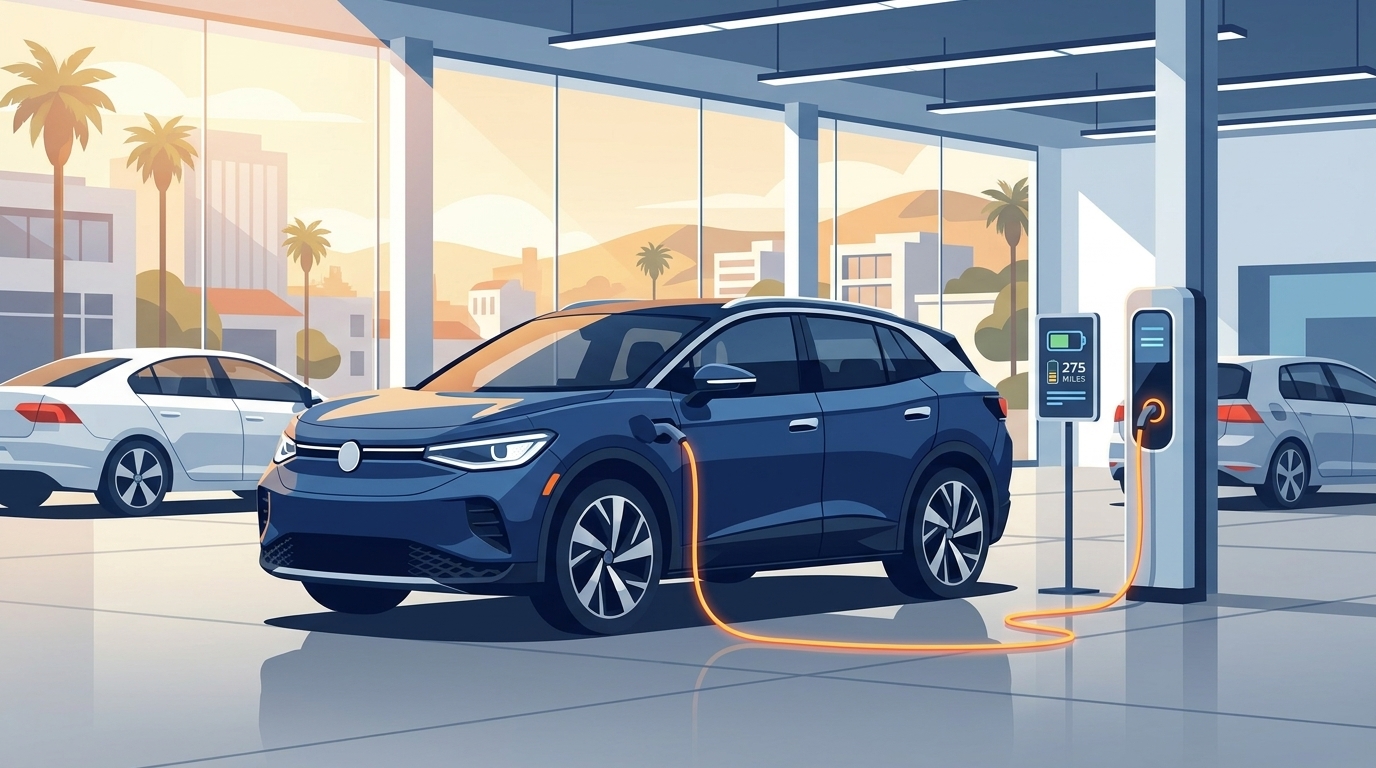
- You're leasing an EV like the ID.4. EV technology is still evolving quickly. Leasing lets you upgrade to the next generation of range and software in three years rather than being locked into today's specs for a decade.
- Your commute is predictable and contained. If you're driving from Sunnyvale to a Mountain View or Palo Alto office, you may stay well under 12,000 miles annually — the sweet spot for a standard lease.
- You want to keep cash free. Tech-sector buyers often prefer the lower monthly payment so they can deploy capital elsewhere.
- You like having a factory warranty for the entire ownership period. A 36-month lease lines up neatly with Volkswagen's bumper-to-bumper coverage.
Car Lease vs Finance: When Buying Pulls Ahead
Financing wins when you plan to keep the car well past the loan payoff. The cheapest year of car ownership is almost always year six or seven — when you own the car outright, the payment is gone, and you're only covering insurance, maintenance, and fuel.
Buying also makes sense if:
- You drive more than 15,000 miles per year (lease overage fees add up fast at 20–25 cents per mile)
- You want to modify the vehicle
- You're hard on interiors — kids, dogs, contractor gear, beach trips down to Santa Cruz
- You want the option to sell or trade whenever you choose, not on a lease's schedule
Over a 7–10 year horizon, buying a reliable Volkswagen and driving it past the loan term almost always beats back-to-back leases on total dollars spent.
Volkswagen Financing Comparison: A Sunnyvale Example
Let's run a simplified scenario for a 2026 Tiguan with a $32,000 negotiated price.
Lease path (36 months)
- Monthly payment: roughly $370
- Down payment: $2,500
- Total out-of-pocket over 36 months: about $15,800
- At month 37: you return the car, walk away, or buy it at the residual
Finance path (60 months)
- Monthly payment: roughly $560
- Down payment: $2,500
- Total out-of-pocket over 36 months: about $22,660
- At month 37: you still owe 24 payments but the car has real equity
On a strict 36-month comparison, leasing looks cheaper by about $6,800. But extend the timeline to 84 months and the picture flips — the finance buyer has a paid-off Tiguan worth around $14,000–$17,000, while the lease customer has either started a new lease (and a new payment) or written a check for the residual.
California-Specific Factors That Affect the Math
California treats vehicle transactions in ways that genuinely change calculator outputs, and Sunnyvale buyers should plug these in honestly:
- Sales tax on leases. In California, you generally pay sales tax on each monthly lease payment rather than on the full vehicle price upfront. This can soften the cash-flow hit of leasing compared to states that tax the entire vehicle at signing.
- Registration and license fees. California's vehicle license fee is value-based, so a more expensive Volkswagen carries higher annual registration costs whether you lease or buy.
- Smog and emissions. Newer leased VWs sidestep biennial smog checks during the early ownership years, a small but real convenience.
- EV incentives. Incentives for electric Volkswagens like the ID.4 change frequently at both the federal and California level. Confirm current eligibility with your dealer before assuming a credit will apply, since the rules around leased EVs and pass-through incentives have shifted in recent years.
How to Use the Calculator Honestly
Most people fudge two inputs and then wonder why their actual costs don't match the calculator's promise.
Be realistic about mileage
Sunnyvale traffic on the 101 and 237 corridors can push annual mileage higher than people expect, especially if you commute to San Jose or San Francisco. Track a typical month before committing to a 10,000-mile lease cap.
Be realistic about how long you keep cars
If your honest answer is "I trade every 3 years no matter what," leasing is almost always cheaper for you. If your honest answer is "I drove my last car until the wheels fell off," financing wins by a wide margin. Don't run the calculator assuming a 7-year hold if your behavior says 3.
Frequently Asked Questions
Is it better to lease or buy a Volkswagen in 2026?
It depends on your driving habits and how long you keep cars. Leasing usually saves money over a 3-year window and works well for EVs like the ID.4. Buying saves more over a 7+ year window, especially if you drive over 15,000 miles annually.
Can I buy my Volkswagen at the end of the lease?
Yes. Every Volkswagen lease includes a buyout option at the residual value stated in your contract. If the car's market value exceeds the residual at lease-end, buying it out can be a smart move.
What credit score do I need to lease a VW?
Volkswagen Credit's most competitive lease offers generally go to applicants with strong credit, but tiered programs exist for a range of profiles. A Sunnyvale Volkswagen finance specialist can pre-qualify you to show exactly which tier you'd land in.
Do lease payments include maintenance?
Standard wear and routine maintenance follow Volkswagen's recommended schedule. Some lease packages bundle scheduled maintenance — ask specifically when comparing offers.
Getting Help With the Decision
A calculator is a starting point, not a verdict. The version on a manufacturer site uses standardized residuals and money factors, but your actual offer depends on current incentives, your credit tier, the specific trim and options you want, and any loyalty or conquest programs in play that month.
Drivers in Sunnyvale, CA who want to see both paths modeled with real numbers — including current Volkswagen Credit lease programs and finance rates — can reach Sunnyvale Volkswagen at https://www.sunnyvalevw.com/ to walk through the math. The dealership's 4.4-star Google rating reflects a sales process customers describe as transparent and pressure-free, with one recent reviewer noting the experience was "smooth" and had "no hidden fees" — which is exactly the environment you want when comparing a lease structure against a finance structure dollar for dollar.