New vs Used Volkswagen: Which Should You Buy in Sunnyvale?
Comparing new 2026 Volkswagen models against used and CPO options in Sunnyvale, CA — pricing, warranty, depreciation, and tech weighed for Silicon Valley buyers.
Few car-buying questions matter more in Silicon Valley than whether to stretch for a brand-new vehicle or capture the savings of a used one. For Volkswagen shoppers in Sunnyvale, the math has shifted meaningfully for the 2026 model year: new VWs arrive with updated driver-assistance technology and reworked powertrains, while two- to four-year-old used and Certified Pre-Owned (CPO) examples sit at price points that can be 25–35% below equivalent new MSRPs. Neither path is universally correct. The right answer depends on how a buyer weighs upfront cost, warranty coverage, depreciation exposure, and the value of the newest safety features for daily commutes on US-101, I-280, and SR-85.
What follows is a dimension-by-dimension comparison built around the specifications and market realities most relevant to buyers in Sunnyvale and the broader Santa Clara County market.
Starting Price: Where Sunnyvale Buyers Feel the Biggest Gap
New 2026 Volkswagens span a wide MSRP range. The Jetta starts at $23,995, the Tiguan opens at $30,805, the Golf R commands $50,730, and the all-electric ID. Buzz tops the lineup at $59,995. Those figures exclude destination and handling charges, dealer-installed options, and California taxes and fees — a meaningful add in Santa Clara County. High-demand models such as the Golf R, ID.4, and certain Tiguan and Atlas trims can transact at or above sticker in the Bay Area early in the model year.
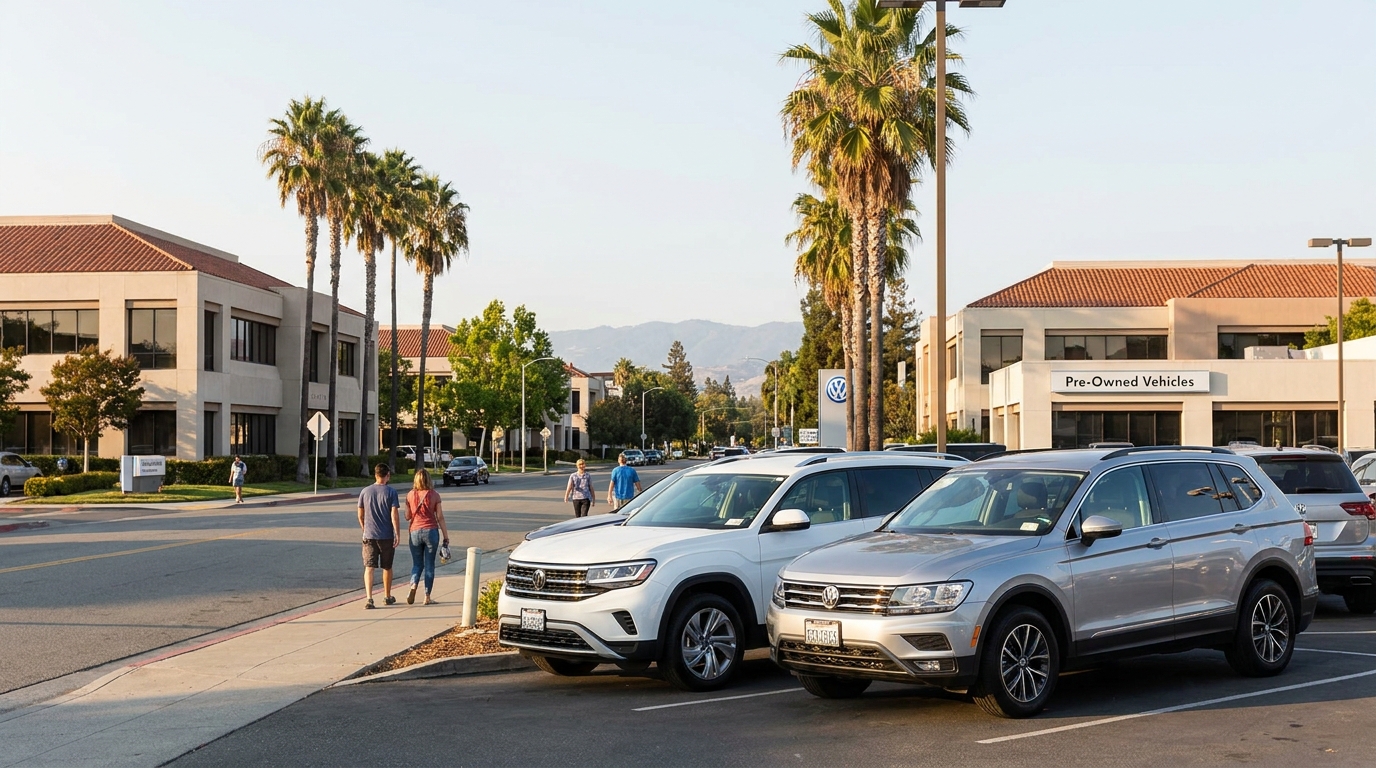
Used Volkswagens, especially CPO examples two to four years old, typically land 25–35% below the equivalent new MSRP. On a Tiguan, that gap alone can translate to thousands of dollars freed up for insurance, charging infrastructure at home, or simply a shorter loan. For value-focused Sunnyvale buyers, this is the single largest factor in favor of going used.
Powertrain and Performance
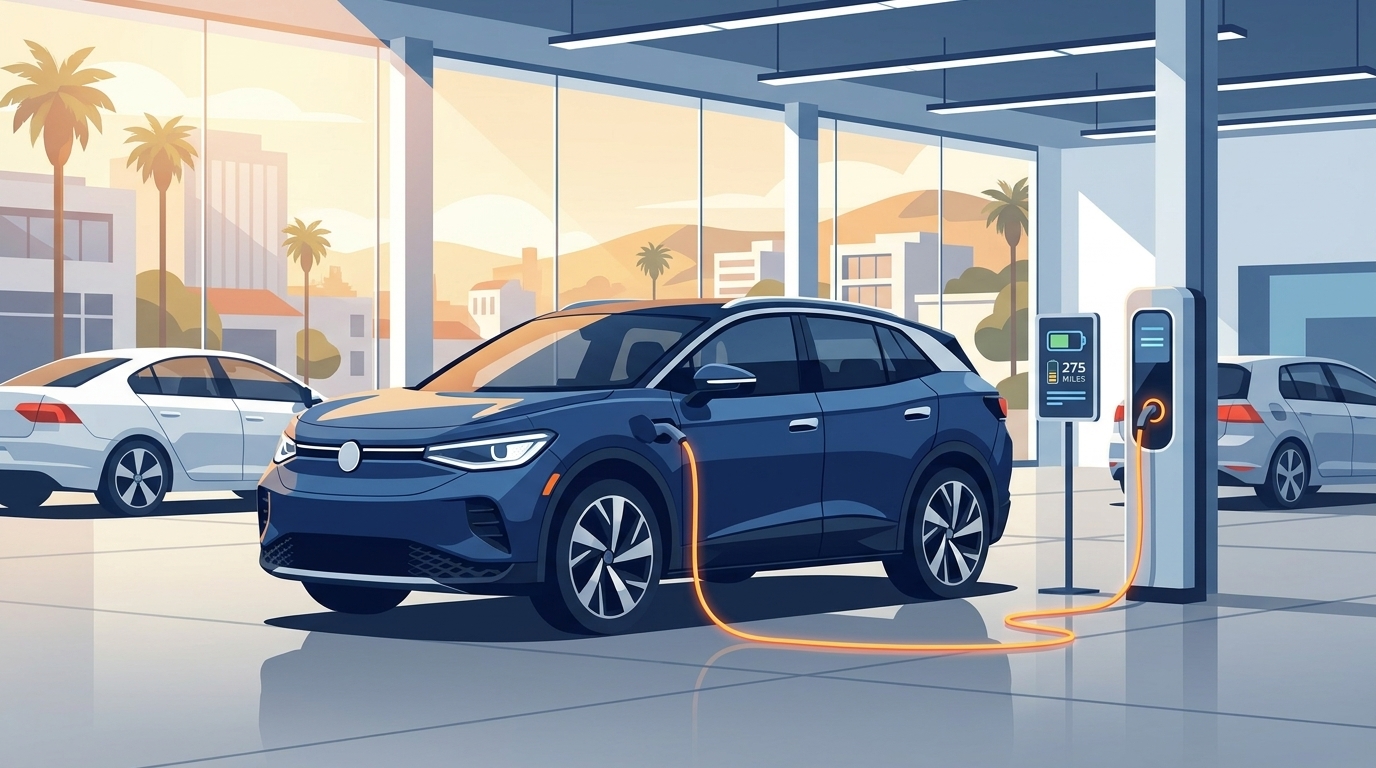
The 2026 lineup brings the latest VW powertrains. The Tiguan SEL R-Line Turbo uses the new EA888 evo5 engine producing 268 hp and 258 lb-ft of torque, while the standard Tiguan delivers 201 hp. The Golf R remains the performance flagship at 328 hp with 4MOTION all-wheel drive and a seven-speed dual-clutch transmission, hitting 0–60 mph in roughly 4.1 seconds. On the EV side, the 2026 ID.4 delivers up to 291 miles of EPA-estimated range on the Pro RWD trim.
Recent used models are close but not identical. A two- or three-year-old Golf R produces around 315 hp; recent GTI examples make 241–245 hp; older Tiguan generations sit near 184 hp. The performance delta is modest for most ICE shoppers, but it widens for EVs — early ID.4s have shorter range and older software than the 2026 car.
Fuel Efficiency and EV Range
The 2026 Jetta returns 33 mpg combined, the Tiguan FWD posts 29 mpg combined, the Golf R rates 25 mpg combined, and the Taos reaches up to 28/36 mpg city/highway. Recent used Jettas land in the 33–35 mpg combined range, recent GTIs around 27 mpg, and recent Tiguans in the mid- to high-20s. For ICE shoppers, the gap is small. For EV shoppers, however, range improvements over the past few model years are significant, and 2026 ID.4 buyers benefit from the longest factory-quoted range to date.
Warranty Coverage
New 2026 Tiguans carry a 4-year/50,000-mile new-vehicle limited warranty, and the ID.4's high-voltage battery is covered for 8 years/100,000 miles. CPO Volkswagens add 2 years/24,000 miles of coverage on top of the remaining factory warranty, plus 24/7 roadside assistance, and the ID.4 battery warranty continues from the original in-service date — meaning a used ID.4 buyer inherits only what remains of that 8-year clock.
For buyers who plan to keep the vehicle long after the warranty expires, the warranty advantage is real but not decisive. For buyers who prioritize predictable ownership costs in years one through four, new is the cleaner choice.
Safety and Driver-Assistance Technology
This is where 2026 pulls meaningfully ahead. The 2026 Tiguan introduces updated Travel Assist with Assisted Lane Change as standard equipment, and the Taos and Jetta gain rear-seat pretensioners. For Sunnyvale commuters who spend real time in stop-and-go traffic on 101 between Mountain View and San Jose, or who run SR-85 to South Bay employers, hands-on adaptive cruise with automated lane changes is a genuinely useful daily-driver feature.
Used 2026 and 2026 models offer much of the current ADAS suite, but lack the latest refinements. Older used VWs step further back in driver-assistance capability. Buyers who weight safety technology heavily should compare specific trim and model-year equipment carefully.
Depreciation and Long-Term Value
Depreciation is the quiet expense most new-car buyers underestimate. New vehicles absorb their steepest value loss in years one through three, and Bay Area insurance premiums compound the cost of ownership during that window. Used buyers sidestep that curve. Among Volkswagen SUVs, the 2026 VW Atlas posted a three-year resale value score of 82/100 per a J.D. Power-cited dealer source, which is competitive for the segment.
That said, depreciation is partially offset on new vehicles by a longer warranty horizon and the latest features. Buyers planning to keep a vehicle 8–10 years narrow the gap considerably.
Cargo and Practicality
Cargo numbers are essentially identical between new and used versions of the same generation. The 2026 Tiguan offers 33.8 cu ft behind the second row and 69.8 cu ft with seats folded; the Atlas reaches 96.8 cu ft; the Taos extends to 65.9 cu ft; the Jetta sedan holds 14 cu ft of trunk space. A 2026 or 2026 Tiguan of the same generation will measure within roughly the same envelope.
Customization and Inventory in Sunnyvale
New-vehicle buyers can specify exact configurations, including new 2026 colors such as Avocado Green Pearl two-tone on the Tiguan, or place a factory order. Used buyers are limited to existing inventory and may need to compromise on color or option packages. In Sunnyvale, high-demand models can be tight on dealer lots early in the model year, which is worth factoring into timing.
So Which Should Sunnyvale Buyers Choose?
Buyers who prioritize cutting-edge driver-assistance technology, EV range, full factory warranty, and the ability to spec the car they actually want will be better served by a new 2026 model. Buyers who prioritize lower upfront cost, reduced depreciation exposure, and a vehicle that has already absorbed its steepest value loss should look hard at CPO inventory — particularly given the 100+ point inspection, genuine VW parts in program repairs, and the 2-year/24,000-mile coverage extension.
Frequently Asked Questions
Is a CPO Volkswagen worth the premium over a non-certified used VW?
For most buyers, yes. The 2-year/24,000-mile added warranty, 100+ point inspection, and 24/7 roadside assistance address the largest risks of buying used. Non-certified used VWs are cheaper but carry only the remaining original factory warranty.
Do Bay Area dealer markups apply to used Volkswagens too?
Markups are most visible on high-demand new models like the Golf R and ID.4. Used pricing is driven more by mileage, condition, and local supply than by manufacturer allocation, so the dynamics differ.
How does California sales tax affect the new-versus-used calculation?
California applies sales tax to the full purchase price of the vehicle. Buyers should factor Santa Clara County's combined rate into total cost of ownership when comparing a new MSRP to a used asking price.
Where to Go From Here
Shoppers in Sunnyvale who want to compare a specific 2026 model against equivalent CPO inventory side by side can reach Sunnyvale Volkswagen at https://www.sunnyvalevw.com/ to review current stock, warranty terms, and out-the-door pricing for both paths. Walking the lot with a clear sense of which dimensions matter most — price, technology, warranty, or depreciation exposure — is the fastest way to land on the right Volkswagen for the next several years of Bay Area driving.