VW Lease vs Finance in Santa Clara, CA: 2026 Costs
How Santa Clara VW buyers should weigh leasing vs buying in 2026, including California use tax rules, EV exemptions, and monthly payment math.
For Santa Clara drivers shopping a Volkswagen in 2026, the lease-versus-buy decision comes down to three variables: how California taxes each transaction, how long the vehicle will stay in the household, and whether the model qualifies for the state's partial zero-emission vehicle sales and use tax exemption. Leasing generally produces a lower monthly payment and shifts residual-value risk to the lessor; buying builds equity and, for drivers who keep vehicles beyond the loan term, produces a lower total cost of ownership. The right answer in Santa Clara depends heavily on whether the VW in question is an ID.4 (which qualifies for the state EV tax break) or a gas model like a Jetta, Tiguan, or Atlas.
This guide walks through the actual cost mechanics under California law, using Santa Clara County's tax environment, so the comparison isn't abstract.
How California Taxes a VW Lease vs a Purchase
The single biggest structural difference between leasing and buying a Volkswagen in California is how sales and use tax is applied. When a Santa Clara buyer purchases a vehicle outright or finances it, California imposes sales or use tax on the full purchase price at the combined state and local rate for the buyer's registration location, per Revenue and Taxation Code §§ 6051 and 6201. There is no trade-in credit — the taxable base is the full sticker, not the price after any trade allowance.
Leases work differently. Under RTC § 6010(e)(5), a lease is treated as a continuing sale, and use tax is measured by the rentals payable — the monthly lease payments themselves — for each period the vehicle is located in California. The lessor collects and remits that tax with each payment. For a Santa Clara lessee, this means tax is spread across the lease term and calculated only on what is actually paid, not on the vehicle's full capitalized cost.
That distinction matters. On a $40,000 VW Tiguan, a cash or financed buyer pays Santa Clara County sales tax on the full $40,000 at closing. A lessee on the same vehicle pays tax only on each monthly payment as it is billed.
The California EV Tax Exemption and the VW ID.4
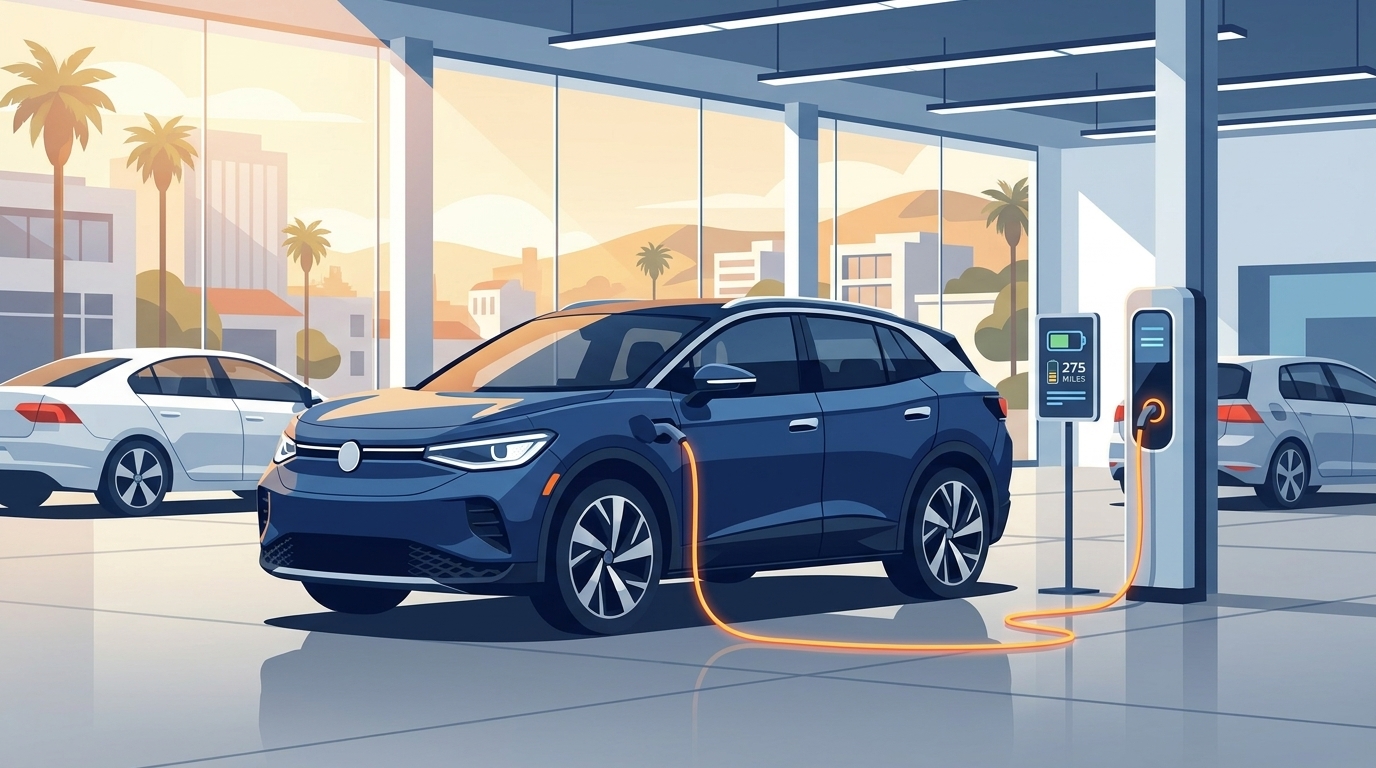
Volkswagen's ID.4 is the model where California tax policy tilts the math most decisively. Qualifying zero-emission and near-zero-emission vehicles receive a partial sales and use tax exemption of 3.9375 percentage points through December 31, 2027. That exemption applies to both purchases and leases, reducing the effective rate on lease payments as well as on outright buys.
For a Santa Clara ID.4 shopper, the exemption meaningfully narrows the gap between leasing and buying. On a lease, the reduced rate applies to every monthly rental payment. On a purchase, it applies once to the full capitalized cost. Buyers planning to keep an ID.4 long-term generally capture more absolute dollar savings from the exemption on a purchase; lessees still benefit, but on a smaller taxable base. Either way, this exemption is scheduled to expire at the end of 2027, and its rate and expiration are subject to legislative change — a factor worth weighing for anyone timing an ID.4 acquisition.
Monthly Payment Comparison: What Santa Clara Drivers Actually Pay
Lease payments in Santa Clara are almost always lower than finance payments on the same VW, because a lease only finances the depreciation between capitalized cost and residual value, not the full vehicle price. A 36-month lease on a Tiguan or ID.4 typically covers roughly the first third to half of the vehicle's expected depreciation curve, plus rent charge and monthly use tax.
A 60- or 72-month finance contract on the same vehicle spreads the full purchase price plus interest across a longer term, and California sales tax is paid up front (usually rolled into the amount financed). Monthly payments run higher, but at the end of the term the buyer owns the vehicle outright.
Rough directional math for a Santa Clara household comparing the two on a mid-trim VW:
- Lease (36 months): Lowest monthly outlay, use tax billed monthly on each payment, no equity at term end, mileage cap typically 10,000–15,000 per year.
- Finance (60–72 months): Higher monthly payment, full California sales tax paid at signing (or capitalized), full equity and no mileage cap, ownership at payoff.
- Cash purchase: No financing cost, full tax paid at closing on the full purchase price, maximum long-term value if the vehicle is held.
Lease-End Buyout: A Second Taxable Event
If a Santa Clara lessee decides to purchase the VW at lease end, California treats the buyout as a separate taxable purchase. Use tax is imposed on the residual/buyout price and is collected either by the lessor or assessed by DMV at registration in the lessee's name, under RTC §§ 6201–6203. Residual value itself is not taxed during the lease term — only if and when the purchase option is exercised.
This is the scenario that catches some lessees off guard. A driver who leases an ID.4, pays monthly use tax on rentals for 36 months, and then buys the car for its residual will pay use tax again on that residual amount. The two taxes are not double taxation in a legal sense — they cover different transactions — but the combined outlay can erode the leasing advantage for anyone who suspects they'll want to keep the car.
VW Lease Terms in California: What to Look For
California's Vehicle Leasing Act (Civil Code §§ 2985–2988) and the disclosure rules in Vehicle Code § 11713 require dealers to spell out capitalized cost, residual value, monthly payment components, fees, and tax treatment on the lease contract. Every VW lease in Santa Clara should show tax charged on each payment as a separate line, since the lessor is required to collect use tax from the lessee.
Before signing, Santa Clara lessees should verify:
- The capitalized cost matches the negotiated selling price, not MSRP.
- The money factor (lease equivalent of interest rate) is disclosed and reasonable.
- The residual value is realistic — higher residuals lower payments but reduce buyout appeal.
- Monthly use tax is broken out and calculated on the rental amount, not the full vehicle price.
- The mileage allowance fits actual driving patterns — Santa Clara commutes through the 101 and 237 corridors, or south into San Jose, add up quickly.
Should Santa Clara Drivers Lease or Buy a Volkswagen?
Lease if the household replaces vehicles every three or four years, wants the lowest monthly payment, drives predictable mileage, and prefers to spread California use tax across the term rather than paying it up front. Leasing is also worth considering for the ID.4 specifically, because the partial EV exemption applies to monthly payments and the technology in EVs continues to evolve quickly.
Buy if the plan is to keep the VW well past the typical loan term, drive high annual miles, or maximize long-term value. Purchasing an ID.4 before the December 31, 2027 expiration of the 3.9375-point EV exemption also captures that full tax break on the entire purchase price in a single transaction.
Frequently Asked Questions
Is a VW lease payment in California taxed on the full vehicle price?
No. Under RTC § 6010(e)(5), California use tax on a lease is measured by the rentals payable — the monthly lease payments — not the full vehicle price. The lessor collects that tax each month.
Do I get a trade-in tax credit when buying a Volkswagen in California?
No. California imposes sales or use tax on the full purchase price of the new vehicle, with no deduction for a trade-in. This is different from many other states and often surprises buyers relocating to California.
Does the California EV tax exemption apply to leases?
Yes. The 3.9375 percentage-point partial sales and use tax exemption for qualifying zero-emission and near-zero-emission vehicles applies to both purchases and leases, reducing the effective rate on lease payments, through December 31, 2027.
What happens if I move my leased VW out of California?
If the leased vehicle is relocated outside California and the registration address is updated to the out-of-state address of use, rentals payable for periods the vehicle is located outside California are not subject to California use tax, per CDTFA Annotation 330.2368. If registration isn't updated, the lessor must either continue collecting tax or retain a written explanation from the lessee.
Is the lease-end buyout taxed again?
Yes. A lease-end purchase option is treated as a separate taxable transaction. Use tax is imposed on the buyout/residual price and is collected by the lessor or by DMV at registration.
The Bottom Line for Santa Clara VW Shoppers
The lease-versus-buy question in Santa Clara has a clear structural answer: leasing minimizes monthly cash outlay and spreads California use tax across the term, while buying minimizes lifetime cost and captures the full EV tax exemption in a single stroke for ID.4 shoppers. The right choice depends on how long the vehicle will stay in the driveway and whether the model is electric.
Santa Clara drivers who want the numbers run against their specific credit tier, trade situation, and target VW model can work through the comparison with the team at Sunnyvale Volkswagen, which handles both lease and finance structuring for buyers across the South Bay. Bringing a written breakdown of capitalized cost, residual, money factor, and monthly tax line into any final decision is the surest way to know which path actually costs less — not on paper, but for the household making the payments.