VW ID.4 vs Tesla Model Y in Palo Alto, CA: 2026 Guide
Compare the 2026 VW ID.4 and Tesla Model Y for Palo Alto commutes — range, charging, price after incentives, and which fits Silicon Valley drivers best.
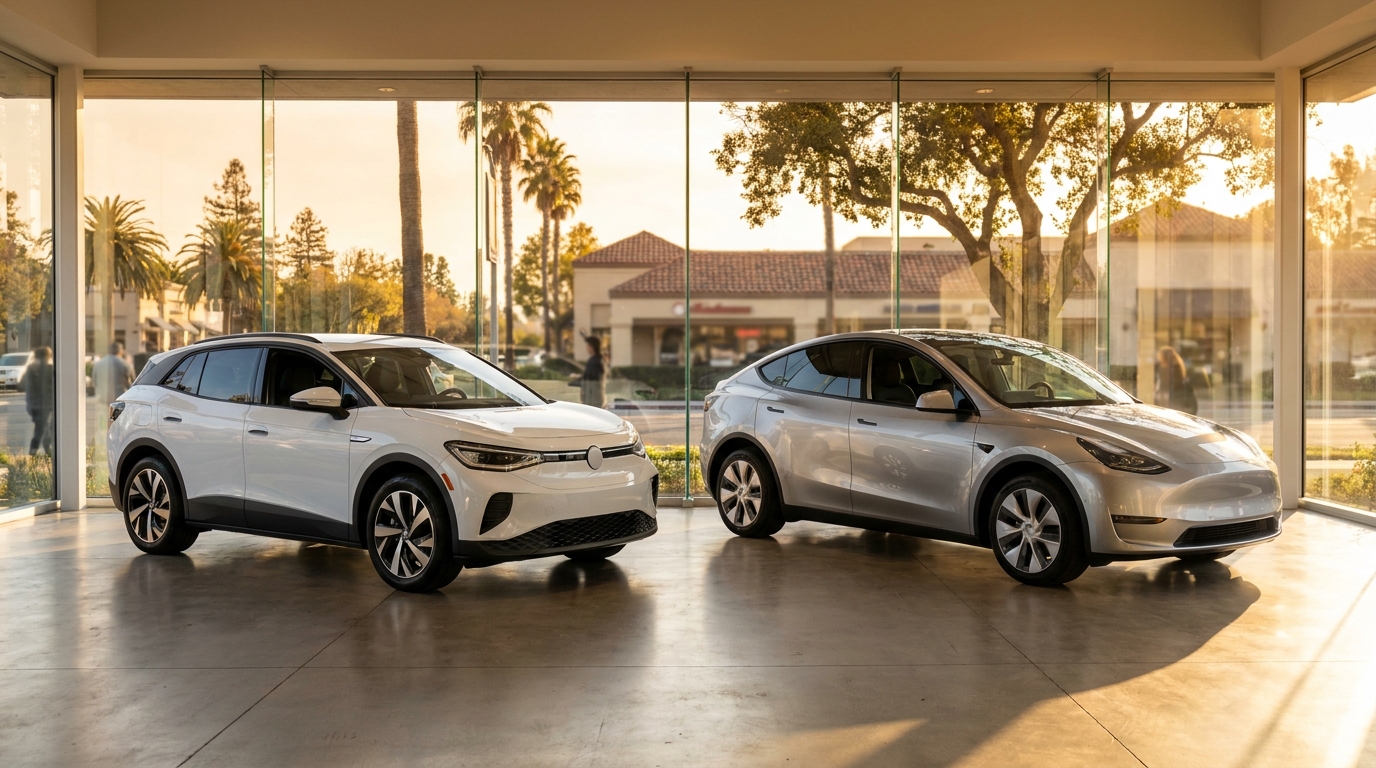
For Palo Alto drivers weighing the 2026 Volkswagen ID.4 against the 2026 Tesla Model Y, the short answer is this: the Model Y wins on range, charging speed, and raw performance, while the ID.4 wins on cabin familiarity, wireless Apple CarPlay and Android Auto, and negotiated transaction price. Frequent I-5 or Tahoe road-trippers will prefer the Model Y's Supercharger access; drivers replacing a conventional SUV who value physical controls and dealer relationships will find the ID.4 the better fit.
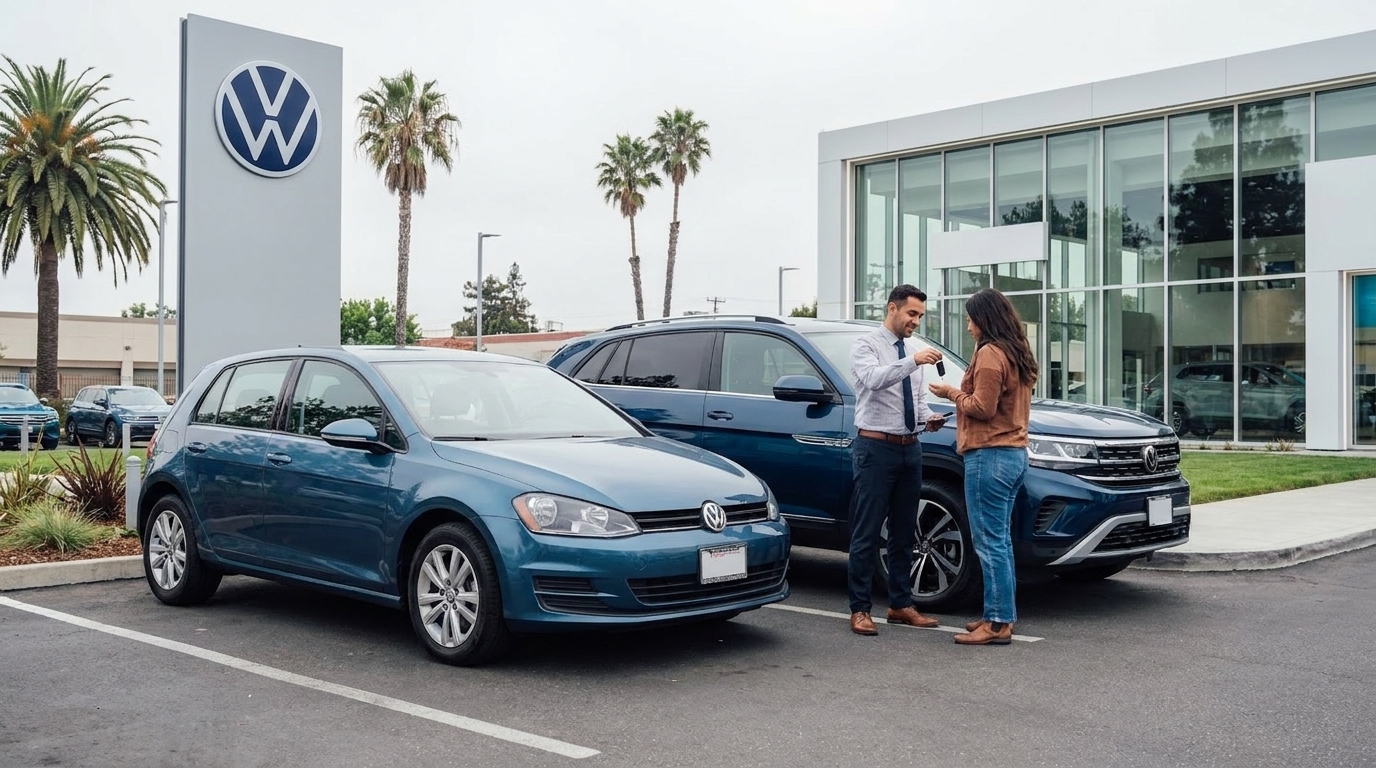
Both are five-passenger, two-row electric SUVs built on dedicated EV platforms, and both are readily available around the Peninsula — the ID.4 through franchised Volkswagen dealers including Sunnyvale Volkswagen just up El Camino Real, and the Model Y through Tesla's direct-sales model. The rest of this guide breaks down where each vehicle earns its case for a Palo Alto garage.
How do the 2026 VW ID.4 and Tesla Model Y compare at a glance?
The 2026 Tesla Model Y leads on range (up to 357 miles EPA for Long Range RWD vs. 291 miles for the ID.4 Pro RWD), DC fast charging (250 kW peak vs. 170–175 kW), efficiency (up to 138 MPGe vs. 113 MPGe), and starting MSRP (~$39,990 vs. $45,095). The ID.4 counters with standard wireless CarPlay and Android Auto, a more conventional cabin, and dealer-negotiated pricing.
| Spec | 2026 VW ID.4 | 2026 Tesla Model Y |
|---|---|---|
| Starting MSRP | $45,095–$46,570 (Pro RWD) | ~$39,990–$41,630 (Standard RWD) |
| EPA Range | 291 mi RWD / 263 mi AWD | Up to 357 mi RWD / 306–327 mi AWD |
| Horsepower | 282 hp RWD / 335 hp AWD | ~295–300 hp RWD / ~375–460 hp AWD |
| Peak DC Fast Charging | 170–175 kW (CCS) | 250 kW (NACS/Supercharger) |
| Combined Efficiency | 113 MPGe RWD / 102 MPGe AWD | ~123–138 MPGe |
| Max Cargo (seats folded) | ~64.2 cu ft | ~71–72 cu ft + 4.1 cu ft frunk |
| Phone Integration | Wireless CarPlay + Android Auto | None (Tesla native only) |
| Battery Warranty | 8 yr / 100,000 mi | 8 yr / 120,000–150,000 mi |
MSRPs above exclude Volkswagen's destination charge of approximately $1,475 and any Tesla order or delivery fees. Both vehicles' final transaction prices are moving targets — Tesla adjusts national pricing frequently, and Bay Area VW dealers routinely negotiate on ID.4 inventory.
Which EV has better range and charging for Bay Area driving?
The Tesla Model Y wins both range and charging for Palo Alto drivers. Its Long Range RWD variant achieves up to 357 miles EPA, while the ID.4 Pro RWD tops out at 291 miles. On DC fast charging, the Model Y accepts up to 250 kW at Superchargers (10–80% in roughly 15–27 minutes), compared to 170–175 kW peak on the ID.4's CCS port. For 101, 280, and I-5 corridor trips, the gap is meaningful.
Around Palo Alto itself, the range difference matters less. A typical commute from Midtown or Barron Park to a Stanford Research Park office, then home via Whole Foods on Emerson, will barely dent either battery. The Model Y's advantage shows up on the Tahoe or Los Angeles run, where Supercharger density along I-5 and 580 is still the most consistent fast-charging network in California.
The ID.4 relies primarily on Electrify America, EVgo, and ChargePoint stations — coverage on the Peninsula is reasonable, but reliability at individual stalls varies. VW's shift toward NACS adapters for future ID.4 models has been announced industry-wide, though buyers should confirm current adapter availability with their dealer at delivery.
How does performance and drivability differ?
The Tesla Model Y is quicker at every comparable trim. The Long Range AWD hits 60 mph in roughly 4.6 seconds and the Performance AWD in about 3.3–3.5 seconds, versus roughly 4.9–6.0 seconds for the ID.4 AWD and 6.4–7.5 seconds for the Pro RWD. Horsepower ranges from ~295–460 hp on the Model Y against 282–335 hp on the ID.4.
Drivability is where the character split shows up. The ID.4 rides softly, uses physical steering wheel buttons, and keeps a separate driver instrument cluster — it feels closer to a conventional Tiguan or Atlas from behind the wheel. The Model Y rides firmer (especially on Performance), routes nearly every function through its 15.4-inch center screen, and rewards drivers who enjoy sharper steering response.
What about interior tech and phone integration?
The 2026 Volkswagen ID.4 is the clear choice for anyone who wants Apple CarPlay or Android Auto. Both are standard and wireless, running on a 12.9-inch central screen with a separate gauge cluster. The 2026 Tesla Model Y offers neither — its 15.4-inch display runs Tesla's proprietary interface with over-the-air updates, native navigation, and integrated Supercharger routing, but no way to project a phone's native maps or messaging apps.
For Silicon Valley buyers who live inside Google Maps, Waze, Spotify, and Apple ecosystems, the ID.4's approach removes friction. For buyers who prefer a single integrated software environment and don't miss CarPlay, the Model Y's interface is more capable and updates more frequently.
Which EV is actually cheaper to buy in Palo Alto in 2026?
On sticker, the Tesla Model Y Standard RWD starts around $39,990–$41,630 — several thousand below the ID.4 Pro RWD's $45,095–$46,570 MSRP. On transaction price, the picture narrows or reverses. Tesla uses fixed national pricing with minimal negotiation, while Bay Area VW dealers frequently offer discounts and aggressive lease specials on ID.4 inventory, which can bring the effective monthly payment at or below a comparably equipped Model Y.
Palo Alto buyers should also factor in California-specific considerations: California charges sales tax on the full purchase price of a new vehicle rather than the trade-in-adjusted amount, and eligibility for the federal EV tax credit and any California rebate programs depends on evolving income and MSRP thresholds that buyers should verify with their tax advisor and the current CVRP or successor program guidelines before signing.
Sunnyvale Volkswagen, located on El Camino Real just north of Palo Alto, is one of the closest VW franchises for Peninsula shoppers cross-shopping the ID.4.
Cargo, towing, and warranty: which is more practical?
The Model Y offers more total cargo flexibility — approximately 71–72 cubic feet with seats folded plus a 4.1 cubic foot frunk, versus roughly 64.2 cubic feet maximum in the ID.4 (no frunk). Behind the rear seats, both sit in the 30–33 cubic foot range. The Model Y AWD is rated to tow up to 3,500 pounds; ID.4 tow ratings are not confirmed in current U.S. specifications.
Warranties are close but not identical. Both include 4-year/50,000-mile basic coverage and 8-year battery coverage, but Tesla's battery and drive unit warranty extends to 120,000–150,000 miles depending on configuration, versus 100,000 miles for the ID.4. Volkswagen offsets that with 2 years / 20,000 miles of complimentary scheduled maintenance — a real cost avoidance in the early ownership period.
Which EV is the better fit for a Palo Alto driver in 2026?
Choose the 2026 Tesla Model Y if long-distance range, Supercharger access, quicker acceleration, and a single integrated software environment matter most. Choose the 2026 Volkswagen ID.4 if wireless CarPlay/Android Auto, a conventional cabin with physical controls, a softer ride, and the ability to negotiate price or lease terms with a local dealer matter more. Both handle a Peninsula commute and weekend Santa Cruz run without stress.
A reasonable heuristic: households already deep in the Apple or Google ecosystem, or replacing a Tiguan, RAV4, or CR-V, lean ID.4. Households prioritizing road-trip range, resale liquidity, and tech-forward interfaces lean Model Y. Test-driving both back-to-back is the fastest way to settle the question — the interior philosophies are different enough that most buyers form a clear preference within an hour.
Frequently asked questions
Is the 2026 VW ID.4 or Tesla Model Y better for road trips from Palo Alto to Tahoe or LA?
The 2026 Tesla Model Y is better suited for long road trips from Palo Alto. It offers up to 357 miles of EPA range on the Long Range RWD, charges at up to 250 kW on the Supercharger network, and integrates route planning natively. The ID.4 peaks at 291 miles of range and 170–175 kW charging via CCS networks, which are usable but less consistent along I-5 and I-80.
Does the 2026 Volkswagen ID.4 have Apple CarPlay and Android Auto?
Yes. The 2026 Volkswagen ID.4 comes with wireless Apple CarPlay and wireless Android Auto standard on all trims, displayed on a 12.9-inch central touchscreen with a separate driver instrument cluster. The 2026 Tesla Model Y does not support Apple CarPlay or Android Auto; it uses Tesla's proprietary interface on a single 15.4-inch center screen.
How much does a 2026 VW ID.4 cost compared to a Tesla Model Y?
The 2026 Volkswagen ID.4 Pro RWD starts at $45,095–$46,570 before a destination charge of approximately $1,475. The 2026 Tesla Model Y Standard RWD starts at approximately $39,990–$41,630. Comparable AWD trims for both vehicles land in the $50,000–$58,000 range. Bay Area VW dealers frequently offer discounts or lease specials that can narrow the gap on transaction price.
Where can Palo Alto buyers test drive a 2026 Volkswagen ID.4?
Palo Alto buyers can test drive the 2026 Volkswagen ID.4 at franchised VW dealers on the Peninsula. Sunnyvale Volkswagen, located on El Camino Real just north of Palo Alto, carries current ID.4 inventory across the Pro, Pro S, and Pro S Plus trims.
What is the range difference between the ID.4 and the Model Y?
The 2026 Tesla Model Y Long Range RWD achieves up to 357 miles EPA, while the 2026 Volkswagen ID.4 Pro RWD is rated at 291 miles — a difference of roughly 66 miles. On AWD trims, the Model Y ranges from 306 to 327 miles versus 263 miles for the ID.4 AWD, a gap of approximately 40–60 miles. Both use an 82 kWh battery in the ID.4's case; Tesla does not publish exact pack sizes.
Does the Tesla Model Y or VW ID.4 have a better warranty?
Both offer 4-year/50,000-mile basic warranties and 8-year battery warranties. The 2026 Tesla Model Y covers its battery and drive unit for 120,000–150,000 miles depending on configuration, while the 2026 Volkswagen ID.4 caps battery coverage at 100,000 miles. The ID.4 adds 2 years or 20,000 miles of complimentary scheduled maintenance, which the Model Y does not include.
Can the 2026 VW ID.4 use Tesla Superchargers?
The 2026 Volkswagen ID.4 uses a CCS connector and does not natively use the Tesla NACS plug. Volkswagen has announced adapter and future-model NACS access as part of the industry-wide shift, but current 2026 ID.4 buyers should confirm adapter availability and Supercharger compatibility with their dealer at delivery. The 2026 Tesla Model Y uses NACS natively and accesses the full Supercharger network without an adapter.
The bottom line for Palo Alto shoppers
The 2026 Tesla Model Y is the stronger technical package on paper — more range, faster charging, quicker acceleration, and a lower starting sticker. The 2026 Volkswagen ID.4 is the stronger fit for buyers who want wireless CarPlay and Android Auto, a familiar SUV cabin, and the ability to negotiate the deal. Neither is universally correct; the right choice depends on how the vehicle will actually be used.
Peninsula readers who want to see an ID.4 in person, compare trims, or work through lease-versus-buy math with a franchised Volkswagen dealer can reach Sunnyvale Volkswagen at https://www.sunnyvalevw.com/ to schedule a test drive or request current inventory.