VW ID.4 Home Charging for Renters in Sunnyvale, CA (2026)
How Sunnyvale, CA renters charge a Volkswagen ID.4 at home: Level 1 vs Level 2, California tenant rights under Civil Code § 1947.6, and apartment options.
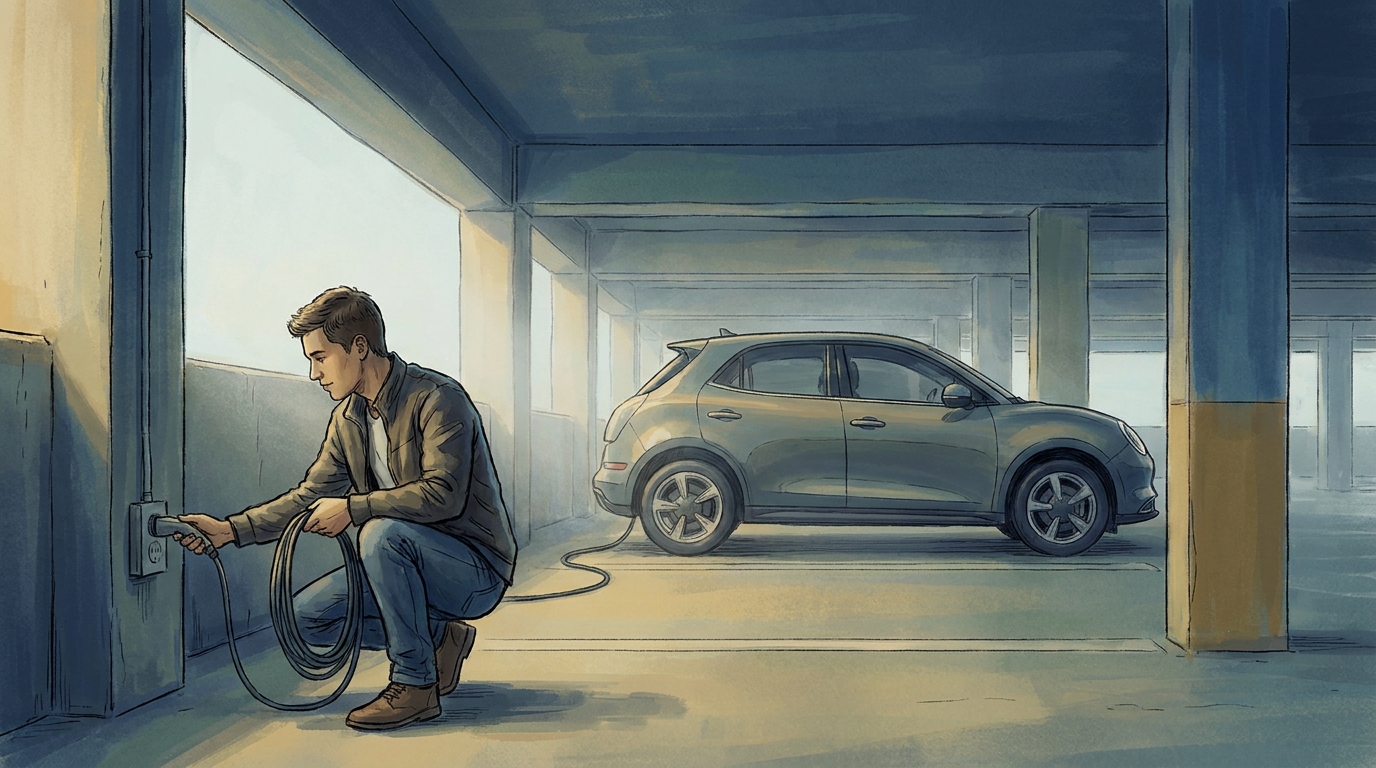
Sunnyvale renters can charge a Volkswagen ID.4 at home in two ways: plug into a standard 120-volt outlet at an assigned parking space for overnight Level 1 charging, or request that the landlord permit installation of a 240-volt Level 2 charger under California Civil Code § 1947.6. The right exists; the mechanics depend on your lease date, your parking assignment, and whether the building already has chargers installed.
That is the straight answer. The rest of this guide covers the hardware the ID.4 actually uses, what the law requires of your landlord or HOA, and how Sunnyvale's apartment-heavy housing stock changes the calculus compared with a single-family garage.
Can a Sunnyvale renter charge a Volkswagen ID.4 at home without a garage?
Yes. Any 120-volt outlet within reach of your assigned parking space supports Level 1 charging, which operates at 120 volts and 8–15 amps and can take 12–24 hours to charge an EV from low to full. For faster speeds, California law gives most tenants the right to request a Level 2 installation at their allotted space, subject to specific conditions.
In practice, Sunnyvale's mix of garden-style apartments, newer mid-rise buildings, and townhome-style condos each present different charging realities. A detached carport with no outlet is a different conversation than a subterranean garage with existing conduit.
What charging hardware does the 2026 Volkswagen ID.4 use?
The ID.4 accepts both AC Level 1/Level 2 charging through its onboard charger and DC fast charging through a CCS port. Level 1 chargers have a maximum output of about 1.1 kW, while many Level 2 chargers offer maximum outputs between 7.2 kW and 9.6 kW, with some delivering up to 11 kW or more. That difference is why Level 2 is the realistic home solution for daily driving.
Shoppers evaluating the 2026 Volkswagen ID.4, starting at $45,095 (as of October 2026) should think of charging hardware as part of the ownership budget, not the sticker. The vehicle itself ships ready for both levels; what varies is the outlet, the circuit, and the EVSE unit mounted on the wall. Sunnyvale Volkswagen can walk through the ID.4's onboard charger limits and the plug types that match a given parking situation before purchase.
Level 1 vs. Level 2: what Sunnyvale renters actually get
| Charging Level | Voltage | Typical Output | Time to Full Charge | Install Needed |
|---|---|---|---|---|
| Level 1 | 120 V | ~1.1 kW | 12–24 hours | Standard outlet |
| Level 2 | 240 V | 7.2–9.6 kW (up to 11+ kW) | Overnight | Dedicated 240 V circuit |
| Public DC Fast (CCS) | 400+ V | 50–350 kW | ~30–60 min to 80% | None (public) |
For reference on nearby public options, Level 2 public stations in Sunnyvale can be useful context if home install is delayed and you need to bridge with workplace or public charging.
What does California law require landlords to allow?
California Civil Code § 1947.6 requires landlords to approve a tenant's written request to install an EV charging station in the tenant's allotted parking space, provided the station complies with Article 625 of the California Electrical Code and the tenant agrees in writing to the landlord's installation, use, maintenance, and removal terms. This applies to leases executed, extended, or renewed on or after July 1, 2015.
The tenant pays the costs — permits, construction, electricity, maintenance, repair, removal, and replacement — and must generally carry personal liability insurance up to 10 times the annual rent. That insurance requirement is waived if the charging station is certified by an OSHA-approved Nationally Recognized Testing Laboratory and installed by a licensed electrician, which covers most mainstream residential EVSE units.
When § 1947.6 does not apply
- The landlord has already installed EV charging in at least 10% of designated parking spaces.
- Parking is not included in the tenant's lease.
- The property has fewer than five parking spaces.
- The property is subject to a residential rent-control ordinance — though this rent-control exception itself does not apply to leases executed, extended, or renewed on or after January 1, 2019.
The landlord is not required to provide an additional parking space to accommodate the installation. If your space is a tandem spot or a stacker, that constraint stays with you.
What if you live in a Sunnyvale condo instead of an apartment?
Condo residents fall under a separate section of the Civil Code that runs to unit owners rather than renters. A common-interest development may not prohibit or unreasonably restrict a unit owner's installation of an EV charging station in the owner's designated parking space or unit. The HOA must process the application without willful delay, and if it does not deny in writing within the statutory period after a complete application is submitted, the application is deemed approved.
For installations in common area or exclusive-use common area, the owner must use a licensed contractor, meet architectural standards, and carry a $1 million umbrella liability policy naming the association as an additional insured, according to afdc.energy.gov. A condo renter cannot invoke § 4745 directly against the HOA — the request has to come through the unit owner. An HOA that willfully violates the statute can face actual damages plus a civil penalty of up to $1,000.
Are there Sunnyvale-specific permitting or incentive programs?
California requires cities and counties to develop streamlined permitting processes for EV charging stations, which applies to permits pulled with the City of Sunnyvale for residential and multifamily installs. Separately, Silicon Valley Clean Energy offers incentives for installing EV chargers at multifamily properties, according to svcleanenergy.org — a detail worth mentioning to a landlord or HOA board that cites cost as the barrier.
For new ID.4 buyers, Electrify America has offered charging plans for eligible new VW ID.4 vehicles, according to electrifyamerica.com; program terms should be confirmed with the dealer at purchase. Program terms for later model years should be confirmed with the dealer at purchase.
How should a Sunnyvale renter actually sequence this?
Confirm your parking assignment is written into the lease, check whether your building already has 10% of spaces electrified (which would exempt the landlord from § 1947.6), and submit a written request that references the statute and names a UL-listed EVSE installed by a licensed electrician. Expect to pay for the permit, the circuit, and the unit yourself, and expect to carry liability insurance unless the UL-listed/licensed-electrician waiver applies.
Henry was a great help to me as a first time car buyer! He was very transparent and very knowledgeable, and made me feel very comfortable and confident with the purchase. Sunnyvale VW is a great place to get a new car, and Henry is definitely a great guy to do your business with!
Frequently asked questions
Can I just use a regular 120-volt outlet to charge my ID.4?
Yes. Level 1 charging uses a standard 120-volt outlet at 8–15 amps and adds a limited amount of range per hour. A full charge from low can take 12–24 hours, which works for drivers covering under 40 miles a day but struggles for longer commutes. Many Sunnyvale renters start on Level 1 and move to Level 2 once they confirm their routine.
Does my landlord have to pay for the Level 2 charger?
No. Under California Civil Code § 1947.6, the tenant bears all costs including the permit, construction, electricity, maintenance, repair, removal, and replacement. The landlord's obligation is to approve a compliant request and not unreasonably obstruct the installation, provided your lease was executed, extended, or renewed on or after July 1, 2015 and the other statutory conditions are met.
What if my apartment already has some EV chargers installed?
If the landlord has already installed EV charging stations in at least 10% of the designated parking spaces, § 1947.6 does not apply and the landlord is not required to approve additional installations at your space. In that scenario, your options are to request access to an existing shared charger, rely on Level 1 at your spot if an outlet is available, or use public charging.
Do condo HOAs in Sunnyvale have to allow EV chargers?
Under California Civil Code § 4745, a common-interest development may not prohibit or restrict the installation or use of EV chargers in a homeowner's designated parking space or unit. Reasonable restrictions are allowed, but they cannot significantly increase cost or decrease performance. If the HOA does not deny a complete application in writing within 60 days, it is deemed approved.
What's the maximum home charging speed the ID.4 supports?
Through AC Level 2, many home EVSE units deliver between 7.2 kW and 9.6 kW, with some capable of 11 kW or more depending on the vehicle's onboard charger and the circuit. For DC fast charging on public CCS stations, the ID.4 charges at substantially higher speeds — but DC fast charging is not a home-install option for renters.
What should I do before signing a lease if I plan to buy an ID.4?
Confirm in writing that parking is included in the lease, ask whether the property has five or more parking spaces, and ask whether any EV chargers are already installed and at what percentage of spaces. Those three facts determine whether Civil Code § 1947.6 gives you the right to install a Level 2 charger at your assigned space.
The bottom line for Sunnyvale renters
Home charging an ID.4 from a Sunnyvale apartment or condo is workable, but the path depends on your lease date, your parking assignment, and whether your building is already partially electrified. California law tilts in the tenant's favor for most post-July-2015 leases, but the tenant carries the costs and the insurance. Renters in Sunnyvale who want to walk through ID.4 charging options, confirm which EVSE pairs best with their parking situation, or review current purchase and charging-plan terms can reach Sunnyvale Volkswagen at 408-604-0990 or https://www.sunnyvalevw.com/ to get started.