VW Dealer Financing vs Credit Union Loan in Palo Alto, CA
Compare Volkswagen dealer financing against credit union auto loans in Palo Alto, with California disclosure rules, APR context, and negotiation tactics.
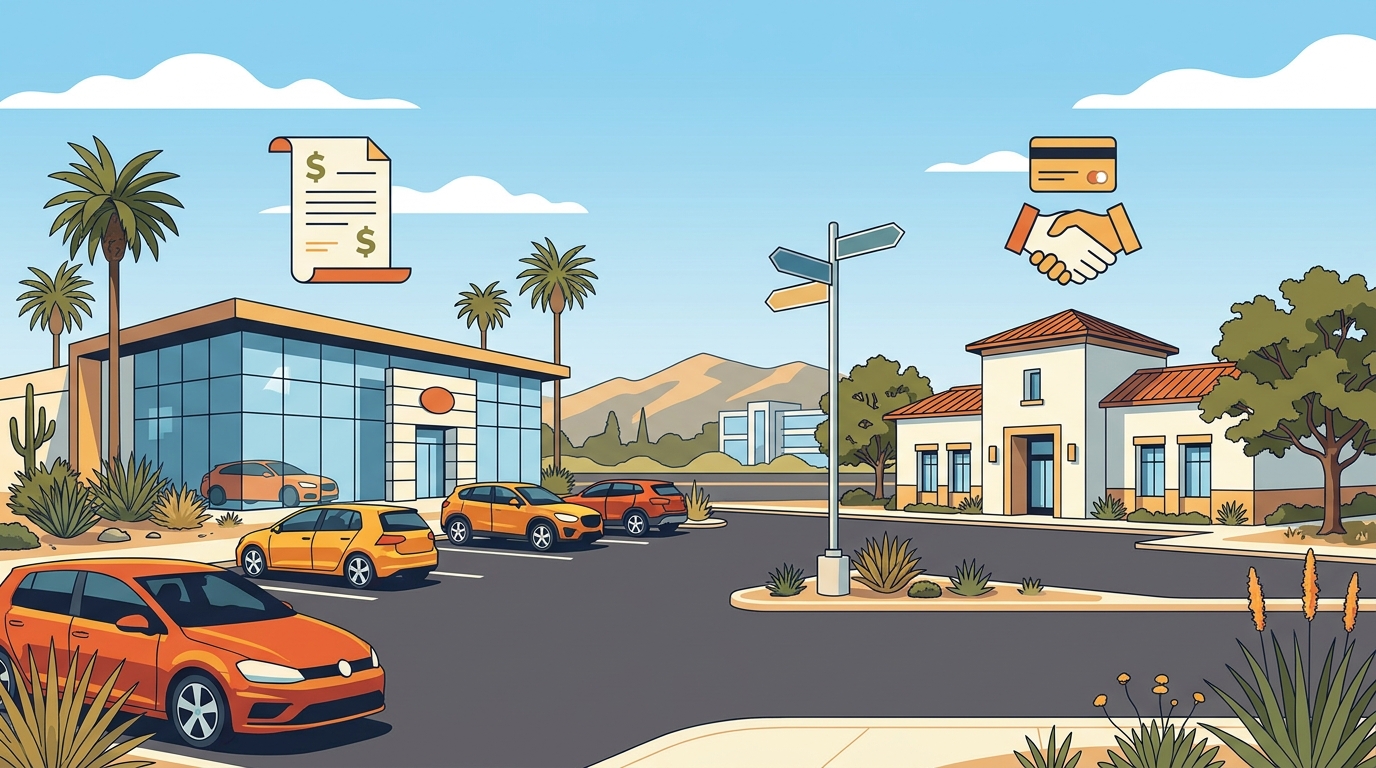
For most Palo Alto buyers, the cheaper auto loan in 2026 is whichever lender ends up with the lowest APR after the dealer has a chance to match — and that answer depends on credit tier, promotional manufacturer rates, and how disciplined the buyer is about reading the contract. Credit unions typically publish tighter, more transparent rate sheets; Volkswagen dealer financing can undercut them when VW Credit is running subvented promotional APRs on specific models. The right move is to arrive pre-approved and let the two compete.
This comparison lays out how each channel actually prices a loan, what California's new disclosure rules mean for the negotiation, and where financially sophisticated buyers along the Peninsula tend to come out ahead.
The Short Answer: Which Rate Usually Wins in 2026?
Credit unions win on baseline rates for well-qualified borrowers; dealer financing wins when the manufacturer is buying down the rate. Bay Area credit unions serving Palo Alto — including institutions tied to Stanford and the broader tech workforce — routinely quote among the lowest new-auto APRs in California because they operate as not-for-profit cooperatives and are exempt from the rate-cap provisions of the California Financing Law (Fin. Code § 22000 et seq.) that apply to non-bank lenders.
Volkswagen dealer financing runs through VW Credit, Inc. and a panel of bank lenders. On models VW is trying to move, promotional APRs can drop below what any credit union will match. On standard financing without a manufacturer subvention, the dealer rate typically includes a small markup known as dealer reserve — the spread between the buy rate the lender quotes the dealer and the sell rate offered to the customer.
How Volkswagen Dealer Financing Actually Works
Dealer financing is indirect lending: the dealership takes the application, shops it to multiple lenders, and presents the customer with an offer. California does not cap dealer reserve by statute, but the practice is regulated indirectly through disclosure and misrepresentation rules under the Consumer Legal Remedies Act (Civ. Code § 1750 et seq.) and the Unfair Competition Law (Bus. & Prof. Code § 17200 et seq.).
The upside is convenience and access to captive-lender promotions. VW Credit periodically offers subvented APRs on specific trims or model years — rates a credit union structurally cannot beat because the manufacturer is subsidizing the difference. The downside on non-promotional deals is that the sell rate may sit 100 to 250 basis points above the buy rate unless the buyer negotiates.
What California's CARS Act Changes
and operative October 1, 2026, reshapes how dealers must present financing. Under the new regime, dealers must disclose the total vehicle price in advertisements and the first written communication referencing a specific vehicle, and must retain those records for at least two years.
When the conversation turns to monthly payments, dealers are required to disclose the total amount the consumer will pay at that payment level, disclose that lower monthly payments often increase the total paid, and clearly flag any extended loan term used to produce a lower payment. Misrepresentations about financing terms, credit approval likelihood, and optional add-ons — service contracts, GAP, credit insurance — are prohibited outright, and dealers cannot charge for add-ons that provide no real, measurable benefit.
How Credit Union Auto Loans Compare
Credit unions win on predictability. A pre-approval letter from a Palo Alto–area credit union states a firm APR, term, and maximum loan amount before the buyer sets foot on a lot. Because banks and credit unions making direct auto loans are generally exempt from California Financing Law rate provisions, they set rates competitively against each other — not against a statutory ceiling.
The tradeoff is that credit unions do not offer manufacturer subvention. If Volkswagen is running a promotional APR on a specific Jetta or Tiguan trim, the credit union rate will look higher on paper. Credit unions also cannot bundle rebates the way a captive lender sometimes can, though in most VW promotions the buyer must choose between the low APR and the cash rebate — not both.
Side-by-Side: Where Each Channel Wins
- Best baseline APR for strong credit: Credit union, in most non-promotional scenarios.
- Best rate on a subvented VW model: Dealer financing through VW Credit.
- Most transparent rate quote: Credit union pre-approval, with a stated APR before vehicle selection.
- Fastest close on a Saturday: Dealer financing, particularly when the buyer wants to drive home the same day.
- Strongest protection against rate markup: Arriving with a credit union pre-approval and asking the dealer to beat it in writing.
- Access to manufacturer cash rebates: Dealer, though these typically cannot be stacked with promotional APRs.
The Palo Alto Buyer Profile
Buyers in Palo Alto, Menlo Park, and the surrounding Midpeninsula corridor tend to arrive at the dealership already pre-approved — often through a Stanford-affiliated credit union, an employer-linked cooperative, or a national online bank. That pattern is the single biggest reason the local market rewards a two-quote strategy: the credit union sets the floor, and the dealer either matches, beats, or loses the financing portion of the deal.
Bay Area buyers should also weigh California's sales tax treatment, which does not credit trade-in value against the taxable purchase price — the tax is calculated on the full price of the new vehicle. That structure makes the financed amount larger than buyers coming from trade-in-credit states expect, which in turn magnifies the APR difference between lenders over the life of the loan.
How to Run the Comparison Correctly
- Get a credit union pre-approval first. Lock in an APR, term, and maximum amount in writing before shopping.
- Ask the dealer for the buy rate, not just the sell rate. Under CARS Act rules operative October 1, 2026, misrepresenting financing terms is prohibited; a straightforward request for the lender's quoted APR should be honored.
- Separate the price negotiation from the financing negotiation. Settle the total vehicle price — which must be disclosed under the CARS Act — before discussing monthly payment structures.
- Compare total cost, not monthly payment. A 72- or 84-month term can produce a lower monthly figure while adding thousands to the total; the CARS Act now requires that tradeoff be disclosed.
- Scrutinize add-ons line by line. Service contracts, GAP, tire-and-wheel, and paint protection must be presented as optional, and cannot be charged if they provide no measurable benefit.
Frequently Asked Questions
Is dealer financing always more expensive than a credit union loan?
No. On non-promotional financing, credit unions usually offer lower APRs, but Volkswagen dealer financing can beat any credit union when VW Credit is running a subvented promotional rate on a specific model.
Does California cap auto loan interest rates?
There is no general statewide numeric APR cap on auto loans made by banks, credit unions, or most finance companies in California. Rate cap provisions under the California Financing Law apply primarily to certain non-bank consumer loan products and not uniformly to retail auto installment contracts.
Can a dealer change the APR after I take the car home?
Conditional-delivery (or "yo-yo") practices are constrained under California consumer protection law. Dealers using conditional delivery must disclose in writing that the sale is conditional and specify the exact conditions; if financing cannot be secured, the dealer must notify the buyer, return any trade-in, and refund the down payment.
What if I negotiated in Spanish, Chinese, Vietnamese, Korean, or Tagalog?
Under Civil Code § 1632, when an auto sales or financing contract is primarily negotiated in one of those languages, the dealer must provide a translation of the contract terms — including price, APR, payment schedule, and add-ons — in that language before the contract is signed.
The Bottom Line for Palo Alto Buyers
The winning rate is whichever lender the buyer forces to compete. A credit union pre-approval establishes the benchmark; the dealer either matches it, produces a subvented manufacturer rate that beats it, or steps aside on the financing while still earning the vehicle sale. Under the CARS Act framework taking effect October 1, 2026, the disclosures required at the dealership make that comparison substantially easier to run in real time.
Palo Alto buyers who want to see both quotes side by side on a specific Volkswagen can reach Sunnyvale Volkswagen at https://www.sunnyvalevw.com/ to structure the deal — bring the credit union pre-approval, ask for the dealer's best financing offer in writing, and choose whichever total cost is lower.