VW Dealer Financing vs. Bank Loan in Sunnyvale, CA
Compare VW dealer financing and bank auto loans in Sunnyvale, CA — how California's dealer reserve caps, CARS Act disclosures, and rate shopping affect savings.
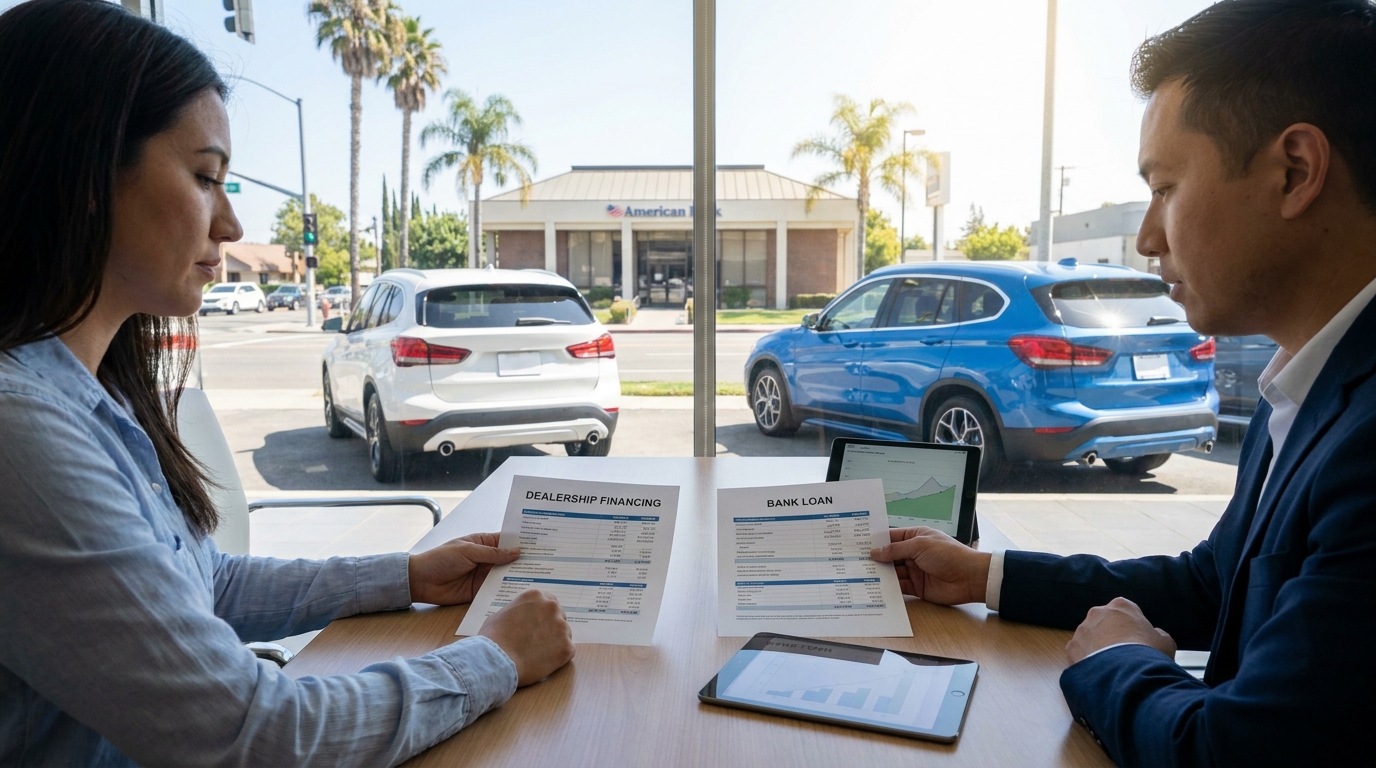
For most Sunnyvale buyers, the cheaper option is whichever lender offers the lowest APR after a same-day rate comparison — and California law now makes that comparison easier. Dealer financing often wins on convenience and manufacturer incentives (like subvented VW Credit rates), while bank loans typically win when a buyer has strong credit and no promotional dealer rate is available. The right answer depends on the specific offer sheet in front of you, not on a general rule.
How does VW dealer financing actually work in Sunnyvale?
Dealer financing in Sunnyvale is indirect lending: the dealership submits a credit application to multiple finance sources — including VW Credit, banks, and credit unions — then presents the buyer with an approved offer. Under California's Car Buyer's Bill of Rights, a dealer's compensation from that finance institution is capped at 2% of the purchase amount for loan terms longer than 60 months, and 2.5% for terms of 60 months or shorter.
That cap matters. It limits how much markup — commonly called "dealer reserve" — a dealership can add above the bank's buy rate before presenting the sell rate to the buyer. Two exceptions apply: the caps do not govern assignments where the dealer bears the entire financial risk, or where the contract is assigned more than six months after signing.
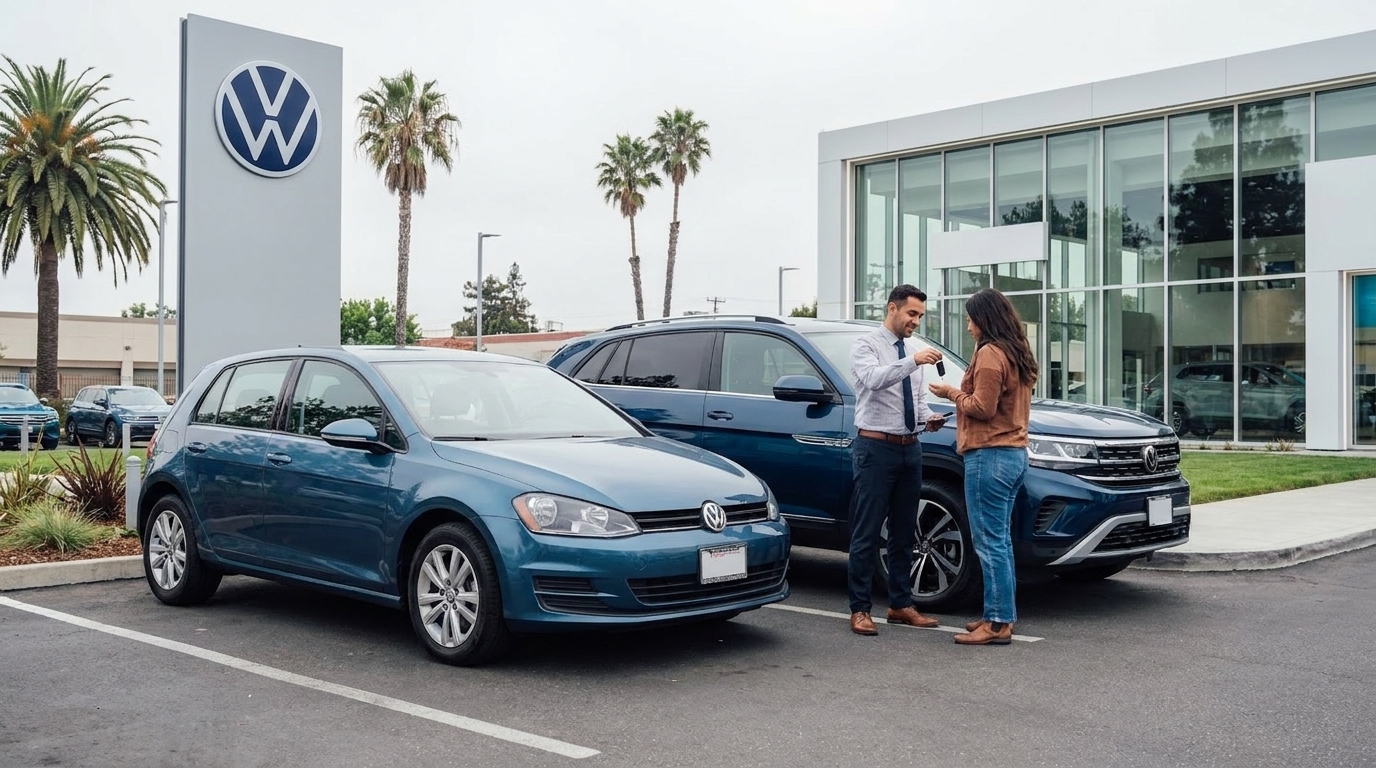
At a Volkswagen store like Sunnyvale Volkswagen on El Camino Real, the finance office typically presents the strongest of several bank offers alongside any promotional VW Credit APR the buyer qualifies for. When a manufacturer subvented rate is active — for example, a promotional APR on a Jetta, Tiguan, or ID.4 — dealer financing can undercut what any Sunnyvale-area bank would offer on the same term.
How does a bank auto loan compare for Sunnyvale buyers?
A bank auto loan is direct lending: the buyer applies to a bank before or during the purchase, receives a pre-approval with a fixed APR and maximum amount, and brings that pre-approval to the dealership as a cash-equivalent offer. There is no dealer reserve markup because the dealer is not a party to the loan.
For borrowers with strong credit profiles common in the South Bay tech corridor, national banks and Bay Area regional banks often quote competitive new-car APRs. Bank loans also decouple the financing conversation from the vehicle negotiation, which some buyers find simpler.
The tradeoff is that a bank pre-approval cannot match a manufacturer incentive rate. If VW Credit is running a promotional APR on a specific 2026 model, a bank at market rate will usually lose that comparison on total interest paid.
What does California's CARS Act change for financing disclosures in 2026?
Under, dealers must disclose a vehicle's total price clearly and conspicuously in any advertisement or first written communication referencing a specific vehicle, monetary amount, or financing term. Full dealer compliance is expected by October 2026. When a monthly payment is quoted in writing during negotiation, the total amount the consumer will pay across all scheduled payments must also be disclosed in writing.
If that total assumes a cash down payment or trade-in, the assumed consideration must be disclosed. Any written comparison of payment options that shows lower monthly payments must warn that lower payments often increase total cost, and if the lower payment comes from a longer term, the extended term must be disclosed. Add-on products — service contracts, GAP, paint protection — must be disclosed as optional and cannot be misrepresented as required for financing.
For Sunnyvale buyers, the practical effect is that dealer financing offers must now be presented in a format that makes total-cost comparison against a bank loan straightforward. Dealers must retain the first written communication disclosing total price for at least two years and provide it on written request. Where negotiations happen primarily in Spanish, Chinese, or another Civil Code § 1632 language, the same disclosures must be provided in that language.
Which option usually saves more money?
Neither wins by default — the savings depend on three variables: the buyer's credit tier, whether VW Credit has an active subvented APR on the target model, and the loan term. In Sunnyvale, buyers with 720+ FICO scores comparing a promotional VW Credit rate against a bank offer will often find dealer financing cheaper; buyers without access to a promotional rate will often find a bank match or beat the dealer's quoted APR.
| Factor | Dealer Financing (VW Credit / Bank via Dealer) | Direct Bank Loan |
|---|---|---|
| Access to manufacturer promotional APR | Yes — subvented rates on select VW models | No |
| Dealer reserve markup possible | Yes, capped at 2% (>60 mo) or 2.5% (≤60 mo) under CA law | No |
| Rate shopping across multiple lenders | Handled by dealer F&I office in one application | Buyer shops individually before purchase |
| Negotiation leverage at dealership | Combined with vehicle price talks | Pre-approval acts as a cash-equivalent offer |
| Total-cost disclosure (CARS Act) | Required in writing when payments are quoted | Provided in the bank's TILA disclosure |
The most effective approach for Sunnyvale buyers is to secure a bank pre-approval first, then let the dealer's finance office try to beat it. That converts the dealer financing conversation into a competitive bid rather than a take-it-or-leave-it offer, and it works within — rather than against — the CARS Act disclosure framework.
What should Sunnyvale buyers look for in a VW dealership's finance office?
Transparency in the numbers is what separates a straightforward finance office from a frustrating one. Buyers should expect an itemized conditional sale contract showing cash price, additional charges, amount financed, finance charge, and APR — the itemization California requires under Civil Code § 2982, and which SB 766 extends even where federal TILA would not otherwise apply.
A straightforward finance office will reflect a pattern buyers value: a no-pressure quote process and a full cost breakdown before any signature. The exact disclosure behavior the CARS Act now codifies as a baseline expectation across California is a complete breakdown of total cost rather than a monthly payment quoted without context.
Buyers should also confirm that any add-ons — extended service contracts, tire-and-wheel, GAP — are presented as optional and priced separately from the vehicle and financing. That separation is required by SB 766 and is a reliable indicator of a compliant finance office.
Frequently Asked Questions
Is dealer financing always more expensive than a bank loan in California?
No. California caps dealer reserve compensation at 2% of the purchase amount for terms over 60 months and 2.5% for terms of 60 months or shorter, which limits markup. When VW Credit offers a promotional subvented APR, dealer financing often beats a market-rate bank loan. The cheapest option is whichever lender presents the lowest total finance charge on the same term.
Can a Sunnyvale buyer bring a bank pre-approval and still negotiate with the dealer?
Yes, and it is usually the strongest strategy. A bank pre-approval acts as a cash-equivalent benchmark. The dealership's finance office can then attempt to match or beat that APR through its lender network or a VW Credit program. Under California's CARS Act, any written comparison of payment options must disclose total cost, making a side-by-side evaluation easier.
What disclosures must a VW dealer provide when quoting a monthly payment?
Under Civil Code § 1784.41, when a dealer makes any written representation of a monthly payment during negotiation, they must clearly and conspicuously disclose in writing the total amount the buyer will pay after all scheduled payments. If that total assumes a down payment or trade-in, the assumed amount must also be disclosed. Add-ons must be identified as optional.
Does California law limit how much a dealer can mark up an interest rate?
Yes. The Car Buyer's Bill of Rights caps dealer compensation from a finance institution at 2% of the purchase amount for loan terms greater than 60 months, and 2.5% for terms of 60 months or shorter. Two narrow exceptions apply: when the dealer bears the entire financial risk, or when the contract is assigned more than six months after signing.
When does dealer financing beat a bank loan on a Volkswagen?
Dealer financing typically wins when VW Credit is running a manufacturer-subvented APR on the target model and the buyer qualifies for the top credit tier. Promotional rates on models like the Jetta, Tiguan, or ID.4 can fall well below any market bank rate. Outside of promotional periods, bank loans often match or beat dealer quotes.
What paperwork should a Sunnyvale buyer keep after financing a VW?
Buyers should retain the signed conditional sale contract, all itemized disclosures, and the first written communication disclosing the total vehicle price. California requires dealers to retain that first written communication for at least two years and provide a copy on written request. Finance contracts must be kept for the contract term or seven years, whichever is longer, for DMV compliance.
The bottom line for Sunnyvale VW buyers
The savings winner between VW dealer financing and a bank loan is decided one deal at a time — by credit tier, active manufacturer incentives, and the specific term chosen. California's dealer reserve caps and the CARS Act's total-cost disclosure requirements give Sunnyvale buyers more information to compare than buyers in most other states, which makes a direct side-by-side the smart move rather than defaulting to either channel. Readers in Sunnyvale, CA who want a fully itemized comparison against their own bank pre-approval can reach Sunnyvale Volkswagen at https://www.sunnyvalevw.com/ to work through the numbers with the finance office.