EV Range on One Charge: Santa Clara, CA Commuter Guide
Real-world EV range for Santa Clara commuters in 2026: how far top models go on 101 and 280, charging costs, climate impact, and buying advice.

For most Santa Clara commuters, a modern EV will cover 200 to 320 EPA-rated miles on a single charge, which translates to roughly 170 to 270 real-world miles at highway speeds. Given typical daily round-trips of 30 to 80 miles between Santa Clara, North San Jose, and San Francisco, that means multiple days between charges is the norm — not the exception — when home or workplace charging is available.
Range anxiety remains the loudest objection to going electric, but in Silicon Valley the math has quietly shifted. The question is no longer whether an EV can handle a daily commute; it's which EV makes the most economic sense given local charging costs, mild coastal weather, and the density of the Bay Area's public network.
How far can an electric car actually go on one charge in Santa Clara?
Most current mainstream EVs deliver 200 to 320 miles of EPA-rated range. In Santa Clara's mild, coastal-influenced climate, drivers typically achieve 80 to 85% of that sticker figure on highway-dominated routes — so a 291-mile EPA rating translates to roughly 230 to 245 real-world miles. That's enough for three to seven days of typical commuting between charges.
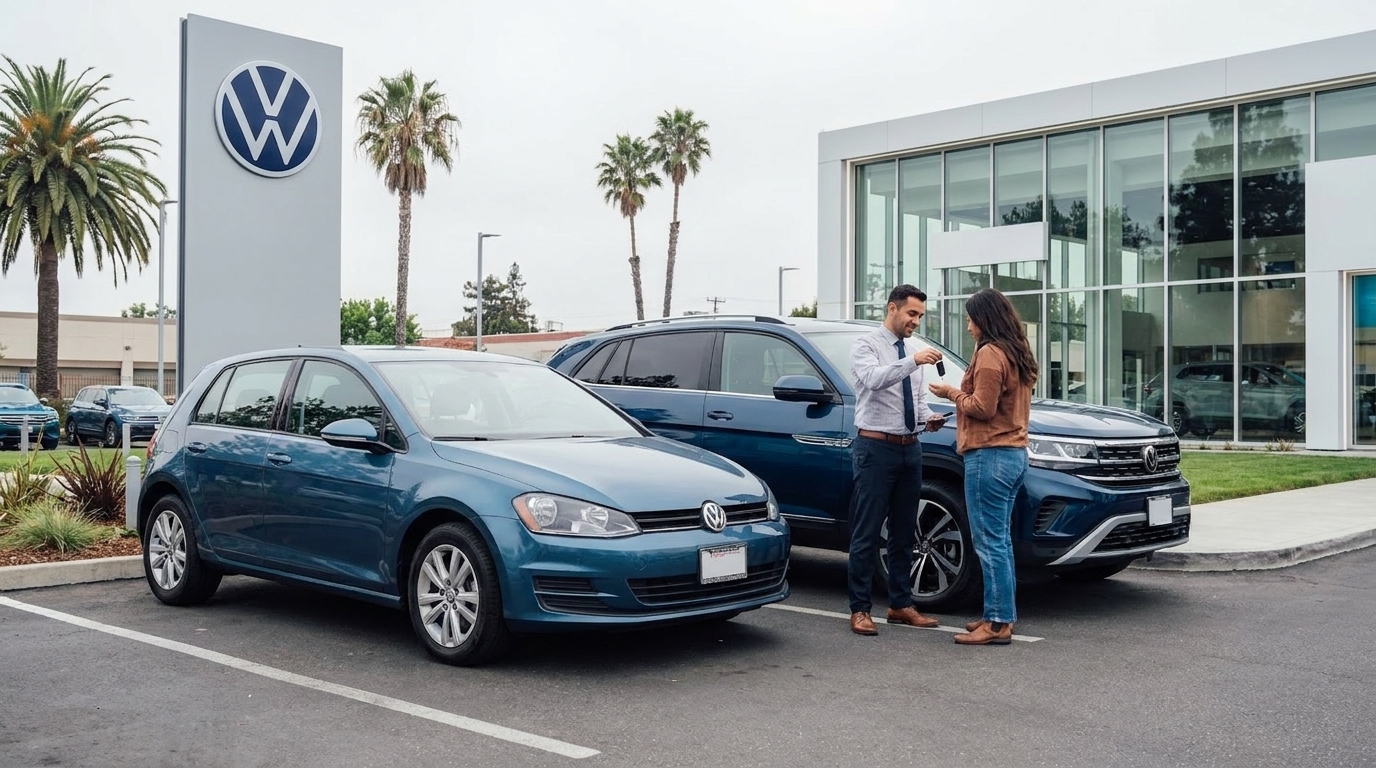
The 2026 VW ID.4, which Sunnyvale Volkswagen stocks and configures for local buyers, is rated up to 291 miles EPA in rear-wheel-drive form and 263 miles in all-wheel-drive form. The 2026 Chevy Equinox EV lands between 250 and 319 miles from its 85-kWh pack. The 2026 Ford Mustang Mach-E offers 260 miles in its standard-range rear-wheel-drive trim and up to 320 miles in the extended-range version.
These figures matter less than the pattern they describe: any EV in this class comfortably absorbs a 30 to 80 mile Santa Clara round-trip with headroom for detours, HVAC use, and the occasional Highway 17 run down to Santa Cruz.
Why does real-world range fall below the EPA sticker?
Real-world range consistently trails EPA estimates because the test cycle underweights sustained highway speeds, aggressive HVAC use, and cold-battery inefficiency. Consumer Reports testing found that half of 26 EVs evaluated failed to meet their EPA range, some by more than 50 miles. Planning around 80 to 85% of the sticker figure is the safer approach for US-101 and I-280 commutes.
Speed is the dominant variable. Aerodynamic drag rises with the square of velocity, so a Mach-E cruising at 75 mph on I-880 uses meaningfully more energy per mile than the same car at 55 mph on El Camino Real. Climate control matters too, though Santa Clara's mild coastal-influenced weather is genuinely kind to batteries — range penalties here are smaller than in hotter inland areas like Santa Clarita or the Central Valley.
Which EVs make the most sense for Silicon Valley commuters in 2026?
For a Santa Clara commuter driving 40 to 60 miles daily, a value-priced electric SUV under $50,000 — such as the 2026 VW ID.4 or the 2026 Chevy Equinox EV — hits the sweet spot of range, cargo, and total cost of ownership. Extended-range options like the Mach-E Premium ER (above $50,000) make sense mainly for drivers with longer commutes or frequent Sacramento and Central Coast trips.
| Model (2026) | EPA Range | Segment | Price Bracket |
|---|---|---|---|
| VW ID.4 (RWD) | Up to 291 mi | Value electric SUV | Under $50,000 |
| VW ID.4 (AWD) | 263 mi | Value electric SUV | Under $50,000 |
| Chevy Equinox EV | ~250–319 mi | Value electric SUV | Under $50,000 |
| Ford Mustang Mach-E (Std RWD) | 260 mi | Electric crossover | Under $50,000 |
| Ford Mustang Mach-E (ER RWD) | Up to 320 mi | Extended-range crossover | $50,000+ |
The used-EV market in Santa Clara is genuinely mature. Two-to-four-year-old Teslas, Bolt EUVs, Kona EVs, ID.4s, and Ioniq 5s in the 200 to 300 mile range routinely list between $20,000 and $35,000. Shorter-range first-generation cars — early Leafs, Fiat 500e, Spark EV — sit between $10,000 and $19,000 but are only practical as second cars or ultra-short commuters.
What does charging actually cost a Santa Clara EV commuter?
Home Level 2 charging at Silicon Valley Clean Energy time-of-use rates runs roughly $40 to $109 per month for about 1,000 miles of driving, based on rates of $0.16 to $0.33 per kWh. Public DC fast charging in the Bay Area costs $0.30 to $0.40+ per kWh, translating to $20 to $65+ per session — a premium supplement, not a primary strategy.
The economics only work when home or workplace charging carries the bulk of the load. Fortunately, the density of tech-campus workplace charging along the Great America corridor, plus SVCE's TOU rates for off-peak home charging, put Santa Clara in a stronger position than most U.S. markets. Silicon Valley Clean Energy also offers a $2,000 EV rebate to qualifying customers, and a state rebate up to $1,750 may apply for EVs under $25,000.
Federal EV tax credits have been described as terminated for 2026 purchases in current analysis, and California's broad-based rebate has closed. Any incentive should be verified with SVCE and state agencies directly before signing, since these programs change frequently.
How long do EV batteries last, and does range degrade in this climate?
Modern EV battery packs generally show gradual capacity fade of a few percent per year rather than sudden failure. Santa Clara's mild, coastal-influenced climate is favorable — batteries degrade faster in sustained heat, which is why inland California markets see steeper long-term range loss than the Bay Area.
For used-EV shoppers, this matters. A 2026 ID.4 that has spent its life garaged in Sunnyvale, Cupertino, or Mountain View will generally show stronger battery health than an equivalent car from Fresno or Bakersfield. Sunnyvale Volkswagen sees this pattern directly in the certified used inventory that cycles through its lot — as one recent reviewer noted after driving two hours to buy a used ID.4 Pro S, the local market's condition and pricing can justify the trip.
What local factors should influence the buying decision?
Santa Clara commuters should weigh four local-specific factors: the density of workplace charging along the Highway 101 and Great America corridor, SVCE's TOU rates and $2,000 rebate, California's HOV clean-air vehicle sticker access on Bay Area express lanes, and the high share of multi-unit housing that makes home charging harder for renters. California building standards increasingly require EV-ready parking in new construction, which is gradually easing that last constraint.
The California Advanced Clean Cars / ZEV program also guarantees strong local model supply — dealers in Santa Clara County generally have deeper EV inventory than dealers in states without ZEV mandates, which affects both new-car selection and used-market liquidity. Resale values remain reasonably strong, which is why range and DC fast-charging capability should factor into the purchase decision even for buyers who plan to keep the car only a few years.
Frequently asked questions
How far can an electric car go on one charge for a typical Santa Clara commuter?
Most current mainstream EVs are rated 200 to 320 miles EPA, which translates to roughly 170 to 270 real-world highway miles. Given typical Santa Clara round-trips of 30 to 80 miles, most drivers with home or workplace charging go three to seven days between charges. Longer-range trims like the Mach-E ER (up to 320 miles) and ID.4 RWD (up to 291 miles) offer the most cushion.
What is the best EV to buy near me in Santa Clara under $50,000?
For Santa Clara commuters under $50,000, the 2026 VW ID.4 (up to 291 miles RWD) and the 2026 Chevy Equinox EV (roughly 250–319 miles) are the strongest value picks. Both offer enough range for multi-day commuting between charges, standard DC fast-charging capability, and cargo room suited to Silicon Valley family duty. The Mustang Mach-E standard-range RWD (260 miles) sits in the same bracket.
How long do electric car batteries last in the Bay Area?
and generally lose a few percent of capacity per year with normal use. Santa Clara's mild coastal-influenced climate is favorable for battery longevity compared to hotter inland California markets, so used EVs sourced locally tend to retain more usable range than equivalent cars from the Central Valley or Southern California interior.
What is the best electric SUV for the money in 2026?
The 2026 VW ID.4 and 2026 Chevy Equinox EV both deliver 250-plus miles of range, standard fast charging, and pricing under $50,000, making them strong value picks in the electric SUV segment. Extended-range options like the Mach-E Premium ER (up to 320 miles, $50,000+) make sense mainly for buyers with longer commutes or regular out-of-region travel.
How much does it cost to charge an EV monthly in Santa Clara?
Home Level 2 charging costs roughly $40 to $109 per month for about 1,000 miles of driving, based on Silicon Valley Clean Energy time-of-use rates of $0.16 to $0.33 per kWh. Public DC fast charging is more expensive at $0.30 to $0.40+ per kWh, or $20 to $65+ per session, and should be treated as a supplement rather than a primary charging strategy.
Where can I find an electric vehicle dealership near me in Santa Clara?
Sunnyvale Volkswagen, located in the Sunnyvale–Santa Clara corridor, stocks and configures the 2026 VW ID.4 for local commuters. Buyers can browse inventory and schedule test drives at https://www.sunnyvalevw.com/. Reviewers consistently cite transparent pricing and a pressure-free purchase process.
The bottom line for Santa Clara EV shoppers
Range anxiety is largely a solved problem for Santa Clara commuters. A 250-mile EV, charged at home or work on SVCE off-peak rates, handles almost any Silicon Valley duty cycle with room to spare — and the Bay Area's dense fast-charging network covers the occasional longer trip. The harder questions are which model fits the budget, which trim balances range against price, and whether current incentives make new or used the better path.
Readers in Santa Clara who want to compare the 2026 ID.4 configuration options in person, or evaluate a certified used ID.4 against other mainstream crossovers, can reach Sunnyvale Volkswagen at https://www.sunnyvalevw.com/ to schedule a test drive or discuss trade-in and financing options.