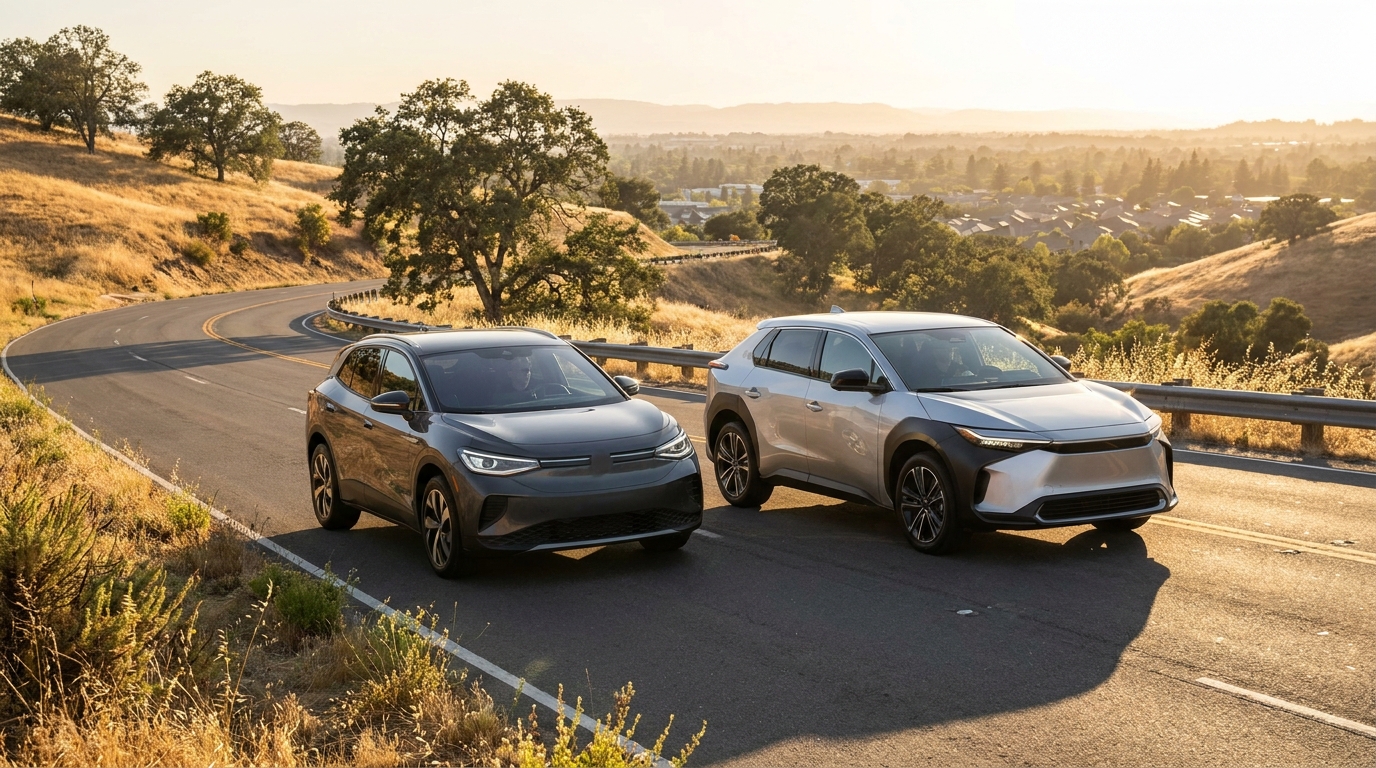
VW Taos vs Tiguan: Choosing the Right Volkswagen SUV for You
Compare the 2026 VW Taos vs Tiguan on price, size, cargo, and power. A Palo Alto buyer's guide to choosing the right Volkswagen SUV.

Buyers walking into a Volkswagen showroom in the Bay Area increasingly narrow their decision to two SUVs: the 2026 Taos and the 2026 Tiguan. Both share Volkswagen's Germanic design language, turbocharged efficiency, and five-passenger practicality — but they solve meaningfully different problems. The Taos is the compact, city-friendly commuter; the Tiguan is the more powerful, more spacious family hauler. For drivers navigating Palo Alto's mix of dense downtown streets, El Camino Real traffic, and weekend runs down to Half Moon Bay or up to Tahoe, the right answer depends on how the vehicle will actually be used.
This comparison breaks down the two SUVs across the dimensions that matter most: price, fuel economy, power, cargo, size, and drivability. It's written for buyers already committed to the Volkswagen brand who want a clear-eyed look at the tradeoffs before visiting a dealer.
Price: Where the Two Volkswagens Diverge
The 2026 Volkswagen Taos starts at $26,500 MSRP, while the 2026 Tiguan starts at $30,805 — a gap of roughly $4,300 before options, destination charges, California sales tax, and DMV registration fees are added. National average transaction prices tell a similar story: buyers are paying approximately $26,194 for the Taos and $29,993 for the Tiguan.
In the Palo Alto market, out-the-door pricing will run higher than sticker due to California's sales tax structure and county registration fees. Buyers should also note that California taxes the full purchase price of a new vehicle rather than the difference after a trade-in — a detail worth factoring into any budget comparison between the two models.
Size Difference: Taos vs Tiguan Dimensions
The size gap between these two SUVs is more significant than the shared VW badge suggests. The Taos measures roughly 175.9 inches long with a turning circle of about 35.1 feet and a curb weight near 3,201 pounds. The Tiguan stretches to approximately 184.4 inches, with a wider 38.1-foot turning circle and a curb weight around 3,563 pounds.
That 8.5-inch length difference matters in practice. Palo Alto residents parking along University Avenue, threading through the older residential grids of Professorville or Crescent Park, or squeezing into the compact stalls at Stanford Shopping Center will notice the Taos is materially easier to maneuver. The Tiguan is still a compact SUV by U.S. standards, but the tighter turning radius and shorter footprint of the Taos give it a real advantage in dense urban settings.
Cargo Space: Taos vs Tiguan for Families and Gear
Cargo capacity is where the Tiguan starts to justify its price premium. The 2026 Tiguan offers 33.8 cubic feet behind the second row and 69.8 cubic feet with the seats folded. The Taos provides 27.9 cubic feet behind the rear seats and 65.9 cubic feet with them folded.
For a couple with one child, a dog, and weekend gear, the Taos is generally sufficient. For families managing strollers, sports equipment, Costco runs, and airport luggage all in the same week, the Tiguan's extra room behind the second row — nearly six additional cubic feet — is meaningful. Both vehicles are configured as two-row, five-passenger SUVs for 2026, so buyers who need a true third row will need to look elsewhere in the Volkswagen lineup.
Engine, Power, and Fuel Economy
The Taos runs a 1.5-liter turbocharged four-cylinder producing 174 horsepower and 184 lb-ft of torque — one output level across all four trims (S, SE, SE Black, and SEL). It delivers up to 31 mpg combined in front-wheel-drive form and 28 mpg combined with all-wheel drive.
The Tiguan uses a 2.0-liter turbocharged inline-four with two output levels: 201 horsepower on the S, SE, and SE R-Line Black trims, and a more assertive 268 horsepower with 258 lb-ft of torque on the top SEL R-Line Turbo. Fuel economy comes in at 29 mpg combined for the FWD S trim, dropping to about 25 mpg combined on AWD and higher trims.
For commuters running Highway 101 or 280 daily, the Taos's efficiency advantage adds up over a lease term. For drivers who regularly climb into the Santa Cruz Mountains, merge onto Bay Area freeways with confidence, or want a genuinely quick daily driver, the Tiguan — particularly the 268-hp SEL R-Line Turbo — is the more satisfying vehicle to drive.
Towing and Utility
The Tiguan offers a manufacturer-rated towing capacity of roughly 1,500 to 1,800 pounds when properly equipped, enough for a small utility trailer, a pair of jet skis, or lightweight recreational gear. The Taos carries no manufacturer towing rating and is not recommended for towing. Buyers with any towing needs should confirm equipment requirements with the dealer and consult the owner's manual for specifics.
Interior Refinement and Ride Quality
Both vehicles use Volkswagen's current interior design language, but reviewers and owners consistently note that the Tiguan feels more refined — quieter at highway speed, with a more composed ride and higher-quality cabin materials. The Taos is competent and well-equipped for its price class, but it doesn't hide its status as the more affordable option. For buyers whose daily drive includes long highway stretches, the Tiguan's refinement is worth a test drive comparison.
Which Volkswagen SUV Is Right for You?
The decision generally comes down to three questions:
- How much cargo and passenger room do you actually need? If a compact hatchback-sized cargo hold is enough, the Taos delivers real savings. If you're regularly loading gear for four adults, the Tiguan earns its extra footprint.
- How important is power? The Taos's 174 hp is adequate; the Tiguan's 201 or 268 hp is genuinely enjoyable. Bay Area on-ramps and mountain passes reward the extra output.
- Where will you park it most often? Downtown Palo Alto, Stanford campus lots, and older residential garages favor the shorter, tighter-turning Taos. Suburban driveways and typical shopping-center parking accommodate either.
Frequently Asked Questions
Is the VW Taos or Tiguan better for Palo Alto commuting?
The Taos is the more efficient and easier-to-park choice for pure commuting, with up to 31 mpg combined and a tighter turning circle. The Tiguan is the better long-distance highway cruiser thanks to its more powerful engine and more refined ride.
How much more cargo space does the Tiguan offer over the Taos?
The Tiguan provides 33.8 cubic feet behind the rear seats versus 27.9 in the Taos, and 69.8 cubic feet with seats folded versus 65.9 in the Taos.
Do the Taos and Tiguan share the same warranty?
Yes — both 2026 models come with Volkswagen's 4-year / 50,000-mile new vehicle limited warranty.
Can the VW Tiguan tow a small trailer?
When properly equipped, the 2026 Tiguan is rated to tow approximately 1,500 to 1,800 pounds. The Taos is not manufacturer-rated for towing.
The Bottom Line for Palo Alto Buyers
The Taos is the smarter buy for urban commuters, small households, and drivers who prioritize efficiency and easy parking. The Tiguan is the better fit for families, drivers who want more power, and anyone who needs meaningful cargo room or light towing capability. Neither is objectively better — they're built for different buyers.
Palo Alto drivers who want to compare both SUVs back-to-back can arrange test drives and get local out-the-door pricing through Sunnyvale Volkswagen at https://www.sunnyvalevw.com/. Driving the two on the same afternoon — ideally on a mix of surface streets and freeway — is the fastest way to feel the size, power, and refinement differences described above.