VW Check Engine Light: Diagnose It in Santa Clara, CA
Learn how Santa Clara VW owners can read fault codes, interpret common triggers, and decide whether to drive or stop before booking service.
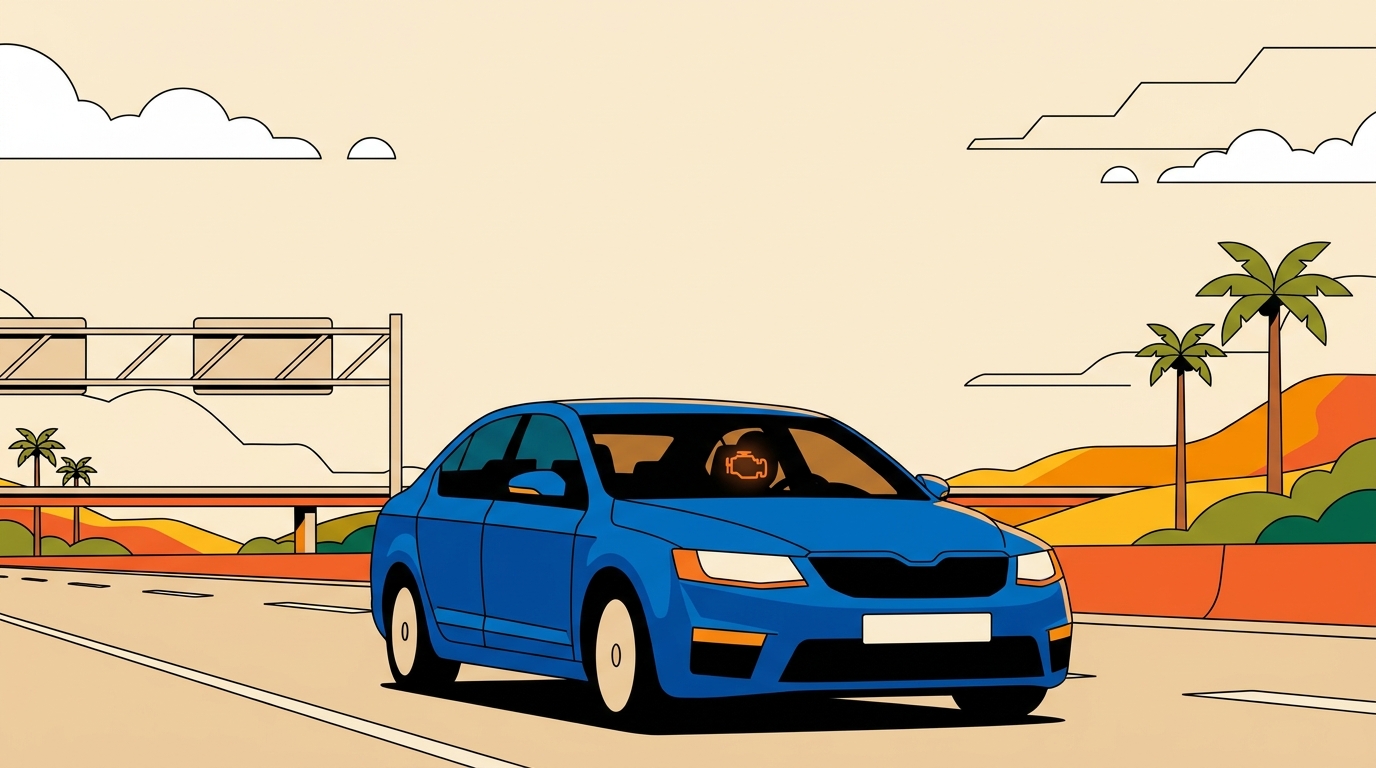
When a Volkswagen check engine light illuminates in Santa Clara, CA, the first diagnostic step is to note whether the light is steady or flashing. A steady amber light generally means the vehicle can be driven cautiously to a scan; a flashing light indicates active misfire or catalytic damage risk and warrants pulling over. An OBD-II scanner plugged into the port beneath the driver-side dash will read the specific fault code that pinpoints the issue.
What does a VW check engine light actually mean in 2026?
A VW check engine light is the powertrain control module signaling that a monitored sensor or system has reported a value outside its expected range. The module stores a five-character diagnostic trouble code (DTC) — for example, P0301 for a cylinder-1 misfire — that identifies the fault. The light itself is a summary; the code is the diagnosis.
On modern Volkswagens sold through dealerships like Sunnyvale Volkswagen, the onboard diagnostics system monitors more than 100 parameters, from oxygen sensor voltage to evaporative system pressure. The light does not distinguish between a loose gas cap and a failing catalytic converter — only the stored code does that. Reading the code before calling a shop can save both time and money.
How can Santa Clara VW owners read the fault code themselves?
Plug a Bluetooth or handheld OBD-II scanner into the diagnostic port located beneath the steering column, turn the ignition to accessory mode, and let the tool query the ECU. Consumer scanners run $25 to $80; smartphone apps like OBD Fusion or Carista pair with a dongle and display live data plus stored codes in under two minutes.
Volkswagen-specific tools such as VCDS (VAG-COM Diagnostic System) go further, reading manufacturer-specific codes that generic scanners miss. For a Santa Clara driver commuting on the 101 or El Camino Real, a basic reader is usually enough to distinguish a P-code that can wait until morning from one that means immediate attention. Sunnyvale Volkswagen's service department uses the factory ODIS diagnostic platform, which reads deeper module data than aftermarket tools.
Which VW diagnostic codes are most common — and what do they mean?
The most frequently seen Volkswagen codes fall into four categories: misfires (P0300 series), oxygen and air-fuel sensor faults (P0130-P0175), evaporative emissions leaks (P0440-P0457), and ignition coil failures (P0351-P0356). Together these account for the majority of VW check engine light events on 2.0T and 1.4T engines common across the Jetta, Tiguan, Atlas, and ID.4 lineup.
| Code | Meaning | Drive or Stop? | Typical Cause |
|---|---|---|---|
| P0171 / P0174 | System too lean | Drive cautiously | Vacuum leak, dirty MAF sensor |
| P0300-P0306 | Cylinder misfire | Stop if flashing | Ignition coil, spark plug, injector |
| P0442 / P0455 | EVAP leak (small/large) | Drive — check gas cap | Loose cap, purge valve, cracked hose |
| P0341 | Camshaft position sensor | Drive cautiously | Sensor failure, timing chain stretch |
| P2015 | Intake manifold flap | Drive — plan service | Known TDI/2.0T actuator issue |
| P0011 | Camshaft timing over-advanced | Stop soon | Cam adjuster, oil pressure, chain |
When is it safe to keep driving versus pull over immediately?
A steady check engine light with no drivability symptoms — no shaking, no power loss, no unusual smells — usually means the vehicle can be driven to a service appointment within a few days. A flashing check engine light, or a steady light combined with rough idle, hesitation, or an oil or coolant temperature warning, means the vehicle should be pulled over safely and towed.
Continuing to drive through a flashing-light misfire can destroy the catalytic converter in under 50 miles — a repair that runs $1,800 to $3,500 on most VW models versus $250 to $600 for the ignition coil or spark plug that likely caused it. California's biennial smog check requirement (administered by the Bureau of Automotive Repair) also means an unresolved emissions code will fail inspection at renewal time for vehicles model-year 1976 and newer, excluding the eight most recent model years for gasoline vehicles.
What should Santa Clara drivers do before calling an authorized VW repair shop?
Before booking service, record the exact code, note when the light appeared (cold start, after fueling, under hard acceleration), and check the gas cap for a proper click-tight seal. A loose fuel cap is responsible for a meaningful share of P0455 EVAP codes and often clears itself after two or three drive cycles once retightened.
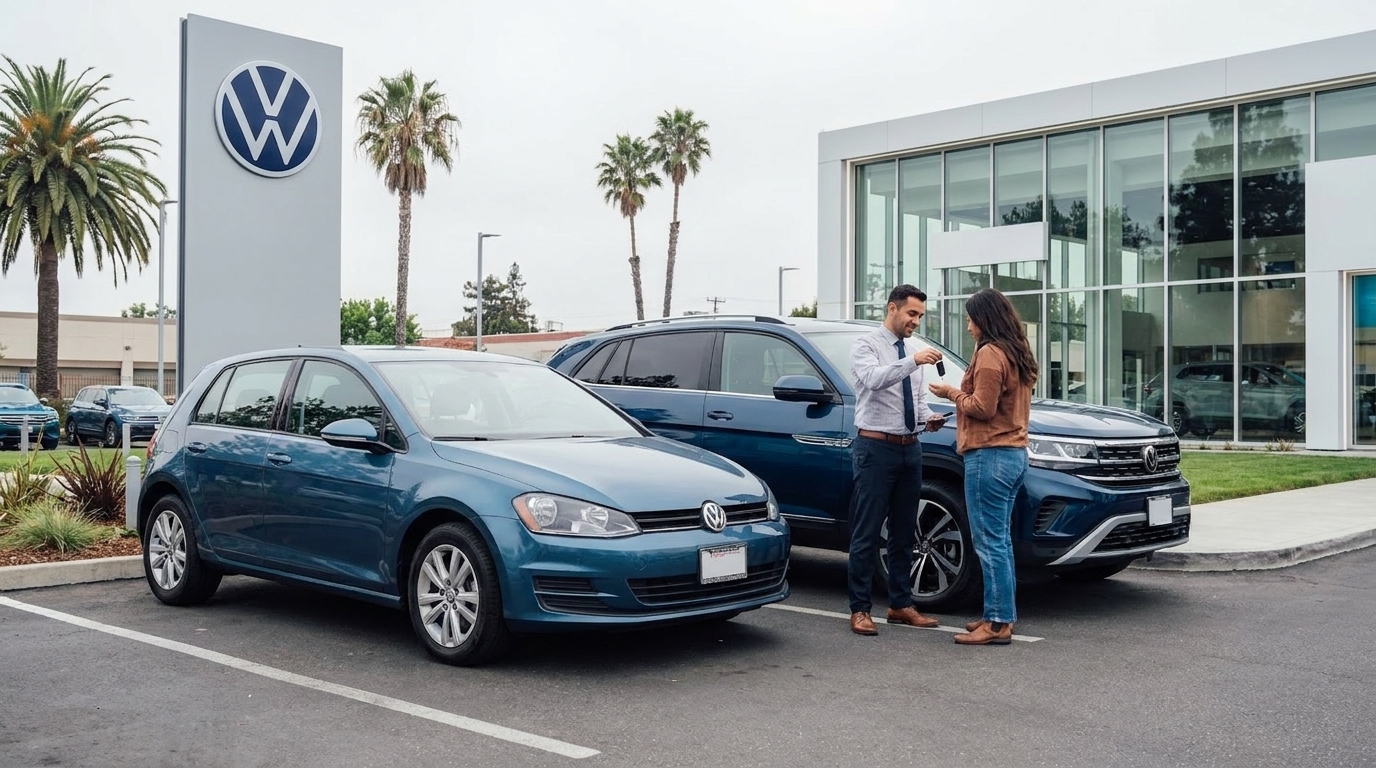
Owners near Rivermark, the Santa Clara Convention Center corridor, or the Mission College area typically have a short drive to authorized VW service. Sunnyvale Volkswagen's service department is a common destination for Santa Clara owners who want factory-trained diagnostics rather than a generic code readout — the dealership holds a 4.4-star rating across 1,405 Google reviews, with customers frequently citing service department transparency. One reviewer described the experience as "smooth" and "stress free," a theme that recurs across the service side of the business as well.
How much does VW check engine light diagnosis cost in Santa Clara in 2026?
Professional VW diagnostic scans in the Santa Clara market generally run $150 to $220 for a full factory-tool readout, with most authorized shops crediting the diagnostic fee toward the repair if the customer proceeds with service. Independent shops may charge less but often lack the ODIS or VCDS tooling needed to read VW-specific module codes.
For emissions-related repairs, California's Consumer Assistance Program (CAP), administered by the Bureau of Automotive Repair, offers up to $1,200 in repair assistance to qualifying income-eligible vehicle owners whose cars fail the Smog Check. This is worth confirming before paying out of pocket for catalytic converter or oxygen sensor work.
Frequently Asked Questions
Can I drive my VW with the check engine light on?
Yes, if the light is steady and the vehicle drives normally — no shaking, hesitation, or unusual noises. Plan to have the code read within a few days. If the light is flashing, or you notice rough running, reduced power, or warning smells, stop driving and arrange a tow. Continued driving on a flashing light can cause catalytic converter damage costing thousands to repair.
Will a loose gas cap really trigger the check engine light on a Volkswagen?
Yes. A loose or cracked fuel cap is one of the most common triggers of P0442, P0455, or P0457 evaporative emissions codes on Volkswagens. Tighten the cap until it clicks three times, then drive normally for two to three complete warm-up cycles. If the light does not clear within about 50 miles of mixed driving, the purge valve or an EVAP hose may be the actual fault.
Do I need a VW-specific scan tool or will any OBD-II reader work?
A generic OBD-II reader will pull standard powertrain codes, which covers most check engine light events. However, Volkswagen uses manufacturer-specific codes for transmission, ABS, airbag, and comfort modules that require VCDS, OBDeleven, or the factory ODIS tool to read. For complex faults or intermittent issues, factory-level diagnostics from an authorized VW service department produce a more complete picture.
How does California's smog check affect an unresolved VW check engine light?
California requires biennial smog inspection for most gasoline vehicles model-year 1976 and newer, excluding the eight most recent model years. A stored emissions-related diagnostic trouble code or an illuminated check engine light is an automatic smog check failure. The Bureau of Automotive Repair oversees the program, and vehicles must pass before registration can be renewed at the DMV.
Is it worth clearing the code myself to see if it comes back?
Clearing the code with a scanner is reasonable once, particularly after fixing an obvious cause like a loose gas cap. If the same code returns within a few drive cycles, the underlying fault is persistent and needs professional diagnosis. Repeatedly clearing codes without addressing the cause can mask a worsening issue and interfere with readiness monitors needed for California smog testing.
Where should Santa Clara VW owners take their car for factory-level diagnostics?
Santa Clara owners looking for factory-trained technicians and access to VW's ODIS diagnostic platform typically use an authorized VW service department. Sunnyvale Volkswagen serves the Santa Clara area with VW-certified diagnostic equipment and manufacturer parts. Independent European specialists can also handle common codes, but warranty-eligible work and complex module coding generally require an authorized dealer.
The bottom line
A VW check engine light is a prompt, not an emergency, in most cases — but the difference between a $30 gas cap and a $3,000 catalytic converter often comes down to how quickly the code is read and interpreted. A basic OBD-II scanner, a look at whether the light is steady or flashing, and a check of the fuel cap will resolve or clarify a large share of events before any shop is involved.
Santa Clara, CA readers who want the diagnosis handled with factory tools and VW-trained technicians can reach Sunnyvale Volkswagen at https://www.sunnyvalevw.com/ to schedule a service appointment or ask a specific question about a stored code.