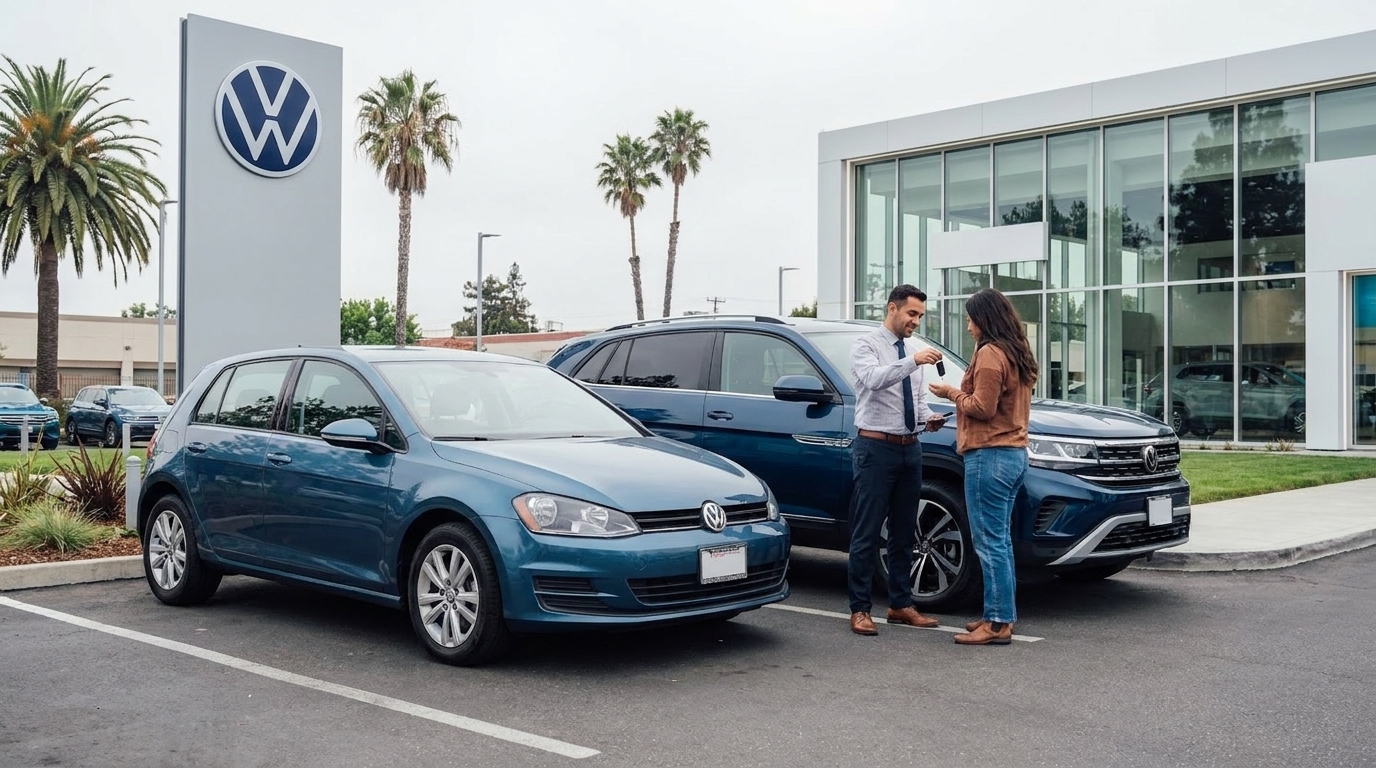
VW Atlas vs. Tiguan: Which to Buy in Palo Alto, CA
Compare the 2026 VW Atlas and Tiguan on price, space, power, and MPG to decide which SUV fits Palo Alto driving, parking, and family needs.
For most Palo Alto buyers, the 2026 Volkswagen Tiguan is the smarter everyday choice — it starts at $30,805, returns up to 29 mpg combined, and fits comfortably in University Avenue parking garages. The 2026 Volkswagen Atlas, starting at $39,310 with 269 hp and seating for seven, is the right call only if a third row, higher tow-friendly torque, or a 96.6 cu ft cargo hold is genuinely non-negotiable. Between those poles lies a real decision, and it hinges on how a household actually uses the vehicle across the Peninsula.
How do the 2026 Atlas and Tiguan compare at a glance?
The Atlas is a midsize three-row SUV with a 269-hp turbocharged 2.0-liter engine, 7-passenger seating, and up to 96.6 cu ft of cargo space. The Tiguan is a compact 5-passenger SUV starting roughly $8,505 lower, delivering 201 hp in standard trims (268 hp in the SEL R-Line Turbo) and materially better fuel economy at 25–29 mpg combined.
| Specification | 2026 VW Atlas | 2026 VW Tiguan |
|---|---|---|
| Starting MSRP | $39,310 | $30,805 |
| Seating | 7 | 5 |
| Horsepower | 269 hp | 201 hp (268 hp SEL R-Line Turbo) |
| Torque | 273 lb-ft | 207–221 lb-ft (258 lb-ft SEL R-Line Turbo) |
| MPG combined | 21–23 | 25–29 |
| Max cargo | 96.6 cu ft | 58.9 cu ft |
| Trims | 5 | 4 |
| Basic warranty | 4 yr / 50,000 mi | 4 yr / 50,000 mi |
MSRPs shown are national U.S. figures from Volkswagen and exclude destination charges, dealer fees, and California-specific costs. Palo Alto shoppers working with Sunnyvale Volkswagen should confirm out-the-door pricing on the exact configuration they want, because a fully optioned Tiguan SEL R-Line Turbo starts around $44,560 — well into lower Atlas trim territory.
Which SUV makes more sense for Palo Alto driving conditions?
For most Palo Alto driving — El Camino Real commuting, Stanford-area errands, and structured parking downtown — the Tiguan's compact footprint is the practical winner. Its 29 mpg combined FWD rating meaningfully reduces fuel spend on Bay Area gas prices, and the smaller turning envelope is easier in older Professorville and Crescent Park garages. The Atlas earns its keep on I-280 family runs to Tahoe or coastal weekend trips, where the third row and 96.6 cu ft cargo hold matter more than curb-to-curb agility.
California AWD buyers should note the fuel economy penalty: Atlas AWD trims drop to 21 mpg combined, while the Tiguan holds 25 mpg combined in AWD form. Over a typical 12,000-mile Peninsula year, that gap adds up.
How much space do Palo Alto families actually need?
The Atlas seats seven and offers 96.6 cu ft of maximum cargo volume with rows folded, versus 58.9 cu ft in the Tiguan. Behind the rearmost row, however, the Tiguan actually offers more usable everyday space — 26.5 cu ft versus 20.6 cu ft behind the Atlas's third row.
That distinction matters. Families of four who rarely need a third row often find the Tiguan more useful day-to-day: stroller, Costco run, two Stanford move-in duffels behind the rear seats without folding anything. Households that regularly carry five-plus passengers — carpools to Palo Alto Unified schools, extended-family weekends, teen sports teams — need the Atlas's third row and won't be talked out of it by an MPG chart.
How do power and drivability differ?
The Atlas produces 269 hp and 273 lb-ft of torque from its Turbo 2.0 TSI, giving it stronger midrange pull for freeway merging fully loaded — relevant on 101 on-ramps and the 92 climb to the coast. The standard Tiguan produces 201 hp and 207–221 lb-ft, which is adequate but noticeably lighter under load.
Buyers who want Atlas-like output in a Tiguan body should look at the SEL R-Line Turbo, which delivers 268 hp and 258 lb-ft of torque. It nearly matches the Atlas on paper while retaining 25 mpg combined AWD efficiency — but its starting price sits close to lower Atlas trims, so the value math tightens considerably.
How much does a new Volkswagen cost near Palo Alto in 2026?
National starting MSRPs run from $30,805 for a base Tiguan S to $39,310 for a base Atlas SE, with the Tiguan SEL R-Line Turbo starting around $44,560. Palo Alto transaction prices layer on destination charges, California sales tax, DMV registration fees, and any dealer-installed options — meaning out-the-door totals typically run several thousand dollars above the sticker MSRP.
The Atlas lineup spans five trims: SE, SE with Technology, Peak Edition, SEL, and SEL Premium R-Line. The Tiguan offers four: S, SE, SE R-Line Black, and SEL R-Line Turbo. A cross-shop worth doing is a loaded Tiguan against a mid-trim Atlas at similar money — the answer usually comes down to whether the third row will ever be used.
What should Palo Alto buyers look for in a Volkswagen dealership?
The right dealership is one that quotes transparently, respects the customer's timeline, and demonstrates competence in both sales and service. Both the Atlas and Tiguan carry Volkswagen's 4-year / 50,000-mile basic warranty, so the ownership experience over the first several years depends heavily on the service department behind the sale.
The right dealership will demonstrate no-pressure sales conversations and clear cost breakdowns — qualities worth asking about before committing to a purchase. That kind of transparency matters when comparing a $30,805 Tiguan against a $39,310 Atlas across trim, tax, and financing scenarios.
Frequently asked questions
Is the VW Atlas or Tiguan better for a Palo Alto commute?
The Tiguan is better suited to a typical Palo Alto commute. Its compact five-passenger footprint fits downtown and Stanford-area parking more easily, and its 29 mpg combined FWD rating (25 mpg AWD) reduces fuel costs versus the Atlas's 21–23 mpg combined. The Atlas makes more sense for households that also need three-row capacity for family trips.
How much does a 2026 Volkswagen Atlas cost?
The 2026 Volkswagen Atlas starts at $39,310 MSRP for the base SE trim, per Volkswagen's official pricing. That figure excludes destination charges, California sales tax, DMV fees, and any dealer-installed options. The lineup includes five trims: SE, SE with Technology, Peak Edition, SEL, and SEL Premium R-Line, with pricing climbing meaningfully at the top of the range.
How much does a 2026 Volkswagen Tiguan cost?
The 2026 Volkswagen Tiguan starts at $30,805 MSRP for the base S trim. The top SEL R-Line Turbo starts at approximately $44,560, which overlaps with lower Atlas trim pricing. All figures exclude destination, California taxes, and registration fees. Four trims are offered: S, SE, SE R-Line Black, and SEL R-Line Turbo.
Which VW SUV gets better fuel economy?
The Tiguan is meaningfully more efficient. It returns 29 mpg combined in FWD form and 25 mpg combined in AWD, including the SEL R-Line Turbo AWD. The Atlas returns 23 mpg combined in FWD SE trim and 21 mpg combined in most AWD configurations. Over a typical Bay Area commuting year, the Tiguan will use noticeably less fuel.
Does the VW Tiguan have a third row?
No. The 2026 Volkswagen Tiguan is a two-row, five-passenger SUV. Buyers who need three-row seating should look at the Atlas, which seats seven. The Tiguan does, however, offer more cargo space behind its rear seats — 26.5 cu ft versus 20.6 cu ft behind the Atlas's third row — making it more practical for daily hauling in a five-person household.
Is the Tiguan SEL R-Line Turbo worth it over the Atlas?
It depends on how the third row and cargo maximum are valued. The Tiguan SEL R-Line Turbo delivers 268 hp and 258 lb-ft of torque — nearly matching the Atlas's 269 hp / 273 lb-ft — while retaining 25 mpg combined AWD. But at roughly $44,560, it costs more than a base Atlas. Buyers who won't use three-row seating usually prefer the Tiguan; buyers who will should choose the Atlas.
Do both models come with the same warranty?
Yes. Both the 2026 Atlas and 2026 Tiguan carry Volkswagen's 4-year / 50,000-mile basic warranty. Longer-term protection depends on the dealer's service relationship, so buyers should ask about scheduled maintenance programs and the service department's capacity before signing.
The bottom line for Palo Alto buyers
The Tiguan wins on price ($8,505 lower to start), fuel economy (up to 29 mpg combined), and daily practicality in a dense Peninsula environment. The Atlas wins where it matters — third-row seating, 96.6 cu ft of maximum cargo, and 273 lb-ft of torque for loaded highway work. There is no wrong answer, only a wrong fit.
Palo Alto readers who want to drive both back-to-back and see out-the-door pricing on specific configurations can reach Sunnyvale Volkswagen at https://www.sunnyvalevw.com/ to schedule a comparison. Bringing the family and the cargo scenarios that actually happen each week is usually the fastest way to decide.