Used VW Pre-Purchase Checklist in Santa Clara, CA
A model-specific pre-purchase checklist for buying a used Volkswagen in Santa Clara, CA — inspection points, paperwork, smog rules, and CPO tradeoffs.
Before buying a used Volkswagen in Santa Clara, CA, verify four things in this order: a clean CARFAX with documented timing-chain and DSG service history, a California smog certificate dated within 90 days of sale, a pre-purchase inspection by a VW-literate technician, and clear title with matching VIN plates. Skip any of those steps and the risk shifts entirely to the buyer.
Volkswagens reward informed buyers and punish careless ones. The 2.0T EA888 engine, the 7-speed DSG transmission, and the MQB electrical architecture all have documented service intervals that separate a sound used VW from an expensive one. This checklist is built specifically for Santa Clara, CA buyers navigating California's smog, tax, and disclosure rules — with input from the sales and service teams at Sunnyvale Volkswagen, who see these cars come through the door every week.
What should Santa Clara buyers check first on a used VW?
Start with the vehicle history report, the maintenance records, and a cold start. A clean CARFAX, receipts showing timing-chain tensioner and DSG fluid service at the correct mileage, and a quiet, smoke-free cold start eliminate roughly 80% of the failure modes that make used VWs expensive. Everything else on the checklist refines from there.
Ask for physical service records, not verbal assurance. A 2026+ Jetta or Tiguan with the EA888 Gen 3 engine should show DSG fluid and filter service every 40,000 miles and spark plugs at 40,000-60,000 miles. A used ID.4 should show a documented battery state-of-health report — Volkswagen's high-voltage battery carries an 8-year/100,000-mile warranty from original in-service date, which transfers to subsequent owners.
Which VW-specific inspection points matter most?
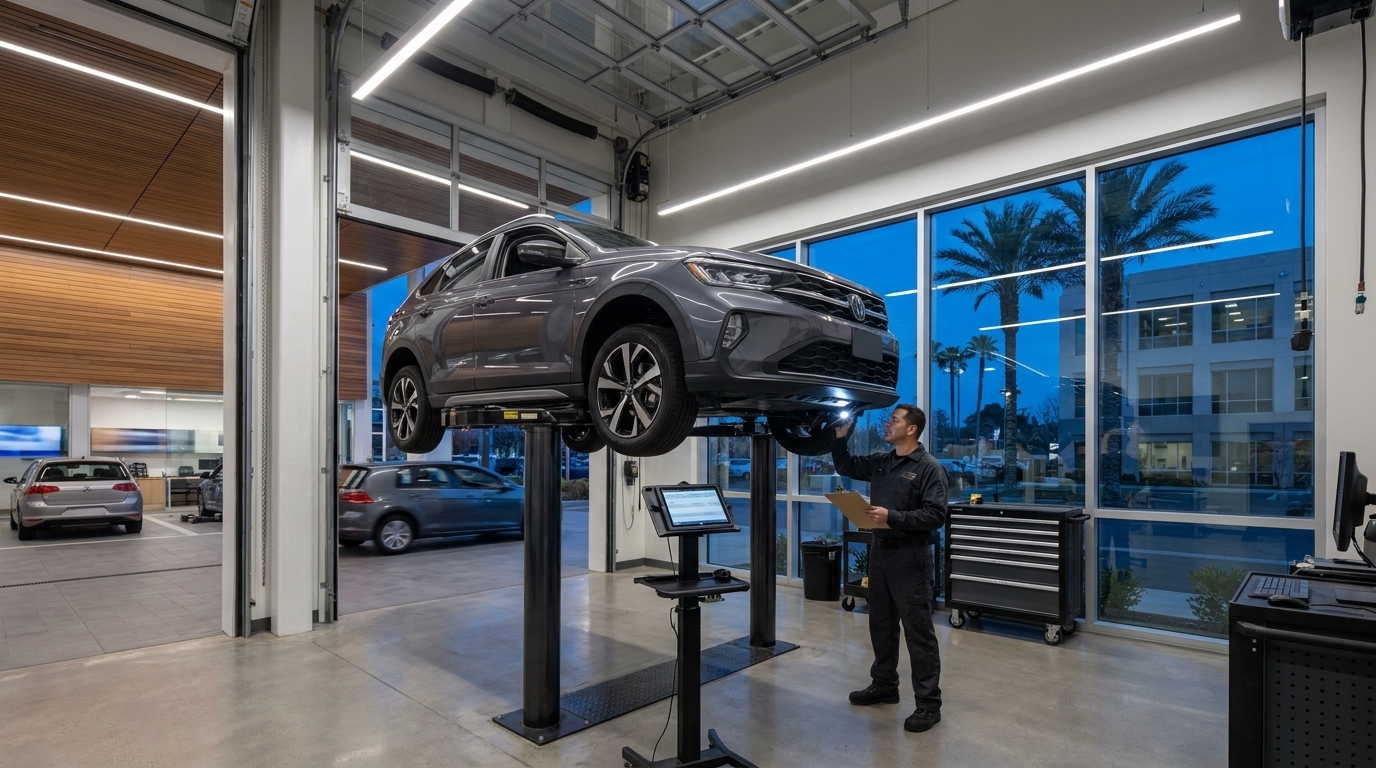
Focus on six model-specific items: timing chain tensioner (EA888 engines), DSG transmission behavior, water pump and thermostat housing, carbon buildup on direct-injection intake valves, sunroof drain channels, and infotainment/MIB firmware. These are the areas where used VWs most often surprise second owners, and each can be assessed in under 15 minutes by a qualified technician.
| Component | What to check | Typical repair range |
|---|---|---|
| Timing chain tensioner (EA888) | Rattle on cold start lasting more than 2 seconds | $1,800-$3,500 |
| DSG transmission | Harsh 1-2 shift, hesitation from stop, service records | $900 service / $4,000+ mechatronic |
| Water pump / thermostat | Coolant weeping at plastic housing | $700-$1,200 |
| Intake valve carbon | Rough idle, misfires above 60k miles | $400-$800 walnut blast |
| Sunroof drains | Water staining in headliner corners, damp carpet | $150-$400 |
| MIB infotainment | CarPlay stability, backup camera lag | $300 software / $1,500+ unit |
How do California rules change the used VW buying process?
California requires the seller to provide a valid smog certificate dated within 90 days of the sale for most gasoline vehicles more than four model years old, and the buyer pays sales tax on the full purchase price of the vehicle — California does not offer a trade-in tax credit. Registration transfer must be completed with the DMV within 10 days of sale.
Santa Clara County sales tax currently sits at 9.125% in most of the city, so a $22,000 used Jetta carries roughly $2,008 in sales tax at the DMV regardless of whether a trade-in is involved. Buyers coming from states like Oregon or Arizona are often surprised by this — California's tax treatment is one of the least buyer-friendly in the country for trade-ins, and it should be modeled into any out-of-state comparison shopping.
Emissions also matter. Santa Clara County falls under Bay Area Air Quality Management District jurisdiction, and any VW showing a check-engine light or incomplete OBD-II readiness monitors will fail the required smog inspection. A pre-purchase scan for stored and pending codes is not optional here.
Certified pre-owned vs. used VW: which makes sense?
Certified Pre-Owned Volkswagens carry a 2-year/24,000-mile limited warranty on top of any remaining new-vehicle warranty, a 112-point inspection, and 24-hour roadside assistance. A non-certified used VW typically costs $1,500-$3,000 less at similar mileage but transfers all mechanical risk to the buyer once any remaining factory coverage expires.
For VWs under 60,000 miles, the CPO premium often pays for itself if a single covered repair occurs — a DSG mechatronic replacement alone can exceed $4,000. For higher-mileage cars or buyers planning to keep the vehicle only 2-3 years, a well-documented non-CPO example inspected by a VW specialist is often the sharper financial move. Sunnyvale Volkswagen stocks both, and the service department can pull a full VIN-specific service history on any VW sold through the franchise network, which helps buyers compare apples to apples.
What paperwork should the buyer verify before signing?
Confirm five documents: California pink slip (title) in the seller's name, current registration, smog certificate dated within 90 days, odometer disclosure statement, and a signed Bill of Sale itemizing all fees. The VIN on the title, the dashboard plate, and the driver-door B-pillar sticker must all match — mismatches are the single clearest indicator of a salvage or clone vehicle.
Buyers should also request the window sticker or Monroney label reprint (available by VIN through Volkswagen of America), which confirms original equipment and prevents surprises about missing options that were advertised. Any dealer add-ons — nitrogen tires, VIN etching, appearance packages — should be itemized and negotiable.
How should the test drive be structured?
A useful test drive lasts at least 30 minutes and includes a cold start, stop-and-go traffic, sustained highway speed above 65 mph, and at least one full-throttle acceleration from a stop. The goal is to load the DSG, warm the engine to operating temperature, and hear any noise the car makes when its systems are actually working.
Central Expressway and El Camino Real give Santa Clara buyers ideal stop-and-go conditions for evaluating DSG low-speed behavior, and Highway 101 or 237 provides the sustained highway load needed to expose driveline vibration and HVAC issues. Take the car onto both. A VW that only gets driven around the block during a test drive is a VW that hasn't actually been tested.
Frequently Asked Questions
Do I need a pre-purchase inspection if the car is certified pre-owned?
A CPO inspection is thorough, but an independent pre-purchase inspection by a VW-literate technician still adds value — it verifies the CPO checklist was executed and surfaces cosmetic or wear issues that don't affect certification but affect ownership cost. For non-CPO used VWs in Santa Clara, an independent inspection is not optional; it is the single highest-return $200 a buyer will spend.
How much does a used VW cost to maintain in Santa Clara?
Typical annual maintenance on a well-kept used Volkswagen in Santa Clara runs $600-$1,100 for a Jetta or Tiguan and $400-$700 for an ID.4, excluding tires and brakes. DSG service every 40,000 miles adds roughly $500-$700 when due. Bay Area labor rates run higher than the national average, so the same service at a franchise dealership costs 15-25% more here than in Sacramento or the Central Valley.
What is the California smog rule for used cars?
In California, the seller must provide a valid smog certificate dated within 90 days of the sale for gasoline vehicles more than four model years old at the time of transfer. Diesel vehicles 1998 and newer with a GVWR of 14,000 pounds or less are also included. Electric vehicles like the ID.4 are exempt. The certificate is the seller's responsibility, not the buyer's.
How reliable is the ID.4 as a used purchase?
The ID.4 has proven mechanically simple compared to combustion VWs, with the main used-buyer concerns being 12V battery health, MIB3 infotainment stability, and battery state-of-health verification. Volkswagen's 8-year/100,000-mile high-voltage battery warranty transfers to subsequent owners, which materially reduces the downside risk that used EV buyers face with less-protected models.
Should I buy a used VW from a private seller or a dealer?
Private sales typically cost 8-12% less but offer no warranty, no financing, and no recourse if the car has undisclosed issues. Dealer purchases include implied warranties, documented reconditioning, and financing options; franchise VW dealers like Sunnyvale Volkswagen can also verify factory service history through the VW network. For buyers new to the brand, dealer purchases meaningfully reduce risk.
What does Sunnyvale Volkswagen offer used-car buyers?
Sunnyvale Volkswagen sells both Certified Pre-Owned and standard used Volkswagens, provides VIN-specific service history verification, and holds a 4.4-star rating across more than 1,400 Google reviews. One recent reviewer described the process as "smooth and stress free" with "no hidden fees" — a theme that recurs across the dealership's customer feedback, particularly around transparent pricing and low-pressure sales.
The bottom line
A used Volkswagen is an excellent value when the buyer does the work upfront and a costly mistake when they don't. The checklist above — history, model-specific inspection points, California paperwork, structured test drive, and CPO-vs-used analysis — closes the gap between the two outcomes. Readers in Santa Clara, CA who want this handled by a franchise VW team can reach Sunnyvale Volkswagen at https://www.sunnyvalevw.com/ to review current inventory, request a VIN-specific service history, or schedule a pre-purchase inspection.