Car Safety Features to Look for When Buying: Modern vs Older Models
Comparing car safety features in modern vs older models? Learn what vehicle safety technology, ADAS features, and crash test scores actually matter when buying in 2026.
Car Safety Features to Look for When Buying: Modern vs Older Models
Buying a car is one of the bigger financial decisions most people make, and safety tends to sit at the top of the priority list — especially if you're transporting family members or logging long commutes through Sunnyvale and the surrounding Bay Area. But walk into a dealership or scroll through a used car listing without a clear picture of what to look for, and it's easy to get overwhelmed by acronyms, trim-level footnotes, and marketing copy that blurs the line between "standard" and "available."
This guide breaks down the car safety features to look for across both modern and older vehicles, explains what vehicle safety technology actually does in real driving situations, and helps you evaluate whether a car's crash test scores and ADAS features are genuinely worth the price difference.
Why the Gap Between Modern and Older Safety Features Is Larger Than You Think
A vehicle from ten or even five years ago might feel familiar and reliable — and in many ways, it is. But the gap in vehicle safety technology between older models and what's available today is significant, and it's not just about airbags.
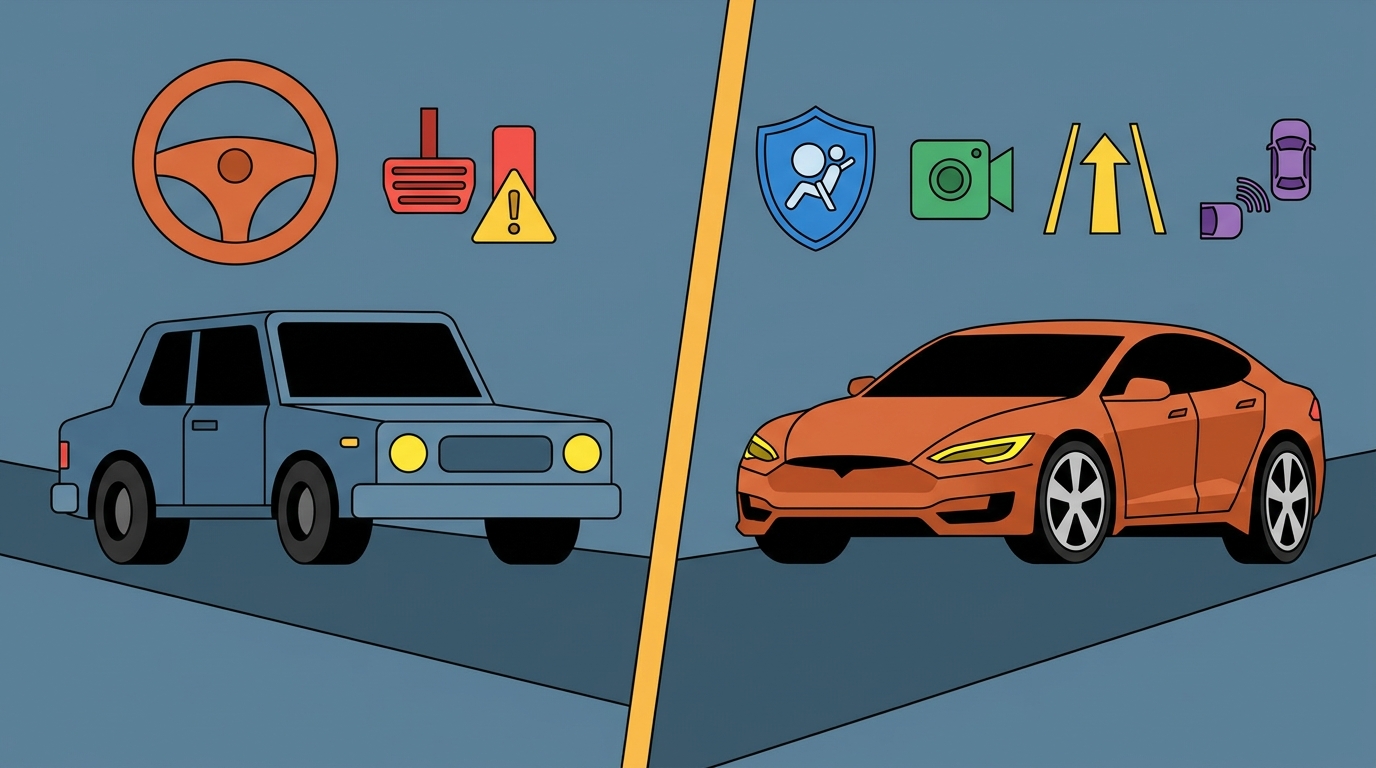
Modern vehicles are built around what the industry calls Advanced Driver Assistance Systems, or ADAS features. These are semi-autonomous technologies that actively monitor your environment and intervene — or alert you — before a crash happens. Older vehicles, even well-maintained ones, typically rely on passive safety systems: seatbelts, airbags, and crumple zones that protect you after an impact rather than helping you avoid one.
That distinction matters. Passive systems are still important, but ADAS features represent a fundamentally different philosophy around vehicle safety — one that's increasingly reflected in insurance premiums, resale values, and regulatory expectations.
Core Safety Features in Modern Vehicles (2026 and Newer)
Automatic Emergency Braking (AEB)
Automatic Emergency Braking is now standard on most new vehicles sold in the U.S., and for good reason. The system uses forward-facing sensors to detect a potential collision and applies the brakes automatically if the driver doesn't respond in time. Studies consistently show AEB significantly reduces rear-end collisions, which are among the most common crash types.
On newer Volkswagen models, AEB is part of the standard IQ.DRIVE suite — it's not a premium add-on. When you're shopping, confirm whether AEB comes standard on the specific trim you're considering or only on higher packages.
Lane-Keeping Assist and Lane Departure Warning
Lane Departure Warning alerts you when your vehicle drifts across lane markers without a turn signal. Lane-Keeping Assist goes one step further and applies gentle steering correction. These systems are particularly useful on longer highway stretches, where driver fatigue is a real factor.
Blind Spot Monitoring
Blind spot monitoring uses radar sensors in the rear bumper to detect vehicles in your adjacent lanes and alert you — usually via a light in the mirror — when it's unsafe to change lanes. This is one of the ADAS features buyers consistently say they can't imagine driving without once they've used it regularly.
Adaptive Cruise Control
Unlike traditional cruise control, adaptive cruise maintains a set following distance behind the vehicle ahead, automatically slowing and accelerating with traffic. On certain models, this integrates with lane centering to create what feels like a genuinely assisted highway experience.
Rear Cross-Traffic Alert and Backup Cameras
Backup cameras are federally mandated on all new U.S. vehicles, so any current model will include one. Rear cross-traffic alert is separate — it warns you of approaching vehicles or pedestrians when reversing out of a parking space, and it's especially useful in Sunnyvale's denser commercial areas where parking lot visibility can be limited.
What Older Models Typically Offer — and Where They Fall Short
Older vehicles generally include seatbelts, front and side airbags, and anti-lock braking systems (ABS) — all meaningful safety technologies. Vehicles from more recent model years often include backup cameras and some early ADAS features, though these are frequently optional rather than standard, meaning they may or may not be present on the specific used car you're looking at.
The critical thing to check with any used vehicle is the actual build sheet or window sticker if available. "The model has blind spot monitoring" doesn't mean the specific car in front of you does. Always verify individual vehicle options, not just model-year generalities.
Older vehicles also tend to perform less well in newer crash test protocols. Both the NHTSA (National Highway Traffic Safety Administration) and the IIHS (Insurance Institute for Highway Safety) have updated their testing methodologies to include more realistic crash scenarios — small overlap frontal tests, updated side impact standards, and headlight evaluations. A vehicle that earned strong safety ratings under older testing standards might score significantly lower if evaluated under current criteria.
How to Actually Read and Use Crash Test Scores
Safety ratings from NHTSA and IIHS are publicly available and genuinely useful — but they require a bit of context to interpret correctly.
NHTSA uses a five-star system, rating vehicles on frontal crash, side crash, and rollover resistance separately. A vehicle can earn five stars overall while performing less impressively in one specific category, so look at individual scores rather than just the headline number.
IIHS ratings use a qualitative scale — Good, Acceptable, Marginal, or Poor — across multiple test categories. Their Top Safety Pick and Top Safety Pick+ designations are widely respected benchmarks. The current TSP+ criteria include requirements around headlight performance and active safety systems, making it a more meaningful threshold than it was in earlier years.
When comparing a modern vehicle to an older one, look up crash test scores for both on the NHTSA and IIHS websites directly. Experts at Sunnyvale Volkswagen can walk you through how specific models have performed and what those scores mean for real-world driving — particularly if you're weighing a newer model against a used option at a lower price point.
Modern vs Older Models: A Practical Comparison
- Automatic Emergency Braking: Standard on most current new vehicles; rare or unavailable on older models
- Blind Spot Monitoring: Common on current mid-trim vehicles; limited to upper trims on older models
- Backup Camera: Federally required on all new vehicles; available but not universal on older vehicles
- Lane-Keeping Assist: Widely available on current vehicles; uncommon on older models
- Adaptive Cruise Control: Standard or optional on most current vehicles; limited availability on older models
- Updated Crash Test Performance: Modern vehicles are designed around current IIHS and NHTSA testing standards; older models may not meet updated benchmarks
Is the Safety Technology Worth the Price Difference?
This is the honest question most buyers eventually ask. A newer vehicle with a full suite of ADAS features will typically cost more than a comparable older model — sometimes significantly more. Whether that gap is worth it depends on how you drive, who's riding with you, and how you weigh upfront cost against long-term risk reduction.
What's worth noting is that vehicle safety technology has a measurable effect on insurance premiums — many insurers discount rates for vehicles equipped with AEB and other active safety systems. Over a multi-year ownership period, those savings can meaningfully offset part of the purchase price difference.
It's also worth remembering that the value of safety features tends to be invisible when they work — you never see the accident that didn't happen. That's precisely what makes them hard to price emotionally but genuinely important to prioritize practically.
Frequently Asked Questions
What are the most important ADAS features to prioritize?
Automatic Emergency Braking, blind spot monitoring, and lane departure warning are widely considered the highest-impact ADAS features for reducing collision risk in everyday driving. If you're choosing between feature packages, these three are where most safety experts recommend starting.
Do older cars fail modern crash tests?
Not always, but many do score lower under updated testing protocols. IIHS and NHTSA have expanded their test scenarios since older vehicles were rated, so a car that earned top marks in a prior model year may no longer meet current Top Safety Pick standards. Always check current ratings, not the original ratings from the model year.
Is a certified pre-owned vehicle safer than a regular used car?
Certified pre-owned programs vary by manufacturer, but they typically include a multi-point inspection that verifies the vehicle's mechanical condition — not necessarily its safety feature set. A CPO vehicle doesn't automatically have more safety technology than a non-CPO model of the same year and trim. What matters is the specific features on that specific vehicle.
How do I verify what safety features a specific used car actually has?
The most reliable methods are the original window sticker (available via the VIN through some manufacturer websites), the vehicle's options package, and a direct inspection. Ask the dealer to demonstrate any ADAS features before you finalize a purchase — they should be verifiable with a short test drive.
Are there safety features I should avoid in older vehicles?
Older vehicles with first-generation active safety systems — particularly early versions of AEB or lane assist — can occasionally be less reliable than their modern counterparts. They were designed for narrower use cases and can produce false positives or slower responses. They're still better than no system, but set your expectations accordingly.
Can I add modern ADAS features to an older vehicle aftermarket?
Aftermarket ADAS add-ons exist — including backup cameras and some blind spot sensors — but they rarely match the integration or reliability of factory-installed systems. Aftermarket AEB, in particular, is not a meaningful substitute for a purpose-built system. If ADAS coverage is a priority, it's generally more effective to select a vehicle that includes those features as original equipment.
How do ADAS features perform in bad weather or low visibility conditions?
Most ADAS systems are designed to operate in a range of conditions but can be degraded by heavy rain, snow, fog, or a dirty sensor. Manufacturers publish operating limitations in the owner's manual. Current systems handle adverse conditions better than earlier generations did, but no active safety system is infallible — they're designed to assist, not replace, attentive driving.
Making a Well-Informed Safety Decision
The car safety features to look for ultimately depend on your priorities, budget, and how you plan to use the vehicle — but the direction of the evidence is clear. Modern vehicles offer vehicle safety technology that older models simply cannot replicate, and crash test scores now reflect testing standards rigorous enough to be meaningful rather than merely reassuring.
If you're in the Sunnyvale area and working through this decision, the team at Sunnyvale Volkswagen (https://www.sunnyvalevw.com/) can help you compare specific models side by side, clarify what safety features come standard on each trim, and explain how crash test scores apply to the vehicles you're actually considering. Rated 4.4 stars across more than 1,455 Google reviews, the dealership is consistently recognized for its transparent, no-pressure approach. One customer wrote that the buying experience was "smooth and stress-free" with a salesperson who was "knowledgeable, responsive to every question" — and another noted receiving a complete cost breakdown that other dealerships had withheld. That kind of straightforward guidance makes it a reasonable starting point when you want clarity rather than a sales push.
View their current inventory or schedule a test drive at sunnyvalevw.com to see which vehicles match both your safety priorities and your budget.