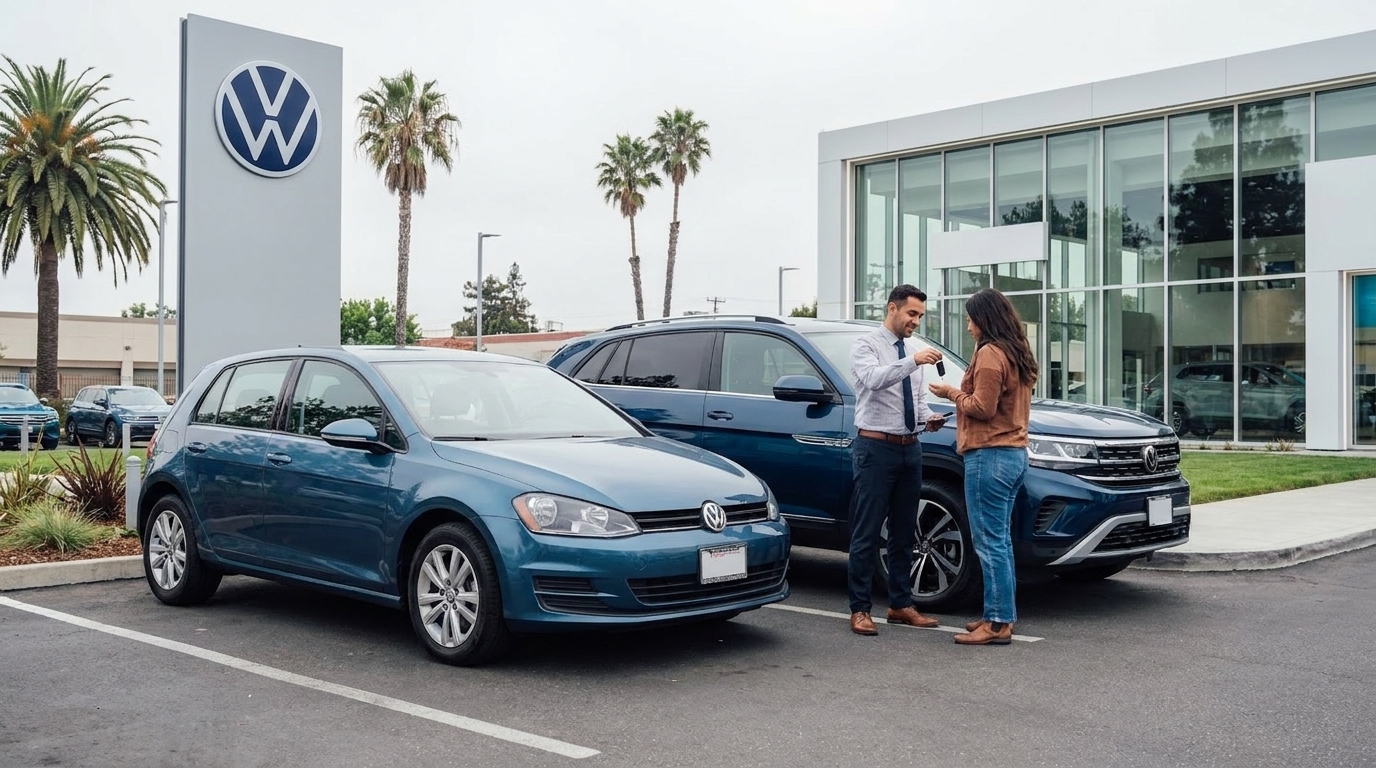
Best Volkswagen Model for Bay Area Driving in San Jose, CA
A 2026 buyer's guide to matching Volkswagen models — Jetta, Taos, Tiguan, Atlas, ID.4, ID. Buzz — to real Silicon Valley commutes, traffic, and parking.

For most Bay Area commuters based in San Jose, the Volkswagen ID.4 is the strongest all-around fit: it offers up to 291 miles of range, qualifies for California's MyFirstEV point-of-sale rebate and Silicon Valley Clean Energy incentives, and benefits from a statewide oversupply — roughly 387 days of 2026 ID.4 inventory — that gives buyers real negotiating leverage. Drivers with shorter urban commutes or who can't charge at home are better served by the Jetta or Taos; larger families gravitate toward the Atlas or ID. Buzz.
The right Volkswagen for a Silicon Valley commute is less about the badge and more about the shape of the drive: how many miles of US-101, I-280, or I-880 the car sees each day, whether a Level 2 charger is realistic at home, and how tight the parking is at the destination. This guide works through the current VW lineup available to San Jose buyers with those variables in mind.
What makes a Volkswagen well-suited to Bay Area commuting in 2026?
A Bay Area-friendly VW needs three things: efficiency or electrification for 30–40 mile one-way commutes, a footprint that survives downtown San Jose garages and Caltrain lot striping, and driver-assist features that reduce fatigue in stop-and-go traffic. Range, MSRP relative to California EV incentives, and days-of-supply on the dealer lot all shape which trim actually makes sense.
Typical five-day commuters in Silicon Valley log 80+ miles daily, which pushes fuel economy and EV range to the top of the criteria list. At the same time, congestion on the 101 corridor between San Jose and the Peninsula makes adaptive cruise, lane centering, and — for EV buyers — single-pedal driving genuinely valuable rather than optional. Sunnyvale Volkswagen, located at 1025 E. El Camino Real in Sunnyvale, sits directly on the commute path most Silicon Valley buyers already drive, which makes cross-shopping trims a practical afternoon errand rather than a weekend project.
Which VW model fits which type of San Jose commute?
Match the model to the commute profile: Jetta for cost-conscious urban and mixed commutes, Taos for a small crossover with easier parking, Tiguan for families needing more cargo, Atlas or Atlas Cross Sport for three-row or larger-family duty, ID.4 for the classic 30–40 mile Peninsula commute with home charging, and ID. Buzz for buyers who want an electric family hauler and can absorb the higher MSRP.
Below is a working comparison of the current lineup against Bay Area commute realities, using verified San Jose-area pricing where available.
| Model | Category | MSRP range | Best-fit commute profile |
|---|---|---|---|
| Jetta | Compact sedan | ~$25,000 base | Cost-focused mixed city/highway, tight parking |
| Taos | Subcompact crossover | $28,000–$35,000 | Solo or couple commuter wanting SUV posture |
| Tiguan | Compact crossover | ~$35,000–low $40,000s | Small family, occasional Tahoe or coast trips |
| Atlas / Atlas Cross Sport | Midsize SUV | $35,000–$55,000+ | Three-row family, longer road trips |
| ID.4 | Electric SUV | $40,000–$50,000 pre-incentive | 30–40 mile Peninsula commute w/ home charging |
| ID. Buzz | Electric MPV | $59,738–$62,653 | Electric family hauler, tech-forward buyer |
Jetta and Taos: the pragmatic picks
For commuters who don't have Level 2 charging at their apartment or condo — a common situation in downtown San Jose, Japantown, and parts of Willow Glen — an efficient ICE model still makes real sense. VW Tracy currently lists a 2026 Jetta Sport at a net price of $24,254 (MSRP $26,919) and a 2026 Taos S at $28,556 (MSRP $29,971), which sets a useful pricing benchmark for the segment even if San Jose-area dealers structure discounts differently.
Tiguan and Atlas: the family-scale answers
Families that need three rows or that regularly head to Santa Cruz, Tahoe, or the Central Valley usually land on the Tiguan or one of the Atlas variants. The Atlas and Atlas Cross Sport span roughly $35,000 to $55,000+ depending on trim, and the Tiguan slots in between the Taos and the Atlas at roughly $35,000 to the low $40,000s.
Is the ID.4 the right EV for a Silicon Valley commute?
For most Peninsula and South Bay commuters with access to home charging, yes. The 2026 ID.4 is rated up to 291 miles of range in RWD form, comfortably covering a 30–40 mile one-way commute for a full week between charges, and California's MyFirstEV program provides a $3,500 point-of-sale incentive ($1,750 state + $1,750 OEM) for eligible first-time ZEV buyers on model year 2026 and newer.
Silicon Valley Clean Energy layers an additional $2,000 EV rebate for qualifying customers, and its time-of-use electricity rates run $0.16–$0.33/kWh. At roughly 1,000 miles per month, home Level 2 charging works out to about $40–$109/month depending on when the vehicle charges — materially less than the gasoline equivalent for a Jetta or Taos on the same route.
The other tailwind is inventory. California is sitting on an estimated 387 days of supply of the 2026 ID.4, which translates directly into stronger dealer discounts and more flexible lease structures than a buyer would encounter on a tight-supply model. Buyers cross-shopping trims at Sunnyvale Volkswagen and other franchised VW dealers in the San Jose corridor should treat that oversupply as leverage, not as a warning sign about the vehicle.
What about the ID. Buzz for Bay Area families?
The ID. Buzz is a legitimate option for Silicon Valley families who want an electric vehicle with minivan-scale interior space and are comfortable in the $59,738–$62,653 range typical of San Jose listings. Same MyFirstEV and Silicon Valley Clean Energy incentives apply, but the higher starting price means the effective net cost lands well above the ID.4.
Practical considerations: the ID. Buzz is physically large, which matters in older San Jose neighborhoods with narrower garages and street parking, and at downtown structures near SAP Center or San Jose State. Buyers who regularly use Peninsula park-and-ride lots or Caltrain garages should physically confirm fit before signing.
How do California incentives change the math in 2026?
California's incentive landscape has narrowed but is still meaningful for EV buyers. The broad-based Clean Vehicle Rebate Project (CVRP) has closed, and current analyses describe the federal EV tax credit for 2026 purchases as terminated. What remains — and matters — are targeted programs: MyFirstEV's $3,500 point-of-sale rebate administered by CARB, and Silicon Valley Clean Energy's $2,000 EV rebate for qualifying customers.
For a 2026 ID.4 buyer who qualifies for both, that's up to $5,500 in stacked incentives applied against a $40,000–$50,000 MSRP, before any dealer discount tied to the statewide inventory overhang. Eligibility rules — income limits, first-time buyer status, program funding availability — change, so confirmation at the point of sale matters more than any generalized calculation.
How should San Jose buyers actually choose between these models?
Start with charging access, then commute distance, then family size, then budget. Buyers with home Level 2 charging and a Peninsula commute should short-list the ID.4 first. Buyers without home charging should default to the Jetta or Taos. Larger families work down from the Atlas or ID. Buzz based on whether electrification is a priority.
The competitive landscape helps. Multiple franchised VW dealers operate within a 5–15 mile radius of central San Jose, which means buyers can and should get real numbers from more than one before committing. Sunnyvale Volkswagen publishes buyer guides and EV resources specific to the San Jose–Sunnyvale corridor and carries the full lineup including the ID.4 and ID. Buzz, which makes it a workable single stop for cross-shopping the electrified and ICE options in one visit. Sunnyvale Volkswagen publishes buyer guides and EV resources specific to the San Jose–Sunnyvale corridor, which makes it a workable single stop for commuter-focused buyers cross-shopping electrified and ICE options in one visit.
Frequently asked questions
What is the best Volkswagen for a long Bay Area commute?
The ID.4 is the strongest fit for most long Bay Area commutes, with up to 291 miles of range on the RWD trim, which handles 30–40 mile one-way drives comfortably between charges. For commuters without home charging, the Jetta offers the lowest cost of ownership in the current VW lineup, starting around $25,000 MSRP.
Does the 2026 ID.4 qualify for California EV incentives?
Yes. The 2026 ID.4 qualifies for California's MyFirstEV point-of-sale rebate — $3,500 total, split $1,750 state and $1,750 OEM — for eligible first-time ZEV buyers or lessees. Silicon Valley Clean Energy customers may also qualify for an additional $2,000 EV rebate. Program eligibility depends on income limits and funding availability at time of purchase.
Is the Volkswagen Taos big enough for a Bay Area family?
The Taos works for couples and small families with one child, but families needing more cargo space or three rows typically move up to the Tiguan or Atlas. The Taos starts around $28,000 and tops out near $35,000, which keeps it competitive with other subcompact crossovers in the San Jose market.
How much does it cost to charge a Volkswagen ID.4 at home in Silicon Valley?
At Silicon Valley Clean Energy time-of-use rates of $0.16–$0.33/kWh, home Level 2 charging for roughly 1,000 miles per month runs approximately $40–$109 depending on when the vehicle charges. Charging during off-peak overnight windows sits near the low end, while peak-time charging pushes toward the upper range.
Why is the 2026 ID.4 discounted so heavily in California?
California is carrying an estimated 387 days of supply of the 2026 ID.4 statewide, which is well above typical inventory levels. That oversupply translates into stronger dealer discounts, more aggressive lease terms, and additional negotiating leverage for buyers. The vehicle itself is unchanged — the discount reflects inventory conditions, not a product issue.
Which VW is easiest to park in downtown San Jose?
The Jetta and Taos have the smallest footprints in the current Volkswagen lineup and are the easiest to park in downtown San Jose garages, older neighborhood driveways, and Caltrain lots. The ID.4 sits in the middle. The Atlas, Atlas Cross Sport, and ID. Buzz are the largest and warrant a physical fit check in the buyer's regular parking situations before purchase.
Bottom line for San Jose buyers
The Volkswagen that fits Bay Area driving best is the one matched to a specific commute, charging situation, and family size — not a universal winner. For most Silicon Valley commuters with home charging access, the 2026 ID.4 is the leading choice on range, incentives, and current pricing leverage. For buyers without home charging or with tighter budgets, the Jetta and Taos remain the pragmatic answers. Readers in San Jose who want to walk through the tradeoffs against a specific commute and driveway situation can reach Sunnyvale Volkswagen at https://www.sunnyvalevw.com/ to compare trims and current incentives in person.